
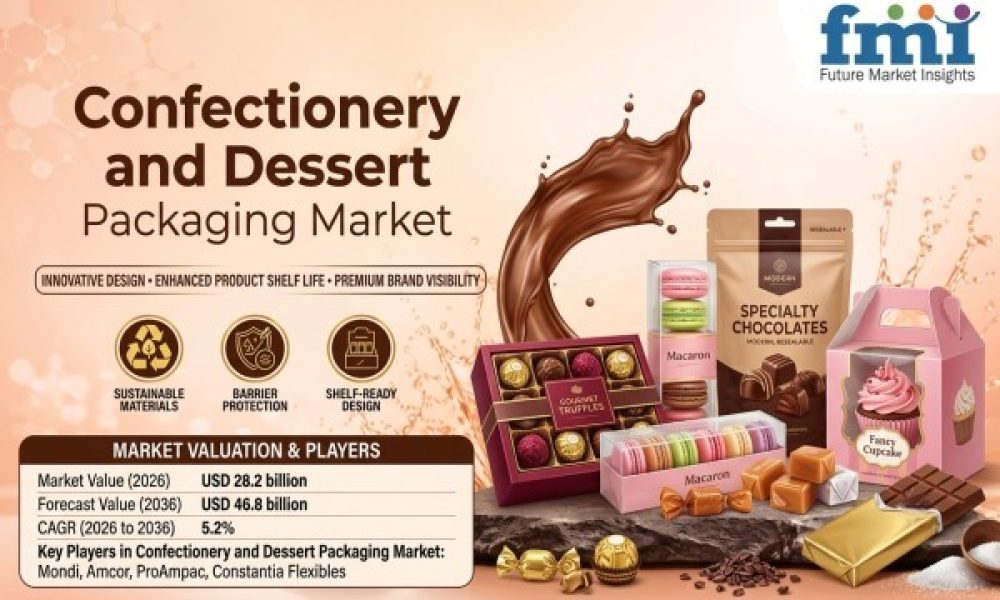
The global confectionery and dessert packaging market is projected to grow from USD 28.2 billion in 2026 to USD 46.8 billion by 2036, registering a 5.2% CAGR, according to Future Market Insights (FMI). Demand is being supported by recurring packaging requirements across chocolate, bakery desserts, chilled products, and seasonal confectionery programs.
Packaging suppliers are facing a market where product protection and material performance remain central to purchasing decisions. Chocolate requires protection against aroma loss, grease exposure, and temperature changes, while chilled and frozen desserts introduce additional stiffness and condensation considerations.
Get detailed market forecasts, competitive benchmarking, and pricing trends:
https://www.futuremarketinsights.com/reports/sample/rep-gb-34274
Seasonal Production Keeps Packaging Demand Recurring
Seasonal confectionery programs create repeated packaging orders as brands move through major retail campaigns. The National Confectioners Association reported that four major candy seasons generated 62% of United States confectionery sales during 2024, highlighting the importance of fixed production windows and rapid packaging changeovers.
The United States confectionery and dessert packaging market is projected to expand at a 5.5% CAGR through 2036. National retail programs require dependable printing, wrapping, sealing, and artwork approval across multiple product formats.
These requirements also increase the commercial cost of failed packaging trials. A material change must maintain seal quality, grease resistance, and production-line performance without disrupting a scheduled campaign.
Recyclable Mono Gains Ground Through Material Qualification
Recyclable mono structures are projected to hold 51.4% share of the material category in 2026. Their appeal comes from simpler structure identification and documented recycling design, but adoption still depends on technical validation.
ProAmpac announced multiple recyclable-technology patents in March 2025 covering mono-material films for dry and frozen foods across rollstock and pouch formats. The technologies address heat resistance and barrier requirements for commercial processing.
For confectionery producers, the shift toward mono-material packaging is therefore not based on recyclability claims alone. Packaging teams must also assess grease contact, sealing performance, production speed, food-contact requirements, and the availability of a suitable recovery route.
Resealable Pouches Lead the Format Category
Resealable pouches are expected to account for 45.7% share in 2026, supported by storage convenience across multipack sweets and gummies.
The format allows consumers to divide products across multiple eating occasions while helping protect opened products during household storage. For manufacturers, however, commercial approval requires reliable zipper alignment and consistent sealing at planned production speeds.
Constantia Flexibles expanded its food portfolio following the completed Aluflexpack acquisition in August 2025, including advanced pouches and closure options. The development adds capacity for formats where closure performance and barrier protection are important to confectionery applications.
Chocolate Remains the Largest Product Segment
Chocolate is projected to account for 49.6% of the product category in 2026. Its broad retail distribution and sensitivity to aroma, grease, and surface appearance create specific packaging requirements.
Amcor reported in September 2025 that Cadbury had launched cold-activated wrappers from June 2025 using recycle-ready film and food-safe thermochromic printing. The development demonstrates how promotional packaging can combine visual functionality with primary packaging performance.
Nandini Roy Choudhury, Principal Analyst at Future Market Insights, said: “Confectionery packaging choices should begin with fat content and aroma sensitivity rather than a preferred material claim. Chocolate needs grease protection and stable seals through warm distribution; frozen desserts add low-temperature stiffness and condensation risks.”
Regional Requirements Create Different Packaging Priorities
Country-level forecasts show varying growth rates across major markets. China is projected to record a 6.3% CAGR, followed by the UK at 5.9%, the USA at 5.5%, France at 5.1%, and Germany at 4.7%.
China’s food-packaging projects must align national material standards with high-volume manufacturing. GB/T 36392-2025, published in June 2025, established specifications for coated paper and board used in food packaging and became effective in January 2026.
In the UK, packaging programs increasingly account for PackUK fees alongside food-contact and material reporting requirements. Germany’s packaging market is shaped by formal recyclability assessment, while France combines producer-responsibility requirements with European food-contact and recovery rules.
These differences mean packaging structures cannot always be transferred between markets without additional validation.
Fiber Formats Create Another Commercial Route
Fiber-based packaging is opening opportunities for dessert applications that require rigid presentation while reducing plastic use. The commercial case depends on whether liners, coatings, and lidding structures can maintain the required shelf-life and processing performance.
Amcor and Metsä Group announced in May 2025 that molded fiber food packs would become commercially available in Europe later that year. For confectionery and dessert producers, such developments provide another route for trials involving trays, cups, and presentation formats.
Competitive Landscape
The competitive environment includes Mondi, Amcor, Huhtamaki, ProAmpac, Constantia Flexibles, and Sonoco.
Mondi and Constantia Flexibles compete across films, pouches, wraps, and tailored barrier structures. Amcor and Huhtamaki provide printed wrappers and dessert formats, while Huhtamaki also covers ice-cream cups and cone sleeves.
ProAmpac supplies recyclable rollstock and pouches, while Sonoco offers rigid paper containers for products such as powdered chocolate. The market therefore spans flexible, fiber, paperboard, and rigid packaging routes.
Discover the Full Details in Our Report—Read More Now!
https://www.futuremarketinsights.com/reports/confectionery-and-dessert-packaging-market
Report Scope
The FMI study covers the confectionery and dessert packaging market by format, material, product, and region. Formats include resealable pouches, trays, wraps, and rigid packaging. Materials include recyclable mono, fiber, and film, while products cover chocolate, bakery, and desserts.
The analysis covers North America, Latin America, Europe, East Asia, South Asia, Oceania, and the Middle East and Africa. The forecast period extends from 2026 to 2036 and uses hybrid bottom-up and top-down market sizing supported by primary interviews and official desk research.
FMI Custom Research: Strategic Intelligence for Confident Decision-Making
In today’s rapidly evolving business environment, leadership teams need more than market data—they need clear, actionable intelligence tailored to their strategic objectives. FMI’s Custom Research solutions are designed around the specific business questions organizations need answered, enabling executives to evaluate growth opportunities, validate investments, assess competitive dynamics, and reduce uncertainty before making critical decisions. By combining deep industry expertise, primary research, and proprietary market intelligence, FMI delivers insights that help organizations move from assumptions to evidence-based strategies with greater speed and confidence.
Business Impact
FMI helps organizations transform market complexity into strategic clarity, enabling leadership teams to identify growth opportunities faster, optimize resource allocation, strengthen competitive positioning, and make high-stakes business decisions with confidence.
To explore how FMI Custom Research can support your strategic priorities, please connect with our team at – [email protected]
About Future Market Insights (FMI)
Future Market Insights, Inc. (FMI) is an ESOMAR-certified, ISO 9001:2015 market research and consulting organization, trusted by Fortune 500 clients and global enterprises. With operations in the U.S., UK, India, and Dubai, FMI provides data-backed insights and strategic intelligence across 30+ industries and 1200 markets worldwide.



