
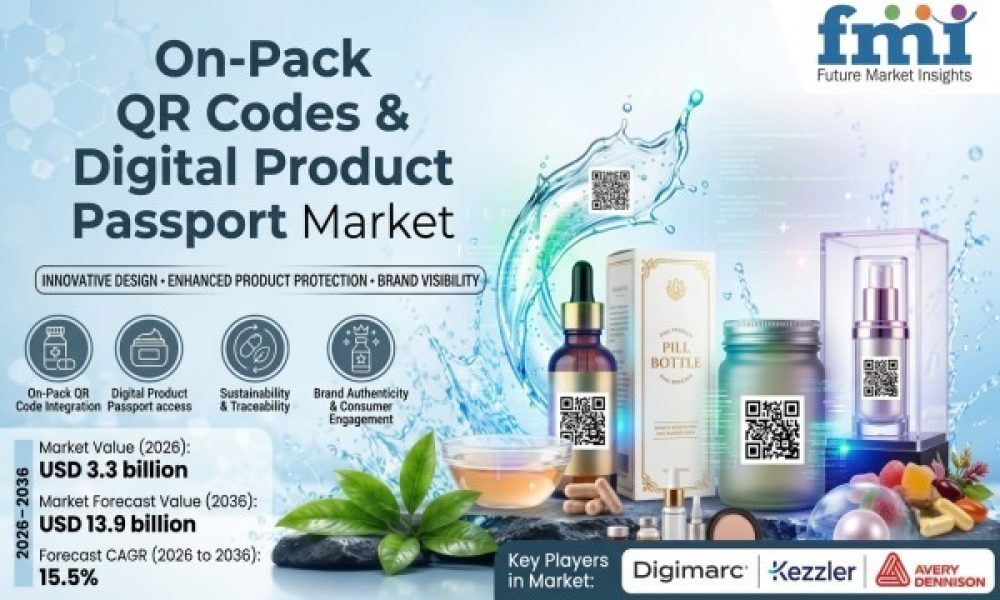
The global On-Pack QR Codes & Digital Product Passport Market is projected to grow from USD 3.3 billion in 2026 to USD 13.9 billion by 2036, registering a 15.5% CAGR over the forecast period, according to Future Market Insights.
The market is moving beyond promotional QR codes toward governed product information, traceability, recycling guidance, authentication, and digital product passport applications. Brand owners are using connected identifiers to provide ingredient, allergen, sourcing, usage, and recycling information without adding more content to already constrained packaging artwork.
A key development is the growing alignment between packaging identifiers and standards-based product information. In June 2024, a GS1 statement recorded 22 industry leaders supporting a global transition toward advanced barcodes through investments in code generation and digital link maintenance. For packaging teams, the shift brings a practical requirement: codes must not only appear correctly on artwork but also scan reliably through production, distribution, and checkout environments.
Get detailed market forecasts, competitive benchmarking, and pricing trends:
https://www.futuremarketinsights.com/reports/sample/rep-gb-34269
Ingredient Transparency Leads Application Demand
Ingredient Transparency is forecast to account for 41.1% of application share in 2026. The segment benefits from demand for maintained ingredient and allergen records, alongside nutrition, sourcing, and preparation information.
A November 2025 GS1 UK survey found that 81.0% of shoppers wanted more product information than packs currently display. Connected packaging gives brand owners a way to provide additional information through a governed destination while supporting regional content variants and approval processes.
Recycling Info and DPP Compliance represent additional application areas. Their use differs by operating requirement, with recycling instructions addressing disposal information while digital product passports support regulated lifecycle records.
QR Technology Holds the Largest Technology Share
QR technology is anticipated to represent 50.4% share in 2026. Its adoption is supported by widespread smartphone camera access and compatibility with standards-based product identifiers and GS1 Digital Link structures.
However, implementation extends beyond generating a QR image. Code size, contrast, quiet-zone requirements, substrate behavior, destination continuity, and point-of-sale validation all affect deployment reliability.
GS1 UK documented Tesco trials across 12 own-brand meat and produce lines in April 2025. The trials evaluated printing, supplier data, checkout reading, and use-by information, providing a practical example of the operational testing required before wider deployment.
Food Processing Drives End-Use Demand
Food processing is expected to hold 36.7% share of end use in 2026. Frequent label changes, perishable products, ingredient records, allergen information, batch data, and expiry details create a strong need for synchronized product identifiers and enterprise data.
GS1 UK recorded 1 million fresh-produce checkout scans each day during April 2026 QR planning, highlighting the importance of reading performance when connected identifiers are deployed at retail scale.
The wider market also covers beverages, animal feed, and industrial applications. These users apply connected codes to areas such as recycling guidance, authenticity, traceability, and regulated product information.
Data Governance Remains a Critical Deployment Issue
Poor print quality and unstable digital destinations can undermine scanning performance. Incomplete master data and unclear responsibility for updates can create further exposure once connected packaging is already in circulation.
GS1 US found that 70.0% of logistics operations experienced weekly barcode-readability issues in September 2025. This reinforces the role of grading, label consistency, scanner validation, and production-line verification in connected packaging programs.
At the regulatory level, the European Commission published six harmonized DPP standards in July 2026. The development strengthens specifications around identifiers, data carriers, exchange protocols, semantic models, and lifecycle-data infrastructure.
China and the United States Record the Highest Disclosed Country CAGRs
Among the profiled markets, China is projected to grow at 18.7% CAGR from 2026 to 2036, followed by the United States at 18.3%, the United Kingdom at 17.9%, France at 17.5%, and Germany at 17.1%.
China’s adoption is linked to traceability systems connecting product identifiers with sales and enforcement records. In June 2025, the Hainan Provincial People’s Government described a one-product-one-code system using anti-counterfeiting QR identifiers on individual duty-free packaging units.
In the United Kingdom, retailer pilots are moving toward wider commercial use. GS1 UK documented a branded QR-code debut at a major retailer in June 2026, while earlier Tesco trials provided operational experience with connected grocery packaging.
Competitive Landscape
The competitive environment includes connected identification, traceability, passport-data, inspection, and authentication capabilities.
Notable companies profiled in the market include Digimarc, Kezzler, Avery Dennison, Scantrust, Circularise, OPTEL Group, Systech, and Assent.
Key developments include Digimarc’s April 2025 announcement of a Unilever implementation covering 45,000 SKUs with GS1 Digital Link-enabled 2D barcodes. In June 2025, Kezzler entered a partnership with GS1 Australia focused on 2D barcodes and standardized product information. Avery Dennison introduced ReadyDPP for apparel product-passport creation and management in June 2026.
What the Report Covers
The On-Pack QR Codes & Digital Product Passport Market report analyzes the market by application, technology, end use, and region. Applications include Ingredient Transparency, Recycling Info, and DPP Compliance. Technologies covered are QR, Digital Watermark, and GS1.
End-use analysis includes Food Processing, Beverages, Animal Feed, and Industrial applications. Regional coverage spans North America, Latin America, Western Europe, Eastern Europe, East Asia, South Asia and Pacific, and the Middle East and Africa, with more than 30 countries covered.
Explore In-Depth Analysis—Click Here to Access the Report!
https://www.futuremarketinsights.com/reports/on-pack-qr-codes-and-digital-product-passport-market
FMI Custom Research: Strategic Intelligence for Confident Decision-Making
In today’s rapidly evolving business environment, leadership teams need more than market data—they need clear, actionable intelligence tailored to their strategic objectives. FMI’s Custom Research solutions are designed around the specific business questions organizations need answered, enabling executives to evaluate growth opportunities, validate investments, assess competitive dynamics, and reduce uncertainty before making critical decisions. By combining deep industry expertise, primary research, and proprietary market intelligence, FMI delivers insights that help organizations move from assumptions to evidence-based strategies with greater speed and confidence.
Business Impact
FMI helps organizations transform market complexity into strategic clarity, enabling leadership teams to identify growth opportunities faster, optimize resource allocation, strengthen competitive positioning, and make high-stakes business decisions with confidence.
To explore how FMI Custom Research can support your strategic priorities, please connect with our team at – [email protected]
About Future Market Insights (FMI)
Future Market Insights, Inc. (FMI) is an ESOMAR-certified, ISO 9001:2015 market research and consulting organization, trusted by Fortune 500 clients and global enterprises. With operations in the U.S., UK, India, and Dubai, FMI provides data-backed insights and strategic intelligence across 30+ industries and 1200 markets worldwide.



