
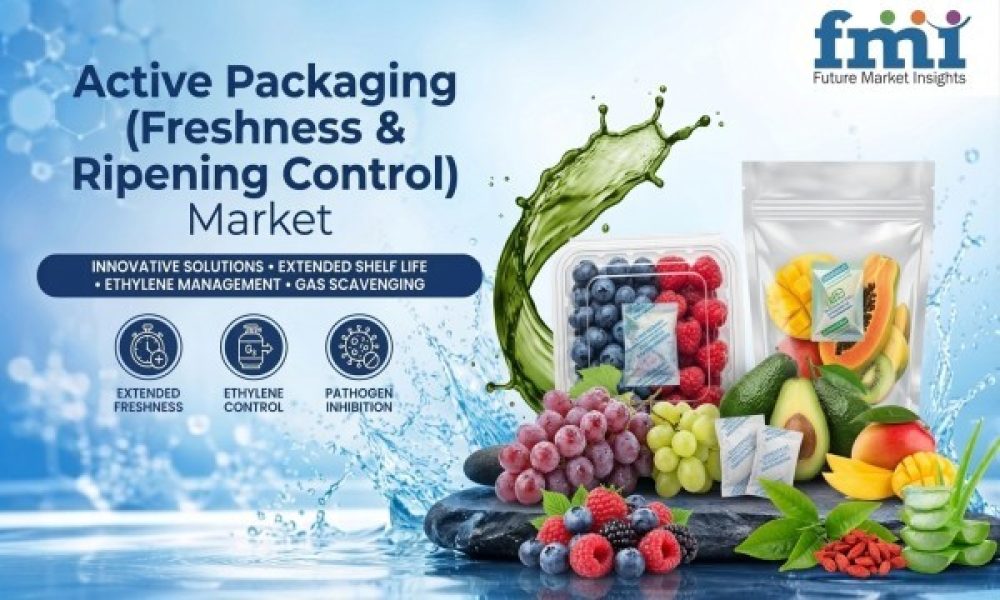
The global Active Packaging (Freshness / Ripening Control) Market is projected to increase from USD 4.8 billion in 2026 to USD 8.5 billion by 2036, advancing at a 5.9% CAGR. Demand is being shaped by longer food distribution routes, tighter control of produce quality, and the need to preserve usable selling time during storage and transport.
Active packaging covers systems that actively manage freshness through ethylene control, oxygen or moisture absorption, and antimicrobial action within defined food-contact applications. Unlike passive barrier packaging, these formats interact with the package environment to address specific causes of food quality loss.
According to Future Market Insights, ethylene scavengers are projected to account for 41.7% of market share in 2026. Produce is expected to represent 40.2% of application revenue during the same year, reflecting the sensitivity of fruits and vegetables to ripening, respiration, moisture and distribution conditions.
Get detailed market forecasts, competitive benchmarking, and pricing trends:
https://www.futuremarketinsights.com/reports/sample/rep-gb-34277
Longer Distribution Routes Create Demand for Active Freshness Control
Food producers and packers increasingly need packaging performance to remain effective beyond the packhouse. Longer distribution routes can expose fresh food to changes in temperature, humidity, respiration and storage duration.
Commercial trials therefore need to match active-material capacity with the food’s respiration rate, package volume and expected transit period. Seal quality and controlled permeability also remain central when active components are integrated into converting lines.
Regulatory requirements add another layer to commercial qualification. European Commission Regulation 450/2009 establishes safety requirements for active materials and additional labeling duties for substances released into food. Developers must therefore consider both functional performance and food-contact compliance when selecting active components.
Produce Remains a Core Application Area
Produce is forecast to hold 40.2% of application revenue in 2026. Fruits and vegetables can experience rapid quality changes during distribution, making ripening and atmosphere management important considerations for growers, packhouses and exporters.
Recent industry activity illustrates the commercial focus. Amcor documented its collaboration with BelOrta in May 2025 on P-Plus liners for pear shipments, with the package designed to regulate oxygen and carbon dioxide to slow ripening and reduce dehydration.
AgroFresh also announced in March 2025 that its table-grape portfolio in Brazil would combine Uvasys sheets with SmartFresh InBox across storage and transport programs. These developments show how active packaging can be linked to specific commodities and distribution requirements.
Retail-Ready Formats Open an Expansion Route
Retail-ready films, liners and pads provide an opportunity to integrate active functionality without requiring major changes to established packing routines. This can reduce the operational burden associated with loose inserts and support adoption across commercial produce formats.
In May 2026, It’s Fresh joined the IFPA Packaging Innovation Program to integrate RYPEN into retail-ready recyclable formats. The planned work includes recyclable film for cardboard punnets and prepared salad packaging applications.
The opportunity is closely linked to validation. Active capacity can vary with humidity and temperature, while migration, recovery and disposal requirements can differ by market. Commercial buyers therefore need evidence that the selected format performs under realistic distribution conditions.
Regional Markets Show Different Adoption Conditions
Country forecasts point to continued expansion across major food-packaging markets. China is projected to record an 8.1% CAGR through 2036, followed by the Netherlands at 7.7%, the USA at 7.3%, Germany at 6.9%, and Japan at 6.5%.
The differences reflect local packaging systems, regulatory requirements, food distribution networks and technology adoption patterns. In Japan, covered food-contact materials are subject to positive-list arrangements. Germany combines European food-contact requirements with established packaging recovery infrastructure, while U.S. programs place emphasis on authorization and food-specific migration evidence.
Competitive Landscape
The competitive environment includes diversified packaging companies and specialists focused on atmospheric control and produce applications.
Amcor, Mitsubishi Gas Chemical Company, Inc., Bioconservacion, Sirane, It’s Fresh!, and AgroFresh are identified among the notable companies profiled in the market.
Mitsubishi Gas Chemical operates atmospheric-control businesses covering oxygen absorbers and oxygen-absorbing films. Bioconservacion focuses on ethylene-control sachets, while Sirane develops absorbent and ethylene-control produce pads. It’s Fresh provides RYPEN formats for ethylene management, while AgroFresh combines active protection formats with post-harvest services.
Analyst Perspective
“Active packaging earns a price premium through control capacity that matches the food’s respiration rate and the expected distribution period. Produce programs should test seal quality and moisture exposure together since either factor can erase laboratory gains during commercial transport. Investment improves when measurable shelf-life extension uses compliant materials and release criteria that packhouses can reproduce across normal harvest variation.”
Nandini Roy Choudhury, Principal Analyst, Future Market Insights
Report Scope
The Active Packaging (Freshness / Ripening Control) Market is segmented by type, application and region. Type coverage includes ethylene scavengers, moisture/O2 absorbers, antimicrobial systems and clay-based formats. Applications include produce, meat, bakery and dairy.
Regional coverage includes North America, Latin America, Western Europe, Eastern Europe, East Asia, South Asia and Pacific, and the Middle East and Africa. The forecast period spans 2026 to 2036, with quantitative analysis presented in USD million and CAGR percentages.
Find Out More—Read the Complete Report for Full Insights!
https://www.futuremarketinsights.com/reports/active-packaging-freshness-ripening-control-market
FMI Custom Research: Strategic Intelligence for Confident Decision-Making
In today’s rapidly evolving business environment, leadership teams need more than market data—they need clear, actionable intelligence tailored to their strategic objectives. FMI’s Custom Research solutions are designed around the specific business questions organizations need answered, enabling executives to evaluate growth opportunities, validate investments, assess competitive dynamics, and reduce uncertainty before making critical decisions. By combining deep industry expertise, primary research, and proprietary market intelligence, FMI delivers insights that help organizations move from assumptions to evidence-based strategies with greater speed and confidence.
Business Impact
FMI helps organizations transform market complexity into strategic clarity, enabling leadership teams to identify growth opportunities faster, optimize resource allocation, strengthen competitive positioning, and make high-stakes business decisions with confidence.
To explore how FMI Custom Research can support your strategic priorities, please connect with our team at – [email protected]
About Future Market Insights (FMI)
Future Market Insights, Inc. (FMI) is an ESOMAR-certified, ISO 9001:2015 market research and consulting organization, trusted by Fortune 500 clients and global enterprises. With operations in the U.S., UK, India, and Dubai, FMI provides data-backed insights and strategic intelligence across 30+ industries and 1200 markets worldwide.



