
Composite Rebar Market Overview :
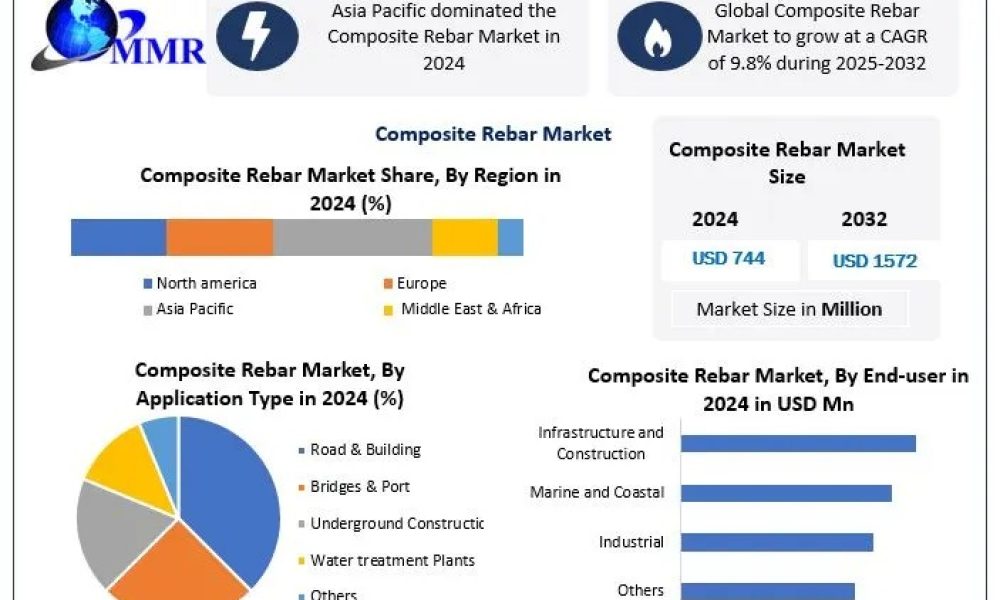
Composite Rebar Market, valued at USD 744 million in 2024, is expected to grow at a CAGR of 9.8% between 2025 and 2032, reaching nearly USD 1.57 billion. Composite rebars, composed of fiber-reinforced polymers such as glass, basalt, and carbon fibers, are gaining significant traction as a corrosion-resistant, lightweight alternative to traditional steel rebar in civil infrastructure and construction.
Key Highlights & Insights
Market Size & Growth: Projected to surge from USD 744 million in 2024 to USD 1.57 billion by 2032 at a CAGR of 9.8%.
Dominating Region: Asia Pacific is the leading regional market, driven by rapid urbanization, mega infrastructure projects, government investments, and environmental conditions favoring corrosion-resistant materials.
Leading Segment: Glass Fiber Reinforced Polymer (GFRP) rebar commands the largest product share due to superior corrosion resistance, lighter weight, and suitability for harsh and coastal environments.
Key Driver: Increasing demand for durable, low-maintenance infrastructure and growing sustainability mandates promoting non-metallic, eco-friendly construction materials fuel market expansion.
Recent Developments
2024-2025: Aslan FRP (Owens Corning) launched corrosion-resistant coatings extending product lifespan by up to 15 years in saline environments.
Pultrall Inc. introduced a next-generation GFRP rebar with approximately 30% higher tensile strength targeting infrastructure projects.
Dextra Group unveiled Durabar+ GFRP rebar with compliance certifications targeting European and North American markets.
Collaboration of Dextra Group with Arkema brought Elium thermoplastic resin to FRP rebars, enabling on-site hot bending and enhanced recyclability.
For full access to the data, request a sample report now.https://www.maximizemarketresearch.com/request-sample/218967/
Market Dynamics
Growth Drivers:
Greater adoption of corrosion-resistant composite rebars in marine, coastal, and chemically aggressive environments prolonging infrastructure lifespan.
Regulatory frameworks promoting environmental sustainability and use of low carbon footprint materials in construction.
Rising global investments in roads, bridges, tunnels, water treatment plants, and urban development projects.
Increasing awareness of lifecycle cost savings due to reduced maintenance and repairs.
Challenges:
Higher upfront cost compared to conventional steel rebar limiting adoption in budget-sensitive projects.
Resistance based on industry familiarity with steel and established building codes.
Regulatory uncertainties and varying standards delaying some applications.
Regional Analysis
Asia Pacific: Market leader with rapid infrastructure growth in China, India, Indonesia, and Vietnam, supported by humid and coastal environments where corrosion resilience is critical.
North America: Early adopter with advanced standards and aging infrastructure renewal programs stimulating demand.
Europe: Progressive regulations encouraging usage in ports, highways, and wastewater treatment facilities.
Middle East & Africa and Latin America: Growing usage aligned with increasing infrastructure investments and urbanization trends.
Product Segmentation
By Product Type: Glass Fiber Reinforced Polymer (GFRP) rebar (largest share), Basalt Fiber Reinforced Polymer (BFRP) rebar, Carbon Fiber Reinforced Polymer (CFRP) rebar, hybrid rebars.
By Application: Roads & buildings, bridges & ports, underground construction, water treatment plants, and others.
By End-User: Transportation, industrial, others.
Key Trends
Shift towards non-metallic, corrosion-free reinforcements in highly corrosive environments.
Growth in lightweight and fire-resistant rebar materials for specialized applications.
Development of composite rebars integrated with digital design tools for BIM and lifecycle management.
Expansion of sustainability-driven construction mandates globally stimulating eco-friendly material adoption.
Quote
Asia Pacific’s leadership in the composite rebar market reflects its urgent infrastructure demands and environmental challenges. Innovations that enhance durability, ease of installation, and sustainability position composite rebars as the future of resilient and green construction.
With rising infrastructure investments and regulatory impetus, composite rebars are redefining construction norms and extending structure durability globally. Continued product innovations and geographic expansion will drive the composite rebar market to new heights by 2032.




