
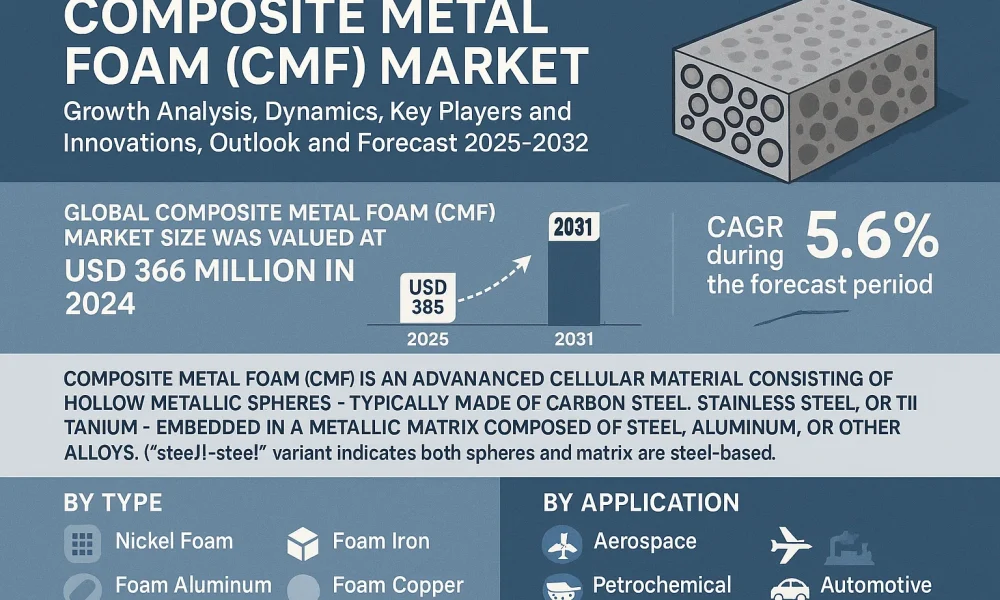
Composite Metal Foam (CMF) Market size was valued at USD 366 million in 2024. The market is projected to grow from USD 385 million in 2025 to USD 532 million by 2031, exhibiting a CAGR of 5.6% during the forecast period.
Composite Metal Foam (CMF) is an advanced cellular material consisting of hollow metallic spheres – typically made of carbon steel, stainless steel, or titanium – embedded in a metallic matrix composed of steel, aluminum, or other alloys. The “steel-steel” variant indicates both spheres and matrix are steel-based. These materials offer exceptional properties including high strength-to-weight ratio, energy absorption, thermal insulation, and radiation shielding.
The market growth is driven by increasing demand across aerospace, automotive, and defense sectors where lightweight yet durable materials are critical. While North America currently leads in adoption, Asia-Pacific is emerging as a high-growth region due to rapid industrialization. Key manufacturers like ERG Aerospace and Cymat Technologies are expanding production capacities to meet rising demand, particularly for nickel and aluminum-based foams which dominate current applications.
Grab Your Complimentary Sample Report- https://www.intelmarketresearch.com/download-free-sample/9121/composite-metal-foam-market
MARKET DYNAMICS
MARKET DRIVERS
Advancements in Aerospace and Defense Industries Accelerate CMF Adoption
The aerospace and defense sectors are increasingly adopting composite metal foam due to its exceptional strength-to-weight ratio and impact resistance properties. With aircraft manufacturers targeting fuel efficiency improvements of 20-30% over the next decade, lightweight materials like CMF are becoming critical. Recent tests demonstrate CMF can absorb up to 80% of kinetic energy from ballistic impacts, making it ideal for armor applications. Military budgets across major economies now allocate significant portions to advanced materials research, with the U.S. Department of Defense directing over $15 billion annually toward next-gen material development programs that frequently include CMF solutions.
Automotive Lightweighting Trends Create Demand for CMF Solutions
The global push for electric vehicles and stricter emissions standards is driving automotive manufacturers toward innovative lightweight materials. Composite metal foams offer an optimal balance between weight reduction and structural integrity, with some formulations being 50% lighter than solid metals while maintaining comparable strength. Major automakers have begun testing CMF components in crash structure applications, where its energy absorption capabilities can improve safety ratings. The EV battery enclosure market alone presents a $2.5 billion opportunity for CMF by 2030 as manufacturers seek thermal runaway protection solutions.
Thermal and Acoustic Properties Expand CMF Applications in Construction
Building designers are embracing CMF for its superior thermal insulation and sound dampening characteristics. Laboratory tests show certain CMF configurations reduce heat transfer by 60-70% compared to traditional metal cladding, while simultaneously providing 85% noise reduction. These properties have led to growing adoption in HVAC systems, industrial facilities, and high-performance architectural applications. The global green building materials market, projected to surpass $800 billion by 2030, represents a significant growth avenue for CMF as sustainable construction practices gain prominence.
MARKET OPPORTUNITIES
Emerging Energy Storage Applications Present New Growth Frontiers
The renewable energy sector’s explosive growth creates substantial opportunities for CMF in battery and hydrogen storage systems. CMF’s combination of lightweight construction, thermal stability, and vibration resistance makes it ideal for next-generation energy storage containers. Pilot programs have demonstrated 40% weight reduction in battery enclosures while improving thermal management and safety. With global energy storage installations projected to grow fifteenfold by 2030, this segment could account for over 25% of total CMF demand.
Medical Implant Innovations Open High-Value Market Segments
The biomedical industry shows increasing interest in CMF for orthopedic implants and prosthetics due to its bone-like mechanical properties and biocompatibility. Recent clinical studies indicate CMF implants with controlled porosity demonstrate 30% better osseointegration than traditional titanium alloys. As the global orthopedic implant market approaches $60 billion, CMF’s ability to match patient-specific modulus requirements positions it for significant adoption in spinal and joint replacement applications.
3D Printing Integration Revolutionizes CMF Manufacturing
Additive manufacturing breakthroughs are overcoming traditional CMF production limitations, enabling complex geometries and customized material properties. Several manufacturers have successfully scaled binder jet printing techniques for CMF components, achieving 60-70% faster production cycles than conventional methods. This technological convergence is creating opportunities in industries requiring high-design flexibility, from custom automotive parts to architectural features.
Segment Analysis:
By Type
- Nickel Foam
- Foam Iron
- Foam Aluminum
- Foam Copper
Nickel Foam is projected to witness the highest growth due to its superior thermal and corrosion resistance properties, making it ideal for aerospace and military applications
By Application
- Aerospace
- Petrochemical
- Military Industry
- Automotive
- Construction and Infrastructure
Aerospace dominates the market, driven by demand for high-strength, lightweight materials that enhance fuel efficiency and structural performance in aircraft components.
By Region
- North America
- Europe
- Asia-Pacific
- Middle East & Africa
- South America
North America holds the largest market share, supported by strong aerospace and defense sectors, along with significant investments in R&D for advanced materials.
List of Prominent Composite Metal Foam Manufacturers
- ADVANCED MATERIALS MANUFACTURING (U.S.)
- ERG Aerospace Corporation (U.S.)
- Cymat Technologies (Canada)
- Alantum (South Korea)
- Mott Corporation (U.S.)
- LiaoNing Rontec Advanced Material Technology Co., Ltd. (China)
- Shanxi Putai Aluminum Foam Manufacturing Co., Ltd (China)
- Mayser GmbH & Co. KG (Germany)
- Ultramet (U.S.)
- Aluminum King Co., Ltd (Taiwan)
- Pohltec Metalfoam GmbH (Germany)
COMPOSITE METAL FOAM (CMF) MARKET TRENDS
Lightweight and High-Strength Properties Drive Adoption in Aerospace & Defense
The global Composite Metal Foam (CMF) market, valued at $366 million in 2024, is witnessing accelerated adoption due to its unique combination of lightweight and high-strength properties. In the aerospace sector, CMF’s ability to absorb impact and resist extreme temperatures makes it ideal for cladding, fuselage components, and blast-resistant panels. The U.S. military alone has invested in research programs exploring CMF applications, particularly in armor systems where its energy absorption capabilities outperform traditional materials by 50-70%. Meanwhile, commercial aviation manufacturers are increasingly incorporating aluminum-based CMFs to reduce aircraft weight while maintaining structural integrity.
Other Trends
Sustainability Initiatives Fuel Demand in Automotive Sector
Automakers are leveraging CMF to meet stringent emission regulations through weight reduction in electric and hybrid vehicles. Aluminum foam, in particular, is gaining prominence in battery enclosures and crash-resistant components, with projections indicating a 6.8% CAGR for automotive applications through 2031. Recent prototyping by European OEMs demonstrates CMF’s potential to reduce vehicle weight by 15-20% compared to solid metals while providing superior noise dampening a critical factor for EV cabin acoustics. Furthermore, the recyclability of CMF aligns with circular economy initiatives gaining traction across global supply chains.
Advancements in Manufacturing Processes Lower Production Costs
Innovations in powder metallurgy and additive manufacturing have reduced CMF production costs by approximately 30% since 2020, making it economically viable for broader industrial applications. Leading manufacturers like Cymat Technologies have patented gas injection methods that enhance pore uniformity in steel-steel CMF variants, while Asian players such as LiaoNing Rontec are scaling production capacities to meet rising infrastructure demands. These developments coincide with increasing investments in smart factories, where automation and AI-driven quality control systems are minimizing material wastage during CMF sintering processes.
Grab Your Complimentary Sample Report- https://www.intelmarketresearch.com/download-free-sample/9121/composite-metal-foam-market
Recent Developments in the Composite Metal Foam (CMF) Market
- Defense and Ballistics Applications
- Researchers and defense contractors have intensified work on CMF-based armor systems for military vehicles and personal protection.
- In 2024, advancements were made in CMF’s ability to stop high-caliber rounds with less weight compared to conventional armor, making it a potential replacement for steel and ceramic composites in defense applications.
- The U.S. Army and other global defense organizations are collaborating with universities and startups to integrate CMF into lightweight, blast-resistant armor.
- Aerospace and Space Exploration
- NASA and aerospace companies are exploring CMF for radiation shielding in spacecraft.
- A 2024 study confirmed that CMF can absorb cosmic radiation and high-energy particle impacts better than traditional aluminum-based shielding, making it suitable for long-duration space missions.
- CMF is also being tested for lightweight fuselage structures to improve fuel efficiency.
- Nuclear Safety Applications
- Recent research has demonstrated CMF’s capability to withstand extremely high temperatures and block neutron/gamma radiation, making it attractive for nuclear reactor shielding.
- In 2023–2024, partnerships between CMF manufacturers and nuclear technology firms began focusing on next-generation reactor designs where safety and cost efficiency are key.
- Automotive Sector Integration
- Automakers are experimenting with CMF for lightweight crash-absorbent panels and bumpers.
- Recent prototypes have shown 50–60% better energy absorption than aluminum foams while reducing overall vehicle weight, aligning with EV manufacturers’ push for higher range and safety.
- Commercialization and Patents
- Several new patents related to CMF manufacturing techniques and material hybridization have been filed in the past two years, aiming to improve cost-effectiveness and scalability.
- Startups and research labs are working on powder metallurgy and additive manufacturing techniques to make CMF production more commercially viable.
About Intel Market Research
Intel Market Research delivers actionable insights in technology and infrastructure markets. Our data-driven analysis leverages:
- Real-time infrastructure monitoring
- Techno-economic feasibility studies
Competitive intelligence across 100+ countries
Trusted by Fortune 500 firms, we empower strategic decisions with precision.
International: +1(332) 2424 294 | Asia: +91 9169164321
Website: https://www.intelmarketresearch.com
Follow us on LinkedIn: https://www.linkedin.com/company/intel-market-research




