
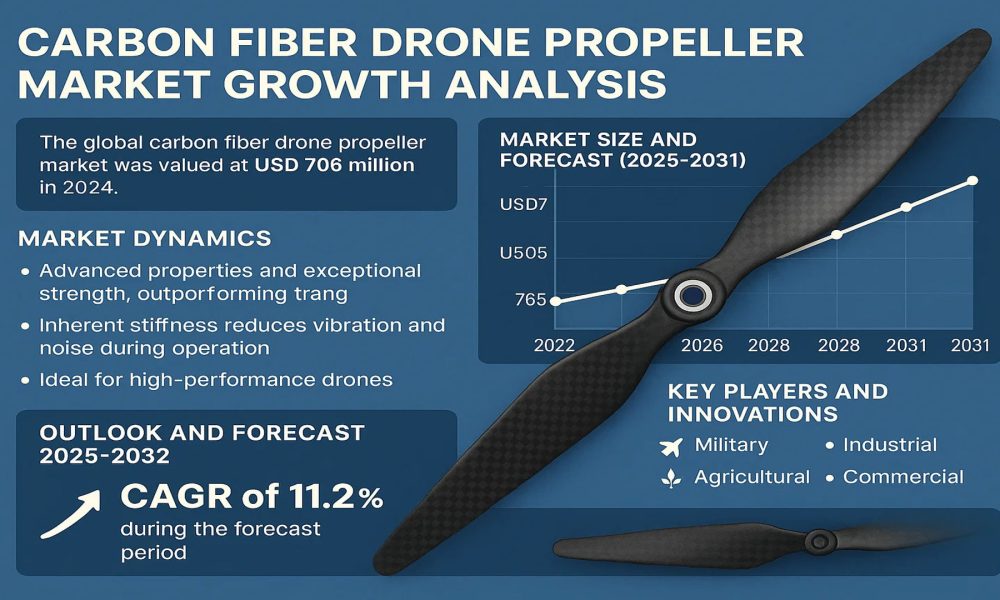
Carbon Fiber Drone Propeller Market was valued at USD 706 million in 2024. The market is projected to grow from USD 765 million in 2025 to USD 1,456 million by 2031, exhibiting a compound annual growth rate (CAGR) of 11.2% during the forecast period.
Carbon fiber drone propellers are advanced components known for their lightweight properties and exceptional strength, outperforming traditional plastic alternatives. Their inherent stiffness reduces vibration and noise during operation, making them ideal for high-performance drones. These propellers are widely used across military, industrial, agricultural, and commercial applications due to their durability and efficiency.
The market is expanding rapidly, driven by increasing drone adoption in sectors such as precision agriculture, surveillance, and logistics. The foldable propeller segment is expected to grow at a notable CAGR, catering to the demand for portable drone solutions. Key players like Mejzlik Propellers, XOAR, and Hartzell dominate the market, leveraging technological advancements to enhance product performance. For instance, manufacturers are focusing on improving aerodynamic efficiency to meet the evolving requirements of drone operators.
Grab Your Complimentary Sample Report- https://www.intelmarketresearch.com/download-free-sample/9718/carbon-fiber-drone-propeller-market
MARKET DYNAMICS
MARKET DRIVERS
Rising Demand for High-Performance Drones Accelerates Adoption of Carbon Fiber Propellers
The global drone industry is experiencing exponential growth across commercial, industrial and military applications, driving demand for high-performance components. Carbon fiber propellers have become critical for modern drones because they offer 40-50% weight reduction compared to plastic alternatives while delivering superior strength-to-weight ratios. Their inherent stiffness reduces vibration by up to 30% and noise levels by 15-20 decibels, significantly improving flight stability and acoustic signatures. With the commercial drone market projected to reach $58 billion by 2030, manufacturers are increasingly specifying carbon fiber propellers as standard equipment for professional-grade UAVs.
Expansion of Industrial and Agricultural Drone Applications Boosts Market Growth
Industrial sectors are rapidly adopting drone technology for inspection, mapping and monitoring applications where flight endurance and reliability are paramount. In agriculture alone, drone usage has grown by 65% annually as precision farming techniques require stable, vibration-free platforms for multispectral imaging. Carbon fiber propellers improve flight times by 12-18% compared to plastic variants while maintaining structural integrity in harsh environmental conditions. Major agricultural drone manufacturers now utilize carbon fiber propellers exclusively for crop spraying drones, which account for nearly 30% of the professional agricultural drone market. This trend is expected to continue as regulatory approvals for beyond-visual-line-of-sight (BVLOS) operations expand globally.
➤ The military drone segment represents another key growth area, with carbon fiber propellers being specified for 85% of new medium-altitude long-endurance (MALE) UAV procurements due to their durability and stealth characteristics.
MARKET OPPORTUNITIES
Emerging Urban Air Mobility Market Creates New Growth Potential
The developing urban air mobility sector represents a significant opportunity for carbon fiber propeller manufacturers. Electric vertical takeoff and landing (eVTOL) aircraft require exceptionally lightweight yet durable propulsion systems, with most prototype designs specifying carbon fiber propellers. Industry projections suggest the urban air mobility market could require over 2 million carbon fiber propellers annually by 2030 as passenger and cargo drone services scale up. Major aerospace companies are already forming strategic partnerships with carbon composite specialists to secure supply chains for this emerging application.
Advancements in Manufacturing Technologies Enable Cost Reduction
Innovations in automated fiber placement and out-of-autoclave curing processes are reducing production costs while improving quality consistency. New resin systems with faster cure cycles are cutting manufacturing time by 30-40%, while robotic layup systems are improving yield rates. These technological advancements are helping bridge the price gap with plastic propellers, particularly in the professional drone segment where customers increasingly recognize the total cost of ownership advantages. Continuous fiber-reinforced thermoplastic components now entering the market promise further cost reductions through recyclability and simpler manufacturing processes.
Segment Analysis:
By Type
- Foldable
- Non-foldable
Foldable propellers are gaining traction due to their portability and ease of storage, making them ideal for consumer drones.
By Application
- Military
- Industrial
- Agricultural
- Commercial
Military applications dominate due to the demand for lightweight, high-performance propellers in surveillance and defense drones.
By Blade Count
- 2-Blade
- 3-Blade
- 4-Blade
- Multi-Blade
3-Blade propellers are widely used for their balance of efficiency and stability, making them suitable for a variety of drone operations.
By Drone Type
- Fixed-Wing
- Multi-Rotor
- Hybrid
Multi-Rotor drones hold the largest share due to their versatility and widespread use in recreational, commercial, and industrial applications.
List of Key Carbon Fiber Drone Propeller Manufacturers
- Mejzlik Propellers (Czech Republic)
- ZhongShan Carbon Composite Material Products Co., Ltd. (China)
- Sensenich Wood Propeller Co (U.S.)
- XOAR (U.S.)
- Tasuns (China)
- Falcon (U.S.)
- Freerchobby (China)
- Hartzell (U.S.)
- Nanchang Sanrui Intelligent Technology Co., Ltd. (China)
- Mad Motor (Germany)
- Zhuhai Hengliyuan Electromechanial Co., Ltd (China)
CARBON FIBER DRONE PROPELLER MARKET TRENDS
Lightweight and High-Performance Materials Driving Market Adoption
The global carbon fiber drone propeller market continues to experience robust growth due to the increasing demand for lightweight yet durable materials in UAV applications. Carbon fiber propellers weigh up to 30-50% less than traditional plastic variants while offering superior strength-to-weight ratios and reduced vibration levels a critical feature for aerial photography and surveying applications requiring stable footage. The market is projected to grow from $706 million in 2024 to $1,456 million by 2031, reflecting an 11.2% CAGR as commercial and military drone shipments expand globally. Manufacturers have responded by optimizing blade designs for noise reduction, with some next-generation propellers achieving 15-20% lower dB levels compared to conventional models, addressing regulatory concerns about urban drone operations.
Other Trends
Foldable Propeller Designs Gaining Traction
Foldable carbon fiber propellers emerge as a key growth segment, expected to achieve near 20% year-over-year revenue increases through 2031. These designs solve critical portability challenges for consumer drones while maintaining structural integrity through advanced hinge mechanisms and reinforced carbon fiber composites. Industry leaders report that foldable models now comprise over 35% of recreational drone propeller sales, particularly among aerial photography enthusiasts requiring compact transport solutions. Continued R&D focuses on improving deployment reliability, with some prototypes demonstrating 50,000+ open/close cycles without performance degradation a vital metric for commercial operators conducting frequent missions.
Industrial and Agricultural Applications Fuel Demand
The expansion of drone-based precision agriculture and infrastructure inspection creates sustained demand for ruggedized carbon fiber propellers. Agricultural drones deploying pesticide sprays require propellers that withstand corrosive chemicals while maintaining lift efficiency a need addressed through specialized resin coatings that boost chemical resistance by 40-60%. Similarly, industrial inspection UAVs operating near wind turbines or powerlines benefit from carbon fiber’s non-conductive properties and impact resistance. Current market data indicates agricultural applications will account for 28-32% of carbon fiber propeller shipments by 2026, particularly in regions like Asia-Pacific where governments subsidize smart farming equipment adoption.
Grab Your Complimentary Sample Report- https://www.intelmarketresearch.com/download-free-sample/9718/carbon-fiber-drone-propeller-market
Recent Developments in the Carbon Fiber Drone Propeller Market
- Lightweight, High-Performance Propellers
Manufacturers are increasingly focusing on ultra-lightweight carbon fiber propellers to improve drone flight endurance, stability, and payload capacity. New designs are optimizing aerodynamic efficiency while reducing vibration and noise. - 3D Printing & Advanced Manufacturing
Companies are adopting 3D printing and precision molding for carbon fiber propeller production, enabling custom designs and faster prototyping. This trend is reducing manufacturing costs and improving consistency in blade strength and performance. - Durability Enhancements
Recent R&D efforts have introduced hybrid carbon fiber composites that enhance propeller durability, making them resistant to impacts, high speeds, and harsh weather conditions. This is particularly beneficial for military drones and industrial UAVs used in rough environments. - Integration for Commercial & Delivery Drones
With the rising demand for drone delivery (e.g., logistics, e-commerce, and medical supply delivery), carbon fiber propellers are being optimized for long-range, heavy-lift drones. Leading drone makers are collaborating with propeller manufacturers for custom, application-specific designs. - Noise-Reduction Technologies
Urban air mobility and commercial drone services are pushing innovation in low-noise carbon fiber propellers. Recent models integrate specialized blade geometries and surface treatments to minimize acoustic footprints, supporting regulatory compliance in populated areas. - Strategic Partnerships & Investments
Key drone and aerospace companies are investing in propeller startups and entering partnerships with composite material suppliers to secure high-performance carbon fiber supply chains. This ensures scalability and reliability for mass drone production. - Sustainability Efforts
Some manufacturers are exploring recyclable or bio-based carbon fiber composites to address environmental concerns. These developments are still in early stages but align with global sustainability goals in aviation and UAV manufacturing.
About Intel Market Research
Intel Market Research delivers actionable insights in technology and infrastructure markets. Our data-driven analysis leverages:
- Real-time infrastructure monitoring
- Techno-economic feasibility studies
Competitive intelligence across 100+ countries
Trusted by Fortune 500 firms, we empower strategic decisions with precision.
International: +1(332) 2424 294 | Asia: +91 9169164321
Website: https://www.intelmarketresearch.com
Follow us on LinkedIn: https://www.linkedin.com/company/intel-market-research




