
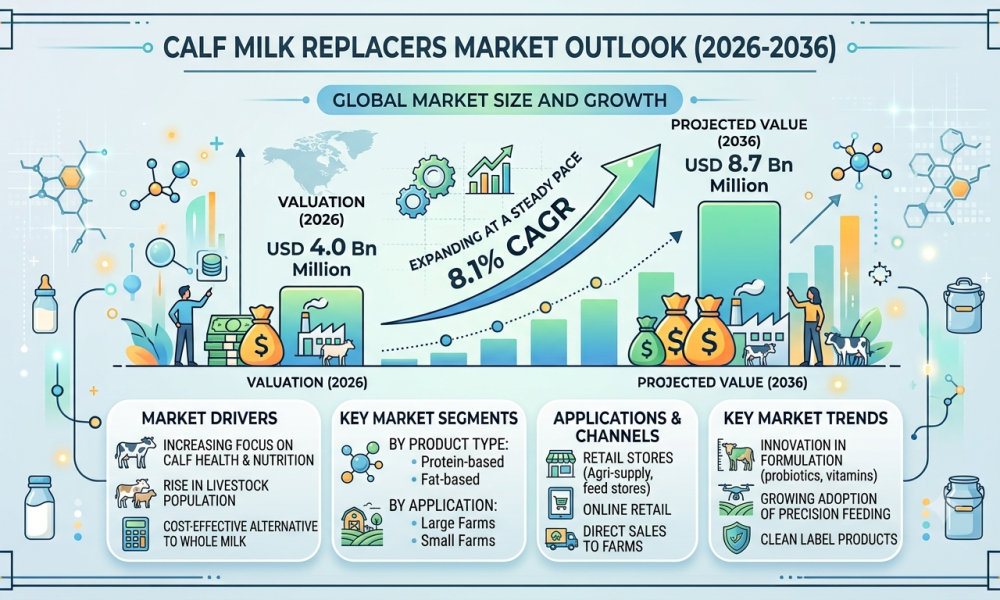
The global calf milk replacer market is projected to grow from USD 4.0 billion in 2026 to USD 8.7 billion by 2036, registering a CAGR of 8.1% during the forecast period. Demand is supported by the need for standardized calf nutrition, commercial dairy farming, and feeding programs that help farms manage pre-weaning nutrition while preserving saleable whole milk. As dairy producers focus on feeding efficiency and consistent calf development, milk replacers are becoming an important component of structured young-animal nutrition programs.
Product formulation, storage efficiency, and reliable distribution are shaping purchasing decisions across the market. Dry powder remains the leading product form because it is easier to store, transport, and reconstitute on farms. All milk protein formulations also maintain a strong position due to their established use in early-life calf nutrition. Meanwhile, dairy-protein price fluctuations and incorrect mixing practices can affect feeding economics, increasing the importance of formulation quality, clear preparation instructions, and technical support.
Get detailed market forecasts, competitive benchmarking, and pricing trends: https://www.futuremarketinsights.com/reports/sample/rep-gb-9915
Global Segment Leaders
- Form – Dry Powder: 96.2% in 2026. Dry powder products lead because they offer storage and transportation advantages and allow farms to prepare feed according to established reconstitution protocols.
- Ingredient Type – All Milk Protein: 49.0% in 2026. This segment benefits from the use of familiar dairy protein fractions and their suitability for early-life calf nutrition.
- Sales Channel – Indirect: 44.9% in 2026. Distributor-led sales support access to calf-rearing inputs, consolidated deliveries, and local assistance for commercial dairy farms.
Country-Level Performance
Poland is projected to record the fastest growth among the profiled countries, with a CAGR of 9.8% through 2036. Germany is expected to expand at a CAGR of 9.0%, supported by demand from commercial dairy operations that require consistent formulations and dependable technical services. South Korea is forecast to grow at 8.6%, reflecting opportunities to increase nutrition spending per calf and adopt specialized feeding solutions.
Japan is projected to register a CAGR of 7.1%, with product consistency and ingredient availability remaining important considerations for dairy operations. The United Kingdom is expected to grow at 6.8%, supported by established dairy practices and continued demand for efficient calf-rearing solutions. The United States is forecast to record a CAGR of 6.3%, driven by its large commercial dairy base and ongoing demand for reliable calf nutrition products.
Regional Context
Europe remains an important market for calf milk replacers, with Poland and Germany expected to record comparatively strong growth. Demand is influenced by commercial dairy operations, established calf-feeding practices, and the need for consistent nutrition across successive calf cohorts. Suppliers serving these markets must combine dependable product specifications with regional distribution and practical technical assistance.
East Asia also presents growth opportunities, particularly in South Korea and Japan. South Korea’s outlook is linked to the potential for higher-value nutrition solutions, while Japan’s market emphasizes formulation consistency and predictable ingredient supply. In North America, the United States benefits from its established dairy industry and commercial use of specialized calf nutrition products. Across regions, growth will depend on balancing ingredient costs, feeding performance, supply reliability, and the economics of calf rearing.
The full report covers North America, Latin America, Western Europe, Eastern Europe, East Asia, South Asia and Pacific, and the Middle East and Africa, with country-level analysis of market trends and growth prospects.
Competitive Landscape
The competitive landscape includes Archer Daniels Midland Company, Nutreco, Cargill, Denkavit, Land O’Lakes Inc., dsm-firmenich, Lesaffre, and Glanbia plc. Market participants compete through formulation expertise, protein quality, product consistency, distribution coverage, and technical support for dairy producers. Companies with established feed networks and young-animal nutrition capabilities are positioned to serve commercial farms seeking dependable supply and standardized feeding programs.
Competition also extends to ingredient suppliers that provide dairy proteins and functional nutrition inputs to milk-replacer manufacturers. Product differentiation depends on the ability to maintain nutritional specifications while managing ingredient-cost volatility and ensuring that products can be prepared consistently under farm conditions. Local distribution and practical feeding guidance remain important considerations when converting product availability into repeat purchases.
Access full Report in PDF Format@ https://www.futuremarketinsights.com/reports/brochure/rep-gb-9915
Key Market Trends
- Growing focus on calf nutrition: Commercial dairy farms are emphasizing standardized feeding programs to support early-life nutrition and consistent calf-rearing practices.
- Preference for powder formulations: Dry powder products benefit from convenient storage, transport efficiency, and controlled on-farm preparation.
- Continued importance of milk proteins: All milk protein formulations retain a significant position as producers and manufacturers prioritize ingredient quality and suitability for young calves.
- Distributor-led market access: Indirect sales channels support product availability and help consolidate the supply of calf-rearing inputs.
- Greater attention to feeding economics: Dairy-protein price fluctuations and preparation errors are encouraging closer evaluation of product specifications, mixing instructions, and overall feeding costs.
The calf milk replacer market outlook highlights the growing importance of standardized early-life nutrition, reliable product formulations, and efficient distribution across commercial dairy systems. Market participants will need to balance nutritional requirements with ingredient costs and farm-level operating needs as demand develops through 2036.
About Future Market Insights (FMI)
Future Market Insights, Inc. (ESOMAR certified, recipient of the Stevie Award, and a member of the Greater New York Chamber of Commerce) offers profound insights into the driving factors that are boosting demand in the market. FMI stands as the leading global provider of market intelligence, advisory services, consulting, and events for the Packaging, Food and Beverage, Consumer Technology, Healthcare, Industrial, and Chemicals markets. With a vast team of over 400 analysts worldwide, FMI provides global, regional, and local expertise on diverse domains and industry trends across more than 110 countries.



