
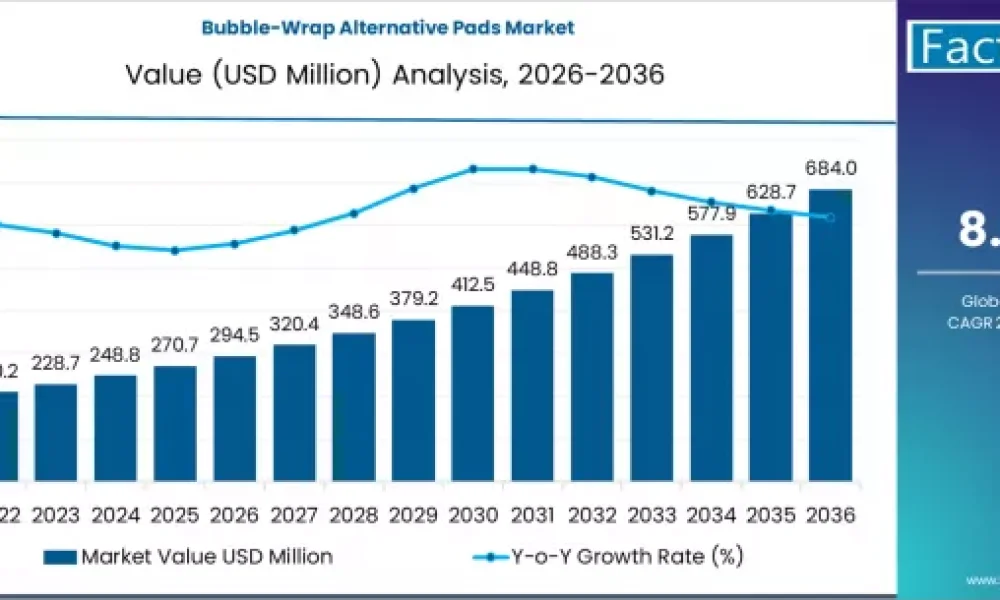
The global packaging landscape is undergoing a decisive shift as the Bubble-Wrap Alternative Pads Market is projected to surge from USD 294.50 million in 2026 to an estimated USD 684.00 million by 2036. This robust growth, representing a compound annual growth rate (CAGR) of 8.8%, marks the decline of traditional single-use plastic cushioning in favor of high-performance, fiber-based, and biodegradable alternatives.
This transition is being spearheaded by major e-commerce players and global electronics manufacturers responding to stringent plastic-reduction regulations and a heightening consumer preference for “circular” packaging. As of 2026, the industry is moving beyond niche substitution to embedding these alternative pads—such as honeycomb paper, molded fiber, and starch-based cushions—as the standard for international shipping and last-mile delivery.
Request for Sample Report | Customize Report |purchase Full Report – https://www.factmr.com/connectus/sample?flag=S&rep_id=12763
The “Who and Why” of the Market Pivot
The primary drivers of this market are heavyweights in the E-commerce (holding a 45% market share) and Consumer Electronics sectors. Industry leaders like Sealed Air, Amcor, and Smurfit Kappa, alongside specialized innovators such as Papair and BubblePaper, are rapidly scaling production of paper-based protective pads to meet the procurement needs of brands like Amazon, Alibaba, and various pharmaceutical giants.
The shift is catalyzed by two critical factors:
- Regulatory Pressure: Stricter ESG (Environmental, Social, and Governance) mandates in the European Union and North America are penalizing non-recyclable plastic waste, making plastic-free alternatives a fiscal necessity.
- Operational Efficiency: Modern alternative pads are now engineered with advanced “airless” cushioning and precision die-cutting, offering shock absorption that matches or exceeds traditional LDPE bubble wrap while reducing warehouse storage volume by up to 25%.
Key Market Drivers and Regional Performance
- Expansion of High-Value Logistics: The rising trade in fragile semiconductors and medical devices requires anti-static and vibration-dampening properties. Alternative pads, specifically those utilizing cross-linked fiber technology, are fulfilling these technical requirements without the ecological cost of plastic.
- Technological Integration: Manufacturers are now integrating smart-tracking capabilities and water-resistant coatings into paper pads, allowing them to survive complex global supply chains that involve varying humidity and temperature levels.
- Geographic Momentum: While Asia-Pacific remains the largest manufacturing hub for these materials, North America is currently the fastest-growing market, driven by a rapid Rx-to-OTC drug market shift and a booming luxury e-commerce sector.
Navigating Material Innovation and Scale
A significant trend in 2026 is the adoption of Expandable Paper Wraps, which are projected to reach a valuation of USD 1.2 billion by 2032 on their own. These materials utilize a hexagonal cell structure that creates a protective “nest” around products, eliminating the need for additional adhesive tapes and further simplifying the recycling process for the end-consumer.
Despite the momentum, the industry faces challenges regarding the cost-to-performance ratio in price-sensitive markets. However, as production scales and biopolymer costs decrease, the “green premium” is narrowing, making alternative pads a viable option for small-to-medium enterprises (SMEs) as well.
“We are witnessing a fundamental re-engineering of the shipping container,” says a senior packaging analyst. “The goal is no longer just protection, but the total elimination of the ‘waste’ phase in the product lifecycle.”
Future Outlook: Toward a Plastic-Free Supply Chain
By 2030, the market is expected to witness the mass commercialization of mycelium-based (mushroom) foams and seaweed-coated paper pads, which offer 100% home-compostability. These innovations will likely push the market toward the upper end of growth projections, cementing alternative pads as the cornerstone of modern logistics.
About the Bubble-Wrap Alternative Pads Industry
The Bubble-Wrap Alternative Pads industry focuses on the development and distribution of non-plastic protective packaging. By utilizing renewable resources such as kraft paper, corrugated cardboard, and bio-based polymers, the sector provides shock-absorbent, lightweight, and curbside-recyclable solutions that safeguard goods while minimizing environmental impact.
About Fact.MR
Fact.MR is a global market research and consulting firm, trusted by Fortune 500 companies and emerging businesses for reliable insights and strategic intelligence. With a presence across the U.S., UK, India, and Dubai, we deliver data-driven research and tailored consulting solutions across 30+ industries and 1,000+ markets. Backed by deep expertise and advanced analytics, Fact.MR helps organizations uncover opportunities, reduce risks, and make informed decisions for sustainable growth.



