

Global Bottled Water Processing System Market: Trends, Growth, and Forecast (2023–2032)
Bottled Water Processing System Market Overview
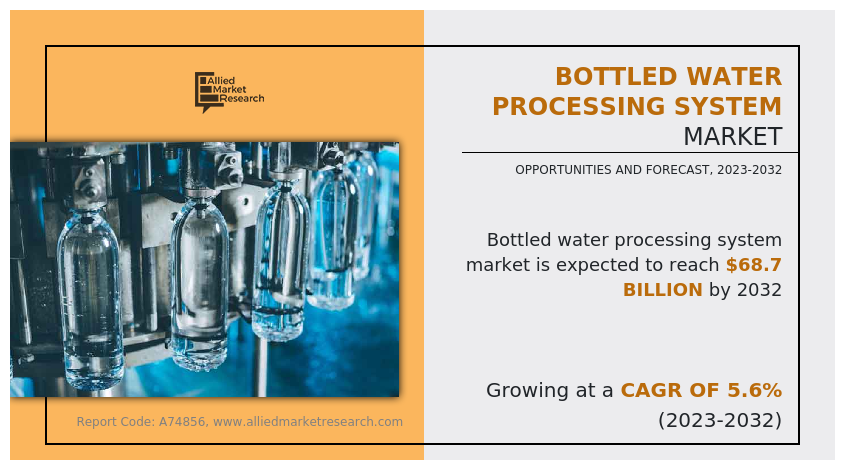
The global bottled water processing system market was valued at $39.4 billion in 2022 and is projected to reach $68.7 billion by 2032, registering a compound annual growth rate (CAGR) of 5.6% from 2023 to 2032. Bottled water processing systems encompass a range of equipment used for purifying and packaging drinking water into plastic or glass bottles. These systems include water purification technologies such as filtration units, UV treatment systems, and reverse osmosis (RO) equipment, as well as packaging machinery like blow molders, washers, fillers, capping machines, and labeling machines.
These systems are highly adaptable, available in various capacities to suit small, medium, and large-scale bottled water facilities. Their flexibility and scalability make them a critical component in meeting the global demand for safe, potable water, driving the market’s steady growth.
𝐃𝐨𝐰𝐧𝐥𝐨𝐚𝐝 𝐏𝐃𝐅 𝐒𝐚𝐦𝐩𝐥𝐞 𝐂𝐨𝐩𝐲@ https://www.alliedmarketresearch.com/request-sample/A74856
Bottled Water Processing System Market Dynamics
Drivers
The fundamental driver of the bottled water processing system market is the universal need for safe drinking water. Health organizations recommend that individuals consume approximately 2 liters of water daily to maintain hydration and health, making water the most consumed beverage globally. Ensuring water safety is paramount, as contamination can pose serious health risks. While urban households often rely on domestic purification systems, bottled water is a convenient and reliable option for situations like travel, conferences, social events, and sports activities. This constant demand for purified water fuels the growth of bottled water processing systems.
Rising awareness of water pollution and contamination has increased consumer preference for bottled water, which undergoes rigorous filtration, purification, and quality control processes. Governments worldwide are investing in bottled water facilities to provide safe drinking water. For example, in September 2022, the Delhi government launched a bottled water facility in South Delhi with a capacity to fill 9,000 bottles daily, highlighting the role of public initiatives in driving market growth. Automated processing systems ensure high production output while maintaining stringent quality standards, further boosting demand.
The increasing purchasing power in developed and developing economies has also spurred demand for premium bottled water products, such as alkaline and functional waters. Brands like Evocus have gained popularity in markets like India, reflecting consumer willingness to invest in high-quality hydration solutions. This trend supports the adoption of advanced processing systems to meet diverse consumer preferences.
Challenges
Environmental concerns related to plastic waste from single-use water bottles pose a significant challenge to the market. Over 55 million plastic bottles are discarded daily in the U.S. alone, contributing to plastic pollution that takes centuries to degrade. Growing consumer awareness of these environmental impacts has led to scrutiny of the bottled water industry. While manufacturers are developing eco-friendly alternatives, such as biodegradable or recyclable bottles, the transition requires significant investment and innovation.
The high initial and operational costs of water purification equipment, such as reverse osmosis systems, also constrain market growth. These systems require substantial capital investment and ongoing maintenance, which can be prohibitive for small-scale producers. Additionally, bottled water must comply with strict regulatory standards set by health authorities, adding to production costs and complexity.
The COVID-19 pandemic disrupted the market in 2020, as lockdowns halted manufacturing and distribution activities. However, the market rebounded post-lockdowns, driven by heightened health consciousness and the resumption of full-scale operations by 2022.
Opportunities
The shift toward sustainable packaging presents significant opportunities for the bottled water processing system market. Innovations in eco-friendly bottles, such as those made from recycled or biodegradable materials, align with consumer and regulatory demands for environmental responsibility. Additionally, the growing popularity of premium and functional waters, such as flavored and alkaline varieties, creates demand for advanced processing systems capable of producing diverse products.
The expansion of bottled water facilities in developing regions, supported by government initiatives and rising disposable incomes, offers further growth potential. The increasing use of bottled water in public settings, such as travel and gatherings, particularly in countries like India and China, is expected to drive demand for processing systems.
𝐄𝐧𝐪𝐮𝐢𝐫𝐞 𝐁𝐞𝐟𝐨𝐫𝐞 𝐁𝐮𝐲𝐢𝐧𝐠@ https://www.alliedmarketresearch.com/purchase-enquiry/A74856
Bottled Water Processing System Market Segmentation
The bottled water processing system market is segmented by capacity, technology, application, and region, providing a comprehensive view of its dynamics.
By Capacity
The market is divided into three capacity categories:
Less than 3,000 BPH (Bottles Per Hour): Suitable for small-scale facilities, expected to grow at a significant CAGR due to demand from emerging markets.
3,000 to 5,000 BPH: Dominated the market in 2022, offering a balance of scalability and efficiency for medium-sized operations.
More than 5,000 BPH: Used in large-scale facilities with high production demands.
By Technology
The market is categorized into five technologies:
Filtration: Removes impurities and contaminants from water.
UV Treatment: Ensures microbial safety through ultraviolet disinfection.
Reverse Osmosis (RO): Held the highest market share in 2022, providing advanced purification for potable water.
Packaging: Expected to grow at the fastest CAGR, encompassing critical processes like blow molding, filling, and capping.
Others: Includes specialized technologies for niche applications.
By Application
The market serves three applications:
Still Water: Registered the highest market share in 2022, driven by widespread demand for plain, non-carbonated water.
Sparkling Water: Carbonated water for refreshment purposes.
Others: Includes flavored, functional, and alkaline waters, expected to grow at the highest CAGR due to rising consumer interest.
By Region
The market is analyzed across four regions:
Asia-Pacific: Held the highest market share in 2022, driven by high disposable incomes and health consciousness in the U.S. and Canada, as well as rapid growth in China and India.
North America: Includes the U.S., Canada, and Mexico, with steady demand for premium bottled water.
Europe: Fueled by stringent water quality regulations in Germany, France, and the UK.
LAMEA (Latin America, Middle East, and Africa): Poised for growth due to increasing infrastructure investments.
𝐔𝐩𝐝𝐚𝐭𝐞 𝐎𝐧 𝐃𝐞𝐦𝐚𝐧𝐝@ https://www.alliedmarketresearch.com/request-for-customization/A74856
Competitive Landscape
The bottled water processing system market is competitive, with key players focusing on product launches and acquisitions. Major companies include Merck KGaA, Creative OZ-Air (I) Pvt Ltd., E-Rotek Water Systems Co., Ltd., Shivsu Canadian Clear Water Technology Private Limited, Evergreen Technologies, Tetra Laval S.A., Accutek Packaging Equipment Companies, Inc., Lenntech B.V., Danaher Corporation (Pall Corporation), and Marlo Incorporated. These companies are enhancing their portfolios to meet evolving market demands.
For instance, companies like Co.Mac srl and Liquid Packaging Solutions, Inc., specialize in advanced packaging systems, addressing the growing need for efficient bottling processes.
Key Benefits for Stakeholders
This analysis provides valuable insights for stakeholders:
Quantitative Analysis: Detailed market size and growth projections from 2022 to 2032.
Market Trends: Identification of current and emerging trends shaping the bottled water processing system market.
Segmentation Insights: In-depth evaluation of capacity, technology, application, and regional segments.
Regional Analysis: Mapping of major countries’ revenue contributions to identify high-growth regions.
Competitive Positioning: Benchmarking of key players to understand their strategies and market presence.
Opportunity Identification: Highlighting opportunities driven by sustainability, premium water demand, and infrastructure growth




