
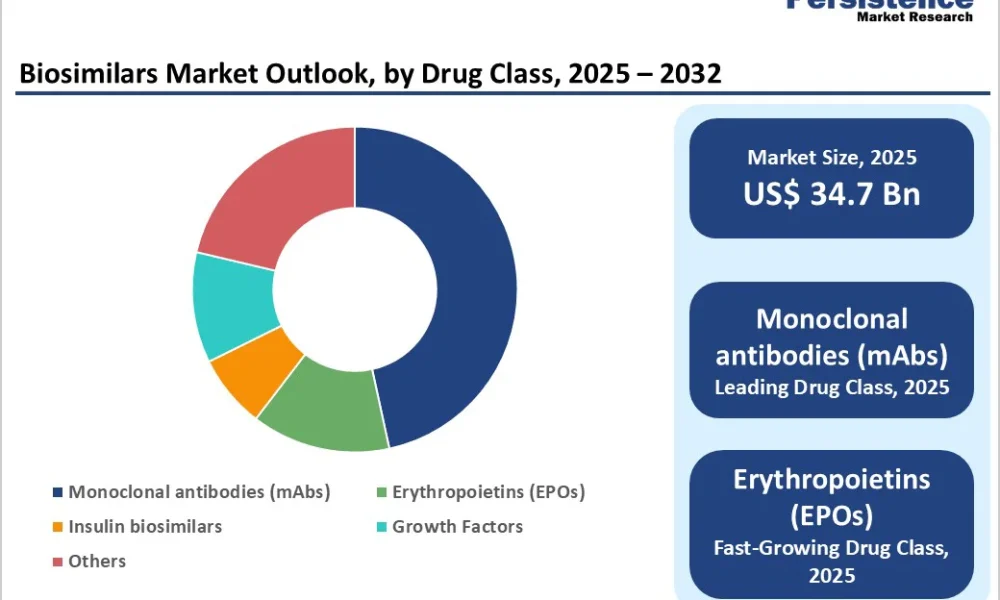
The biosimilars market has emerged as one of the fastest-growing segments in the global pharmaceutical industry. The increasing prevalence of chronic diseases, the expiration of patents on high-value biologics, and the demand for cost-effective healthcare solutions have spurred significant growth in this market. Biosimilars, which are biologic medical products highly similar to already approved reference biologics, offer an alternative to expensive treatments, making them highly attractive to both healthcare systems and patients alike. As the market for biosimilars continues to expand, industry players are focused on overcoming manufacturing complexities, enhancing product quality, and improving patient access.
Overview of the Biosimilars Market
The global biosimilars market was valued at US$34.7 billion in 2025 and is projected to reach US$86.2 billion by 2032, growing at a robust CAGR of 13.9%. This market growth is driven by several factors, including the increasing incidence of chronic diseases, particularly cancer and autoimmune conditions, as well as the expiring patents of blockbuster biologics, creating vast opportunities for biosimilars. North America currently leads the global market, driven by supportive regulatory frameworks and rapid adoption rates, while the Asia-Pacific region is identified as the fastest-growing market due to increasing healthcare access and a rising demand for affordable therapies.
Download Your Free Sample & Explore Key Insights: https://www.persistencemarketresearch.com/samples/2782
Key Growth Drivers Behind the Market’s Expansion
One of the primary growth drivers of the biosimilars market is the patent expiry of major biologics. As numerous high-value biologics lose their exclusivity, biosimilars are able to enter the market at a lower cost, offering significant savings for healthcare systems. For instance, blockbuster drugs like Humira (adalimumab) and Stelara (ustekinumab) are seeing their patents expire, paving the way for biosimilars to capture market share. Additionally, rising healthcare costs, particularly for chronic diseases, are pushing healthcare systems worldwide to seek affordable alternatives. This has led to the increased adoption of biosimilars in both developed and emerging markets.
The monoclonal antibody (mAb) biosimilars segment holds the largest market share, estimated at 46.6% in 2025. This is due to the high demand for mAbs in the treatment of oncology and autoimmune diseases, as well as the strong cost-saving potential associated with their use. North America remains the leading geographical region in terms of market share, accounting for approximately 45% of the global market due to its well-established regulatory pathways, particularly those provided by the FDA. Meanwhile, the Asia-Pacific region is experiencing the fastest growth due to expanding biomanufacturing capabilities, government incentives, and an increased focus on affordable biologics.
Key Highlights from the Report
• The global biosimilars market is valued at US$34.7 billion in 2025, with projections of reaching US$86.2 billion by 2032.
• Monoclonal antibody (mAb) biosimilars will dominate the market, accounting for 46.6% of the share in 2025.
• North America leads the global biosimilars market with 45% of the total market share.
• Over 60 biologics patents are scheduled to expire between 2024 and 2030, opening new opportunities for biosimilars.
• The biosimilars market is expected to grow at a CAGR of 13.9% from 2025 to 2032.
• Asia-Pacific is the fastest-growing region for biosimilars, driven by expanding healthcare access and biomanufacturing capacity.
Market Segmentation
The biosimilars market is segmented based on product type, drug class, application, end-user, and geography. Understanding the segmentation of the biosimilars market provides insights into growth opportunities and regional trends.
By Product Type
The biosimilars market is primarily segmented into monoclonal antibodies (mAbs), insulin, growth hormones, erythropoiesis-stimulating agents (ESAs), and others. Among these, monoclonal antibodies are expected to hold the largest share due to their extensive use in oncology and autoimmune disease therapies. In addition, biosimilar insulins are gaining traction, especially in diabetes treatment, as more patients demand affordable alternatives to insulin glargine and other biologics.
By Drug Class
Monoclonal antibodies (mAbs) are the leading drug class in the biosimilars market, holding a 46.6% share in 2025. This dominance is primarily attributed to their high clinical value in treating cancer and autoimmune diseases. Other significant drug classes include recombinant proteins, such as growth hormones and erythropoiesis-stimulating agents (ESAs), which have a significant market share due to their use in treating conditions like anemia and growth disorders.
By Application
The autoimmune diseases segment leads the biosimilars market, driven by the high prevalence of chronic inflammatory conditions such as rheumatoid arthritis, psoriasis, and Crohn’s disease. Additionally, biosimilars have rapidly replaced originator drugs in this segment, with infliximab and etanercept becoming widely prescribed biosimilars. Oncology also plays a crucial role in driving market growth, as many blockbuster biologics used in cancer treatments approach patent expiry, creating ample room for biosimilar development and adoption.
By End-User
The key end-users of biosimilars include hospitals, specialty clinics, and pharmacies. Hospitals and specialty clinics are expected to account for the largest market share due to their frequent use of biologics in treating complex diseases like cancer and autoimmune disorders. Pharmacies also play an essential role, particularly as demand for biosimilars increases in retail and online settings.
Get Custom Insights Designed for Your Business: https://www.persistencemarketresearch.com/request-customization/2782
Regional Insights
North America
North America is the leading region in the biosimilars market, with an estimated 41.2% market share in 2025. The region benefits from well-established regulatory processes, particularly the FDA’s Biologics Price Competition and Innovation Act, which facilitates the approval and adoption of biosimilars. The U.S. healthcare system has realized substantial cost savings due to the uptake of biosimilars, totaling over $36 billion since 2015. Biosimilars’ market penetration in oncology and autoimmune diseases has been particularly strong in this region. The U.S. is also seeing aggressive formulary shifts driven by payers and pharmacy benefit managers (PBMs), which further fuel the adoption of biosimilars.
Europe
Europe has a mature biosimilars market, with over 86 biosimilars approved by the European Medicines Agency (EMA) since 2006. The region has been a key adopter of biosimilars due to its regulatory clarity and policies focused on cost containment. Countries like Germany, France, and the U.K. have high biosimilar adoption rates, with some biosimilars commanding more than 90% of market share. Europe’s tendering and price-linkage policies have incentivized widespread use, particularly in oncology, rheumatology, and diabetes.
Asia-Pacific
The Asia-Pacific region is experiencing the fastest growth in the biosimilars market, spurred by increasing healthcare access, improving regulatory frameworks, and expanding biomanufacturing capacity in countries like China, India, and South Korea. In China, regulatory reforms have significantly reduced barriers to biosimilar approval, while Japan has approved over 32 biosimilars between 2009 and 2022. The region’s rising population, combined with an increasing incidence of chronic diseases, further fuels the demand for affordable biologics, making Asia-Pacific a key growth engine for the global biosimilars market.
Market Drivers
The biosimilars market is primarily driven by the patent expirations of high-value biologics. As many leading biologic drugs lose exclusivity, biosimilars offer a more affordable treatment option, reducing the financial burden on healthcare systems. The rising incidence of chronic diseases, particularly autoimmune diseases and cancer, further accelerates the adoption of biosimilars. Additionally, regulatory support from agencies like the FDA and EMA provides clarity and safety assurance, fostering confidence among patients, healthcare providers, and payers. Cost containment strategies, driven by payer incentives and competition, also fuel the shift toward biosimilars, creating a more sustainable model for long-term healthcare.
Market Restraints
Despite its rapid growth, the biosimilars market faces several challenges. Complex and costly manufacturing processes are one of the most significant restraints. The development of a biosimilar can cost between $100 million and $300 million, with a timeline of 6 to 9 years, making it a capital-intensive and risky investment. Additionally, the inherent variability in biosimilar production due to the biological nature of these products adds further complexity. The need for stringent quality control and regulatory compliance also contributes to high development costs. These barriers create entry challenges for smaller companies, limiting competition and slowing the adoption of biosimilars in some markets.
Market Opportunities
The biosimilars market presents several high-growth opportunities, particularly in oncology and immunology. As major biologics in these areas approach patent expiry, biosimilar manufacturers can tap into multi-billion-dollar revenue pools. Biosimilars for cancer treatment, particularly monoclonal antibodies, have demonstrated rapid market uptake, with some products capturing 81% market share within five years of launch. Additionally, the development of interchangeable biosimilars, which can be directly substituted for the reference biologic without the need for physician intervention, offers significant potential to increase adoption. Emerging markets, particularly in Asia-Pacific, represent another growth area, as demand for affordable biologics rises.
Checkout Now & Download Complete Market Report: https://www.persistencemarketresearch.com/checkout/2782
Company Insights
Key Players in the Biosimilars Market:
• Pfizer Inc.
• Sandoz International GMBH
• Eli Lilly & Company
• Hospira Inc.
• Amgen, Inc.
• Biocon Ltd.
• Cipla Ltd.
• Teva Pharmaceutical Industries, Ltd.
• Dr. Reddy’s Laboratories Ltd.
• Celltrion, Inc.
• Stada Arzeimittel Ag
• Mylan, Inc.
• Wockhardt Ltd.
Market Segmentation
By Drug Class
- Monoclonal antibodies (mAbs)
- Erythropoietins (EPOs)
- Insulin biosimilars
- Growth Factors
- Others
By Application
- Hematology
- Growth Hormone Deficiency
- Oncology
- Autoimmune Disorders
- Diabetes Mellitus
- Others
By Distribution Channel
- Hospital Pharmacies
- Online Pharmacies
- Retail Pharmacies
By Region
- North America
- Europe
- East Asia
- South Asia & Oceania
- Latin America
- Middle East and Africa
Recent Developments:
In November 2025, Sandoz launched Tyruko in the U.S., a biosimilar to Tysabri, expanding its U.S. biosimilars portfolio.
In July 2025, Sandoz opened a new biosimilar manufacturing facility in Slovenia to support the growing demand for affordable biologics in Europe.
Conclusion
The biosimilars market is poised for substantial growth over the next decade, driven by factors such as patent expirations, increasing chronic disease prevalence, and the need for affordable biologic treatments. With North America maintaining its leadership, and Asia-Pacific emerging as the fastest-growing region, the market presents abundant opportunities for manufacturers, healthcare providers, and patients alike. However, challenges related to manufacturing complexity and high development costs remain key obstacles. As the industry matures, the development of interchangeable biosimilars and expanding market access in emerging regions will unlock new avenues for growth, benefiting global healthcare systems and improving patient access to life-saving therapies.




