
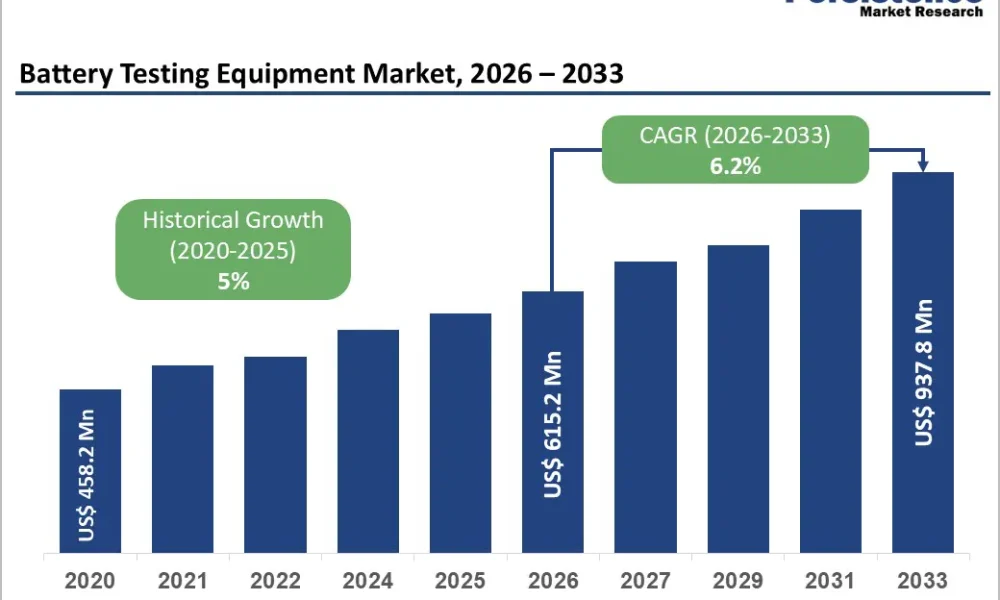
The battery testing equipment market is experiencing steady growth as industries worldwide increasingly rely on advanced battery technologies to power electric vehicles, renewable energy storage systems, consumer electronics, and industrial equipment. According to industry estimates, the global battery testing equipment market size is likely to be valued at US$ 615.5 million in 2026 and is projected to reach US$ 937.8 million by 2033, expanding at a compound annual growth rate (CAGR) of 6.2% during the forecast period from 2026 to 2033. Battery testing equipment plays a vital role in ensuring battery reliability, safety, and performance across various applications. These systems are used to evaluate parameters such as charge-discharge cycles, capacity, internal resistance, and thermal stability, enabling manufacturers to meet stringent safety standards and deliver high-performance battery products.
The rapid growth of the electric vehicle (EV) industry, along with the rising adoption of renewable energy storage systems, is a major factor driving the demand for battery testing solutions. As governments across the globe promote clean energy and electrification initiatives, battery production capacity is expanding significantly. This expansion requires advanced testing equipment to ensure the durability and efficiency of batteries before they are deployed in vehicles or energy storage systems. Among the various product types, battery cyclers and charge-discharge testing systems represent the leading segment due to their extensive use in evaluating battery life cycles. From a regional standpoint, Asia Pacific dominates the battery testing equipment market, supported by the presence of major battery manufacturers and electric vehicle producers in countries such as China, Japan, and South Korea. The region’s strong electronics manufacturing base and large-scale EV battery production facilities continue to reinforce its leadership in the global market.
Key Highlights from the Report
• The global battery testing equipment market is projected to grow at a CAGR of 6.2% between 2026 and 2033.
• Increasing production of electric vehicle batteries is driving demand for advanced battery testing solutions.
• Battery cyclers remain the leading equipment type due to their importance in lifecycle testing.
• Asia Pacific dominates the market owing to strong battery manufacturing capabilities.
• Growing investments in renewable energy storage systems are boosting market expansion.
• Technological advancements in automated battery testing systems are improving testing efficiency and accuracy.
𝐆𝐞𝐭 𝐚 𝐒𝐧𝐞𝐚𝐤 𝐏𝐞𝐞𝐤, 𝐒𝐚𝐦𝐩𝐥𝐞 𝐏𝐃𝐅 𝐈𝐧𝐬𝐢𝐝𝐞: https://www.persistencemarketresearch.com/samples/23632
Market Segmentation
The battery testing equipment market can be segmented based on equipment type, battery type, and end-user industry. From the perspective of equipment type, the market includes battery cyclers, capacity testers, impedance testers, charge-discharge testing systems, and safety testing equipment. Battery cyclers play a particularly crucial role in evaluating the charging and discharging performance of batteries under various conditions. These devices allow manufacturers to simulate real-world usage patterns and analyze the battery’s lifespan and durability. Capacity testers and impedance analyzers are also essential tools for measuring internal resistance and overall battery performance, helping ensure the reliability of battery systems before commercial deployment.
Another key segmentation of the market is based on battery type, which includes lithium-ion batteries, lead-acid batteries, nickel-metal hydride batteries, and other emerging battery technologies. Among these, lithium-ion batteries dominate the market due to their widespread use in electric vehicles, portable electronics, and energy storage systems. As lithium-ion battery production continues to grow globally, the need for sophisticated testing equipment capable of handling high energy density and complex battery management systems is also increasing. Meanwhile, lead-acid batteries continue to maintain relevance in applications such as automotive starting systems and backup power solutions, supporting ongoing demand for testing devices tailored to these battery chemistries.
The market is also segmented by end-user industries, which include automotive, consumer electronics, energy and utilities, aerospace and defense, and industrial manufacturing. The automotive sector represents one of the largest end users due to the rapid expansion of the electric vehicle market. Battery testing equipment is essential for validating battery safety, performance, and durability before integration into electric vehicles. The consumer electronics sector is another significant contributor to market growth, as smartphones, laptops, and wearable devices rely on high-performance rechargeable batteries that require extensive testing during development and production stages.
Regional Insights
From a regional perspective, Asia Pacific holds the largest share of the global battery testing equipment market and is expected to maintain its dominance throughout the forecast period. The region’s leadership is primarily driven by the presence of leading battery manufacturers, strong electronics production capabilities, and a rapidly growing electric vehicle industry. China, in particular, has emerged as the world’s largest producer of lithium-ion batteries and electric vehicles, which has significantly increased the demand for advanced battery testing equipment. In addition, government policies supporting clean energy and EV adoption in countries such as Japan, South Korea, and India are further strengthening the region’s position in the market.
North America represents another important market for battery testing equipment, driven by technological innovation and the increasing adoption of electric vehicles and renewable energy systems. The United States is witnessing strong investments in battery research and development, as well as the establishment of large-scale battery manufacturing facilities. These developments are generating demand for advanced testing solutions capable of ensuring battery reliability and safety.
In Europe, the battery testing equipment market is expanding due to the region’s aggressive push toward electrification and sustainability. European countries are investing heavily in battery manufacturing and electric vehicle production as part of their efforts to reduce carbon emissions and achieve climate targets. The establishment of battery gigafactories across Germany, France, and other countries is expected to significantly boost demand for testing equipment in the coming years.
Meanwhile, Latin America and the Middle East & Africa are gradually emerging as potential markets for battery testing equipment. Increasing investments in renewable energy projects, along with growing demand for energy storage solutions, are creating opportunities for testing equipment manufacturers in these regions.
𝐆𝐞𝐭 𝐚 𝐂𝐮𝐬𝐭𝐨𝐦𝐢𝐳𝐞𝐝 𝐌𝐚𝐫𝐤𝐞𝐭 𝐕𝐢𝐞𝐰 𝐢𝐧 𝐎𝐧𝐞 𝐂𝐥𝐢𝐜𝐤 : https://www.persistencemarketresearch.com/request-customization/23632
Market Drivers
One of the primary drivers of the battery testing equipment market is the rapid expansion of the electric vehicle industry. Governments worldwide are implementing policies and incentives aimed at promoting EV adoption as part of their efforts to reduce greenhouse gas emissions and dependence on fossil fuels. As EV production increases, manufacturers must ensure that batteries meet strict safety and performance standards. Battery testing equipment plays a crucial role in validating battery reliability, charge cycles, thermal stability, and overall efficiency before integration into vehicles.
Another significant driver is the increasing deployment of renewable energy storage systems. Solar and wind energy sources are inherently intermittent, which creates the need for efficient energy storage solutions. Batteries are widely used to store excess energy generated during peak production periods and release it when demand rises. As the installation of renewable energy systems expands globally, the demand for reliable battery testing equipment is also growing to ensure the performance and longevity of energy storage batteries.
Additionally, advancements in battery technologies and the development of new chemistries are contributing to market growth. Manufacturers are continuously working to improve battery energy density, safety, and lifespan. These innovations require advanced testing systems capable of evaluating complex battery characteristics under various environmental conditions, thereby driving demand for sophisticated testing equipment.
Market Restraints
Despite strong growth prospects, the battery testing equipment market faces certain challenges that could limit its expansion. One of the key restraints is the high cost associated with advanced testing systems. Modern battery testing equipment often involves sophisticated electronics, specialized software, and precise measurement instruments. These technologies can be expensive to develop, install, and maintain, which may discourage smaller manufacturers from investing in high-end testing solutions.
Another challenge is the rapid pace of battery technology evolution. As new battery chemistries and designs emerge, existing testing equipment may require upgrades or replacements to accommodate new testing requirements. This constant need for technological adaptation can increase operational costs for manufacturers and testing laboratories. Furthermore, the complexity of testing high-capacity batteries used in electric vehicles and energy storage systems presents additional technical challenges, requiring specialized expertise and infrastructure.
Market Opportunities
The battery testing equipment market offers numerous opportunities for growth, particularly in the area of automation and digital testing solutions. Modern battery testing systems are increasingly incorporating advanced software, data analytics, and artificial intelligence to streamline testing processes and improve accuracy. Automated testing platforms can perform complex evaluations with minimal human intervention, reducing testing time and improving efficiency for manufacturers.
Another promising opportunity lies in the development of next-generation battery technologies, including solid-state batteries and advanced lithium-ion chemistries. These emerging battery technologies are expected to deliver higher energy density, improved safety, and longer lifespans compared to conventional batteries. However, they also require specialized testing equipment capable of evaluating their unique characteristics. Companies that invest in developing testing solutions tailored to these new battery technologies are likely to gain a competitive advantage in the market.
Furthermore, the expansion of battery recycling and second-life battery applications presents additional growth opportunities. As the number of electric vehicles and battery-powered devices increases, there is a growing need to assess the remaining capacity and performance of used batteries. Battery testing equipment plays a critical role in determining whether batteries can be reused, repurposed, or recycled, creating new demand for advanced testing technologies.
𝐁𝐮𝐲 𝐍𝐨𝐰 𝐭𝐡𝐞 𝐃𝐞𝐭𝐚𝐢𝐥𝐞𝐝 𝐑𝐞𝐩𝐨𝐫𝐭: https://www.persistencemarketresearch.com/checkout/23632
Company Insights
The battery testing equipment market is characterized by the presence of several global players offering a wide range of testing solutions for different battery chemistries and applications. These companies focus on technological innovation, strategic partnerships, and expansion into emerging markets to strengthen their competitive position.
• Chroma ATE Inc.
• Arbin Instruments
• Maccor Inc.
• Bitrode Corporation
• Keysight Technologies
• Hioki E.E. Corporation
• National Instruments Corporation
• Neware Technology Limited
• Digatron Power Electronics
• AVL List GmbH
In recent years, several developments have shaped the competitive landscape of the market. Leading manufacturers have introduced advanced automated battery testing platforms capable of conducting high-precision testing for electric vehicle batteries and energy storage systems. Additionally, companies are investing in AI-powered data analysis tools that allow researchers and manufacturers to gain deeper insights into battery performance, enabling faster development of next-generation battery technologies.
Conclusion
The global battery testing equipment market is set for sustained growth as industries increasingly rely on batteries to power electric vehicles, renewable energy systems, and modern electronic devices. With the market projected to grow from US$ 615.5 million in 2026 to US$ 937.8 million by 2033, at a CAGR of 6.2%, the demand for advanced testing solutions is expected to rise significantly in the coming years. Factors such as the rapid expansion of electric vehicle production, increasing adoption of renewable energy storage systems, and continuous advancements in battery technology are driving the market forward. While challenges such as high equipment costs and evolving testing requirements remain, ongoing innovations in automation, digital testing, and next-generation battery technologies are creating new opportunities for industry players. As battery applications continue to expand across multiple sectors, battery testing equipment will remain an essential component in ensuring the safety, performance, and reliability of modern energy storage solutions.




