
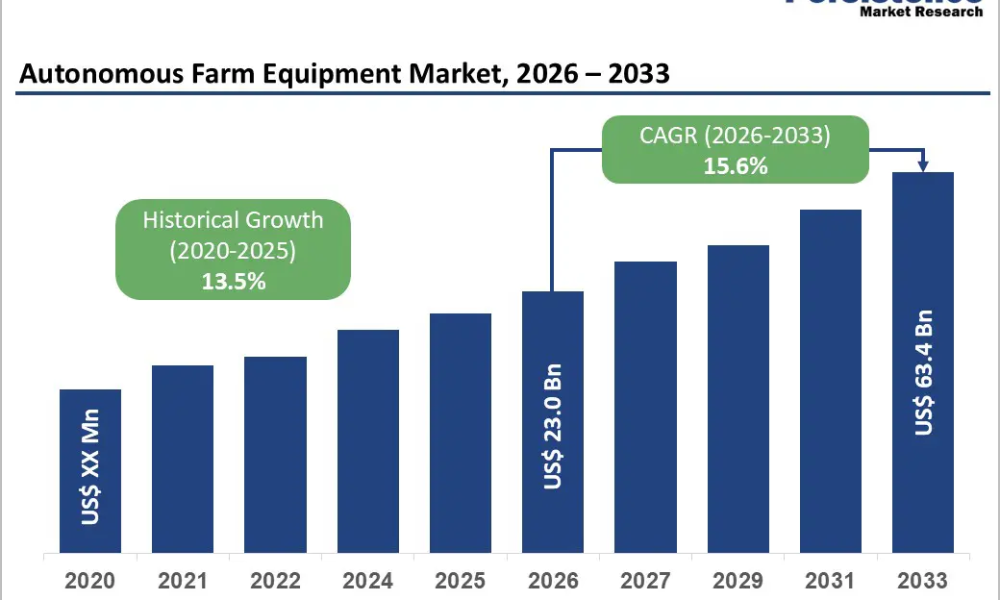
The global Autonomous Farm Equipment Market is entering a transformative phase as automation, artificial intelligence, and precision agriculture technologies redefine traditional farming operations. According to leading market research insights, the global autonomous farm equipment market is projected to grow from an estimated valuation of US$ 23.0 Billion in 2026 to approximately US$ 63.4 Billion by 2033, expanding at a robust compound annual growth rate (CAGR) of 15.6% during the forecast period from 2026 to 2033.
This rapid growth trajectory is primarily fueled by persistent labor shortages in agricultural regions, increasing operational costs, and the urgent need to improve agricultural productivity to meet rising global food demand. Farmers and agribusinesses are increasingly turning to autonomous tractors, harvesters, sprayers, and drones to enhance operational efficiency, reduce dependency on manual labor, and optimize input usage such as seeds, fertilizers, and water.
Autonomous farm equipment integrates advanced technologies including artificial intelligence (AI), machine learning (ML), computer vision, robotics, GPS navigation, and IoT sensors to perform agricultural tasks with minimal or no human intervention. These systems enable precision farming, which reduces waste, improves crop yields, and enhances sustainability outcomes.
Get Your FREE Sample Report Instantly Click Now: https://www.persistencemarketresearch.com/samples/22462
Key Highlights from the Report
➤ The global autonomous farm equipment market is projected to grow from US$ 23.0 Billion in 2026 to US$ 63.4 Billion by 2033, registering a CAGR of 15.6% during the forecast period.
➤ Autonomous tractors represent the largest revenue-generating segment due to their widespread use in planting, plowing, and hauling operations.
➤ Artificial intelligence and IoT integration are significantly enhancing equipment efficiency, enabling predictive maintenance, real-time monitoring, and optimized farm management.
➤ North America currently dominates the market owing to high technology adoption rates and large-scale commercial farming operations.
➤ Asia Pacific is expected to emerge as the fastest-growing regional market due to agricultural modernization and increasing demand for precision farming solutions.
➤ Strategic investments, partnerships, and product innovations by key market players are accelerating global deployment and expanding market competitiveness.
Market Segmentation
Product Type
- Tractors
- Harvesting Equipment
- Irrigation Equipment
- Livestock Equipment
- Haying & Forage Equipment
- Spraying Equipment
- Unmanned Aerial Vehicles (UAVs)
- Others
Application
- Field Farming
- Horticulture
- Dairy Farming & Livestock Management
- Others
Automation Level
- Partially autonomous
- Fully Autonomous
Power Output
- Less than 30 HP
- 31-70 HP
- 71-130 HP
- 131-250 HP
- Greater than 250 HP
By Region
- North America
- Europe
- East Asia
- South Asia and Oceania
- Latin America
- Middle East and Africa
Regional Insights
North America currently leads the autonomous farm equipment market, driven by high levels of technological adoption, large-scale commercial farming operations, and significant investments in agricultural automation. The United States is at the forefront of adopting autonomous tractors and precision agriculture technologies. The presence of major agricultural technology companies and strong research and development infrastructure further supports regional dominance.
Europe represents another major market, driven by increasing focus on sustainable agriculture, environmental regulations, and labor shortages. Countries such as Germany, France, and the United Kingdom are actively adopting autonomous farming technologies to improve efficiency and comply with sustainability standards.
Asia Pacific is expected to emerge as the fastest-growing regional market during the forecast period. Rapid population growth, increasing food demand, and government initiatives to modernize agriculture are key factors driving adoption. Countries such as China, India, Japan, and Australia are investing heavily in agricultural automation to enhance productivity and reduce labor dependency.
Latin America and the Middle East & Africa are also witnessing increasing adoption, particularly in large agricultural economies such as Brazil and South Africa. These regions are leveraging autonomous equipment to improve efficiency in large-scale farming operations.
Customize This Report for Your Exact Requirements: https://www.persistencemarketresearch.com/request-customization/22462
Unique Features and Innovations in the Market
Modern autonomous farm equipment incorporates advanced technologies that differentiate it significantly from traditional machinery. Artificial intelligence and machine learning algorithms enable equipment to learn from operational data, optimize performance, and improve efficiency over time.
Computer vision systems allow machines to detect crops, weeds, and obstacles accurately. This enables precision spraying, targeted harvesting, and reduced input waste. IoT connectivity enables real-time monitoring and remote management of farm operations, allowing farmers to monitor equipment performance from centralized control systems.
Integration with cloud computing platforms allows for data storage, analytics, and predictive maintenance. This helps prevent equipment failures and reduce downtime.
The adoption of 5G connectivity is expected to further enhance autonomous farming capabilities by enabling real-time communication between machines, sensors, and control systems. This will facilitate coordinated operations and improve overall farm productivity.
Robotic technologies are also enabling autonomous equipment to perform complex tasks such as selective harvesting, precision planting, and autonomous navigation in challenging environments.
Market Highlights
The adoption of autonomous farm equipment is being driven by several key factors, including rising labor costs and labor shortages in agricultural regions. Autonomous equipment helps farmers overcome workforce limitations while improving operational efficiency.
The growing demand for food due to increasing global population is another major driver. Autonomous equipment enables farmers to increase productivity and maximize crop yields.
Government initiatives supporting smart agriculture and precision farming are also contributing significantly to market growth. Subsidies, grants, and incentives for adopting advanced farming technologies are encouraging farmers to invest in autonomous equipment.
Environmental sustainability is another key factor driving adoption. Autonomous equipment reduces fuel consumption, minimizes input waste, and improves resource efficiency.
Cost reduction is a major benefit, as autonomous equipment reduces labor costs and improves operational efficiency over the long term.
Key Players and Competitive Landscape
The autonomous farm equipment market is highly competitive, with several leading companies focusing on innovation, strategic partnerships, and global expansion.
✦ Deere & Company – A global leader in agricultural equipment, the company is investing heavily in AI-powered autonomous tractors and precision farming solutions to strengthen its market leadership.
✦ CNH Industrial N.V. – The company is expanding its autonomous equipment portfolio through advanced robotics and digital farming technologies.
✦ AGCO Corporation – AGCO is focusing on smart farming solutions and autonomous tractors integrated with precision agriculture platforms.
✦ Kubota Corporation – Kubota is investing in autonomous rice planting and harvesting technologies, particularly in Asia Pacific markets.
✦ Trimble Inc. – Trimble provides advanced GPS and automation solutions that enhance autonomous farm equipment capabilities.
These companies are investing in research and development, forming strategic partnerships, and launching innovative products to strengthen their market positions.
Recent Developments
- Deere & Companyrecently introduced next-generation fully autonomous tractors equipped with advanced AI vision systems capable of detecting obstacles and optimizing field operations without human intervention.
- AGCO Corporationannounced strategic investments in autonomous farming startups to accelerate innovation and expand its smart farming ecosystem.
Ready to Dive Deep? Buy Full Report Today: https://www.persistencemarketresearch.com/checkout/22462
Future Opportunities and Growth Prospects
The autonomous farm equipment market presents significant growth opportunities driven by continuous technological advancements and increasing demand for sustainable agriculture.
The integration of artificial intelligence, robotics, and IoT will continue to enhance equipment capabilities, enabling fully autonomous farming operations. The development of electric autonomous equipment will further support sustainability goals and reduce environmental impact. Emerging markets present significant opportunities due to agricultural modernization initiatives and increasing investments in precision farming technologies. The adoption of autonomous equipment-as-a-service models will enable smaller farms to access advanced technologies without significant upfront investment, expanding market reach.
Government policies supporting agricultural automation and sustainability will continue to play a crucial role in market growth. As global agriculture faces increasing challenges related to labor shortages, climate change, and food demand, autonomous farm equipment is expected to play a critical role in transforming agricultural operations. With continued innovation and investment, the market is poised for sustained growth and technological advancement through 2033 and beyond.




