
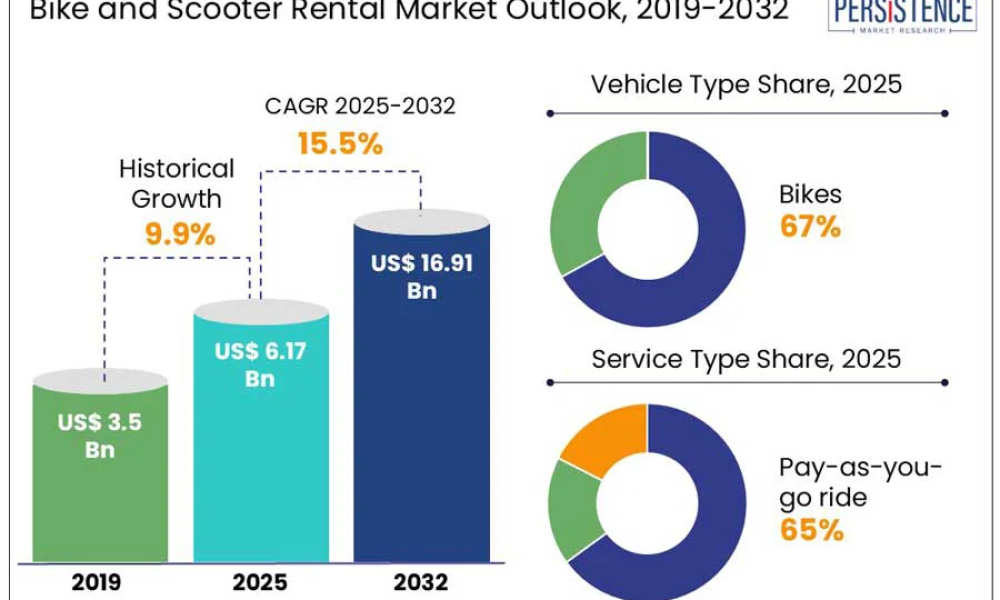
The global bike and scooter rental market has witnessed remarkable growth over the past few years and continues to show significant potential for expansion. Valued at US$ 5.4 billion in 2024, the market is projected to reach US$ 6.2 billion in 2025 and is expected to surge to US$ 16.9 billion by 2032, registering a robust CAGR of 15.5% between 2025 and 2032.
Several factors are fueling this growth. Rapid urbanization, increasing traffic congestion in metropolitan areas, and the rising awareness of sustainable transportation solutions are driving both consumer and commercial demand for shared mobility options. Additionally, the growing popularity of micromobility as a convenient and cost-effective alternative to traditional public transportation is further boosting adoption rates. Government initiatives promoting green mobility and the integration of electric vehicles into urban transport infrastructure are also significant contributors to market growth.
The market is witnessing strategic collaborations between rental providers and municipalities to promote eco-friendly mobility, while technological innovations, including AI-powered fleet management, IoT-based tracking, and mobile app-based rental platforms, are enhancing user experience and operational efficiency.
Get Your FREE Sample Report Instantly Click Now: https://www.persistencemarketresearch.com/samples/35374
Key Highlights from the Report
➤ Market Size and Growth: The global bike and scooter rental market was valued at US$ 5.4 Bn in 2024 and is forecasted to reach US$ 16.9 Bn by 2032, growing at a CAGR of 15.5%.
➤ Rising Urban Mobility Needs: Increasing urban populations and traffic congestion are driving demand for convenient, short-distance transport options.
➤ Sustainability Focus: Growing environmental concerns and regulatory incentives for zero-emission transport solutions are boosting the adoption of e-bikes and electric scooters.
➤ Technological Advancements: Integration of AI, IoT, and mobile platforms is optimizing fleet management and enhancing user experiences.
➤ Expanding Rental Platforms: Rise of app-based rental services and subscription models is making micromobility accessible and user-friendly.
➤ Investment and Partnerships: Increasing collaborations among leading mobility service providers and municipalities are facilitating infrastructure development and market expansion.
Market Segmentation
By Vehicle Type
- Bikes
- Scooters
By Propulsion Type
- Pedal
- Electric
- Gasoline
By Service Type
- Pay-as-you-ride
- Subscription-based
By Region
- North America
- Europe
- Asia Pacific
- South Asia and Oceania
- Latin America
- Middle East and Africa
Regional Insights
The global bike and scooter rental market is geographically diverse, with North America, Europe, and Asia-Pacific emerging as leading regions. Europe currently leads in market adoption due to extensive urban planning for micromobility, robust infrastructure, and favorable regulatory frameworks promoting green transport solutions. Asia-Pacific is the fastest-growing region, driven by rapid urbanization, rising disposable incomes, and government-led initiatives to reduce traffic congestion and pollution in densely populated cities. Countries like China and India are witnessing a surge in app-based electric scooter and bike rentals, with investments from both domestic and international mobility firms accelerating growth.
Customize This Report for Your Exact Requirements: https://www.persistencemarketresearch.com/request-customization/35374
Unique Features and Innovations in the Market
Modern bike and scooter rental solutions are distinguished by their integration of advanced technologies. AI-driven analytics optimize fleet distribution, reduce idle time, and predict maintenance needs, ensuring higher service reliability. IoT-enabled sensors provide real-time data on vehicle usage, battery status, and location, enhancing operational efficiency. Furthermore, 5G connectivity allows seamless communication between vehicles and central platforms, facilitating improved user experiences and enabling advanced features such as augmented reality navigation and dynamic pricing models.
Innovative approaches, such as dockless rental systems and geo-fencing capabilities, provide flexibility for users while allowing operators to control fleet deployment effectively. Electric propulsion systems, regenerative braking, and energy-efficient battery solutions are also reshaping the market, making sustainable mobility more practical and economically viable.
Market Highlights
Businesses and municipalities are increasingly adopting bike and scooter rental solutions due to multiple benefits. Reduced urban congestion, lower transportation costs, and decreased carbon emissions are key factors driving adoption. Regulatory support in the form of subsidies, tax incentives, and dedicated micromobility lanes is facilitating market growth. Moreover, the scalability of shared mobility solutions allows operators to expand fleets rapidly in response to increasing demand, creating new revenue streams and enhancing urban transport efficiency.
The emphasis on sustainability, operational cost reduction, and enhanced user convenience positions bike and scooter rentals as a strategic solution for addressing the evolving mobility needs of urban populations.
Key Players and Competitive Landscape
The global market is characterized by the presence of both established mobility firms and innovative startups. Key players are focusing on strategic expansions, technology adoption, and service diversification. Some of the leading companies include:
✦ Lime – Leveraging technology-driven fleet management, Lime has expanded its presence across major cities worldwide and is focusing on electric scooters and sustainable mobility solutions.
✦ Bird Rides Inc. – Bird emphasizes dockless rental systems and has integrated AI-driven operational tools to optimize fleet deployment and enhance user experiences.
✦ Spin – Acquired by Tier Mobility, Spin focuses on electric scooters and bikes with app-based rental platforms, ensuring convenience and accessibility for urban commuters.
✦ Tier Mobility – Known for its strong European presence, Tier prioritizes sustainability by introducing electric vehicles, battery-swapping technologies, and subscription-based models.
✦ Voi Technology – Voi leverages AI and IoT technologies to monitor usage patterns and improve operational efficiency, particularly in Scandinavian and European cities.
✦ Helbiz – Combining scooter and bike rentals with shared mobility services, Helbiz has introduced gamification features and loyalty programs to engage users and drive adoption.
Recent Developments
- Expansion of Electric Fleet: Lime announced the addition of over 20,000 electric scooters and bikes across North America in 2025, further solidifying its market presence.
- Strategic Partnerships: Bird Rides Inc. partnered with municipal authorities in Europe to implement smart parking zones and optimize fleet allocation, enhancing urban mobility solutions.
Ready to Dive Deep? Buy Full Report Today: https://www.persistencemarketresearch.com/checkout/35374
Future Opportunities and Growth Prospects
The global bike and scooter rental market holds significant opportunities, particularly in untapped regions in Asia-Pacific and Latin America. Rising environmental consciousness and the shift toward electric vehicles are expected to drive adoption, while regulatory support for micromobility infrastructure will encourage new market entrants.
The role of technology will continue to be transformative. AI, IoT, and predictive analytics will optimize operations, reduce costs, and improve user experience, while 5G connectivity will facilitate advanced features such as smart traffic integration and personalized ride recommendations. Additionally, governments are expected to introduce stricter emission norms, further boosting the adoption of electric bikes and scooters in urban centers.
Strategic collaborations, mergers, and acquisitions among market players will accelerate market consolidation, improve service offerings, and expand regional footprints. Subscription-based models and app-enabled rentals are expected to dominate, allowing operators to tap into long-term revenue streams and build customer loyalty.
Overall, the global bike and scooter rental market is on a trajectory for substantial growth, driven by urbanization, sustainability initiatives, technological innovation, and increasing consumer demand for convenient, cost-effective, and eco-friendly mobility solutions. With continued investment in infrastructure, fleet expansion, and smart technologies, the industry is poised to redefine urban transportation across the globe.




