
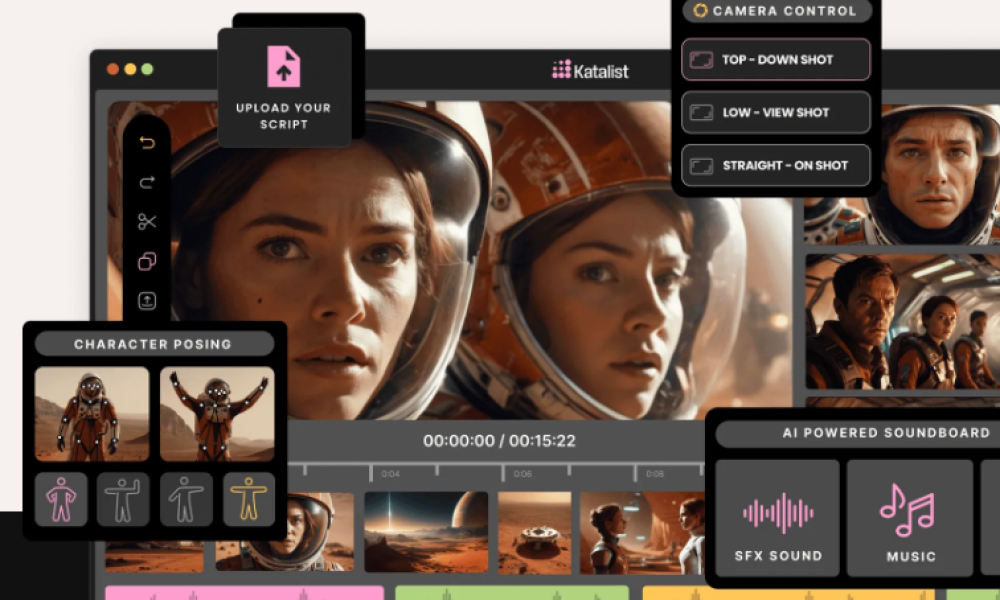
The capital intensive nature of film and commercial production is facing a structural disruption as San Francisco based startup Katalist secures a new $1.5 million funding round. Led by South Central Ventures, the investment marks a transition from experimental AI tools toward a unified operating system for professional video workflows. By consolidating scripting, storyboarding, and final asset generation into a single automated pipeline, the platform is addressing the chronic bottleneck in high end content creation: the reconciliation of creative control with exponential output demands.
The Pre-Production Paradox and the Efficiency Gap
In traditional production, the journey from script to screen is often hindered by the friction of manual visualization. Storyboarding and shot listing, while critical for maintaining directorial intent, are frequently the first stages to be compressed under tight budgets and timelines. Katalist founders Andraz Zvonar and Blaz Blokar, who previously developed creative automation solutions for brands like Nike and Spotify, identified this pre production phase as the primary site for machine learning intervention. Their platform uses advanced algorithms to parse scripts and automatically generate consistent visual narratives, allowing creative directors to iterate on complex scenes in minutes rather than days.
Architecting Continuity in the Age of Generative Media
A persistent challenge in AI assisted video has been the “drift” of characters and settings between frames. Katalist’s technical architecture prioritizes character and scene consistency, ensuring that the visual identity of a project remains stable across millions of generated data points. This focus on “structured pre production” distinguishes the platform from generalist video generators that often struggle with the narrative continuity required for professional storytelling. Today, the platform supports over 250,000 professionals, ranging from independent filmmakers to marketing agencies, who have generated tens of millions of assets for distribution on television and global streaming services.
Democratic Scaling for Global Storytelling
The democratization of high end production tools is shifting the competitive landscape for mid sized agencies and boutique studios. Historically, the ability to produce cinematic quality video was gated by the cost of talent and equipment. Zvonar’s mission with Katalist is to decouple quality from capital, providing a platform where the complexity of a production does not correlate linearly with its cost. By automating the mechanical aspects of scene composition and camera control, the system allows creators to focus on the higher order tasks of narrative and emotional resonance. This shift is reflected in the platform’s adoption statistics, with users already leveraging its tools to reach an audience of more than one billion people through automated workflows.
Institutional Support and the Roadmap for Future Production
The backing of South Central Ventures, a firm specializing in B2B SaaS and AI sectors within Southeast Europe, underscores the global nature of Katalist’s engineering roots. Founded in 2023, the startup has rapidly moved from a 500 Global accelerator participant to a foundational player in the creative tech space. The new capital is earmarked for the development of a native AI timeline editor and generative audio features, which would effectively complete the end to end production loop. As video consumption continues to dominate digital engagement, the move toward a centralized “Video OS” suggests that the future of the industry lies not in isolated tools, but in integrated environments that can synthesize human creativity at the speed of computation.
Strategic Integration in the Modern Creative Stack
As the platform evolves, its integration into the existing creative stack becomes its most potent advantage. Rather than replacing the filmmaker, Katalist is positioning itself as an essential co pilot that manages the logistics of visual translation. The ability to export assembled storyboards and transition directly into a high fidelity video timeline creates a seamless bridge between the conceptual and the tangible. For the modern creator, this means a significant reduction in the “bandwidth versus talent” imbalance, ensuring that the best stories are told based on the strength of their vision rather than the depth of their pockets.



