
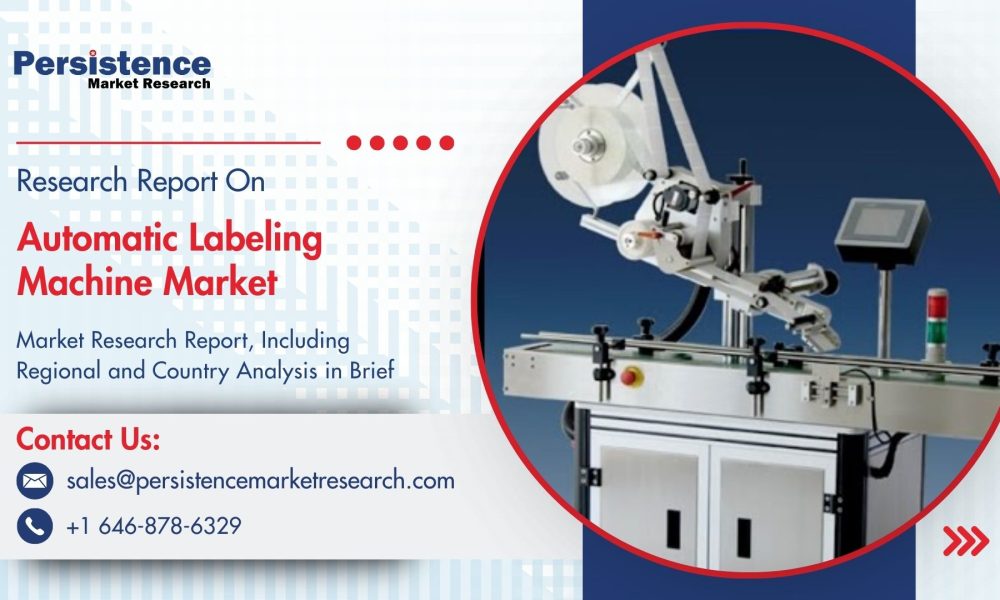
According to the latest study by Persistence Market Research, the global automatic labeling machine market is expected to witness steady growth over the forecast period, reaching US$4.0 Bn by 2032 from an estimated US$3.1 Bn in 2025, expanding at a CAGR of 3.7%. The market growth is primarily fueled by increasing demand for automation in packaging operations, the rising need for consistent labeling quality, and expanding end-user industries such as food & beverages, pharmaceuticals, and consumer goods. As labeling continues to play a crucial role in brand identity, regulatory compliance, and product traceability, manufacturers are increasingly turning to automated systems to enhance productivity and accuracy.
Market Overview
The automatic labeling machine market has evolved significantly in recent years, driven by the growing emphasis on packaging efficiency, brand consistency, and compliance with labeling regulations. These machines are designed to apply labels accurately and consistently to products, containers, or packages, offering significant advantages over manual and semi-automatic labeling processes. They are widely used across industries including food & beverages, pharmaceuticals, chemicals, personal care, logistics, and automotive to ensure faster operations, improved aesthetic appeal, and better inventory management.
Automation has become the cornerstone of modern manufacturing and packaging operations. Companies are increasingly investing in advanced labeling technologies that can integrate seamlessly with their production lines. The adoption of automatic labeling machines not only improves operational speed but also minimizes human error, reduces waste, and ensures adherence to strict labeling standards. Furthermore, the rise of e-commerce and the need for efficient packaging and logistics management have accelerated the demand for versatile labeling machines capable of handling diverse product types and packaging materials.
Get a Sample PDF Brochure of the Report (Use Corporate Email ID for a Quick Response): https://www.persistencemarketresearch.com/samples/29695
Key Growth Drivers
Several factors are driving the growth of the automatic labeling machine market globally. One of the key growth drivers is the rising demand for automation in packaging. As manufacturers strive for operational excellence, the need for systems that can deliver precision, speed, and cost efficiency has grown. Automatic labeling machines help businesses increase throughput and maintain consistency across high-volume production lines, thereby supporting brand image and regulatory compliance.
Another major driver is the growing focus on product identification and traceability. With stringent government regulations surrounding product labeling—especially in food, pharmaceuticals, and healthcare—manufacturers must ensure accurate labeling that includes barcodes, expiry dates, and batch information. Automatic labeling machines enable manufacturers to meet these regulatory requirements while improving the overall efficiency of their packaging processes.
The expansion of the food and beverage industry also plays a crucial role in market growth. As consumer preferences shift toward packaged and ready-to-eat foods, the need for accurate and visually appealing labeling is intensifying. Similarly, the pharmaceutical sector is witnessing significant adoption of automatic labeling systems to meet the growing demand for tamper-evident and informative labeling, ensuring patient safety and compliance with international standards.
Market Trends Shaping the Industry
Recent years have seen notable advancements in labeling machine technology. Manufacturers are introducing smart labeling systems equipped with artificial intelligence (AI) and Internet of Things (IoT) capabilities. These innovations allow real-time monitoring, predictive maintenance, and integration with manufacturing execution systems (MES). The result is improved uptime, reduced downtime, and enhanced productivity.
Another emerging trend is the development of modular and flexible labeling systems that can handle a wide range of product sizes, shapes, and materials. This adaptability is particularly beneficial for small and medium-sized enterprises (SMEs) that produce diverse product lines. Additionally, sustainability has become a central focus, with manufacturers developing energy-efficient machines and supporting the use of recyclable labeling materials. This aligns with global efforts to reduce carbon footprints and promote eco-friendly packaging.
The growing popularity of e-commerce and logistics automation has also spurred innovation in labeling systems. Automatic labeling machines are increasingly being used in warehouses and distribution centers to streamline operations, improve accuracy in shipping labels, and support inventory management systems. These advancements are making labeling machines an essential part of the broader automation landscape.
Market Challenges
Despite the positive outlook, the market faces a few challenges. The high initial cost of automatic labeling machines can be a deterrent for small manufacturers with limited capital. While automation promises long-term benefits, the upfront investment in machinery, software integration, and maintenance can be substantial. Additionally, technical complexities related to machine calibration and the need for skilled operators can hinder adoption in developing regions.
Moreover, the availability of low-cost labeling alternatives such as manual and semi-automatic machines still appeals to small-scale businesses, particularly in emerging markets. Nonetheless, as automation technologies become more affordable and awareness of their long-term benefits increases, these challenges are expected to gradually diminish.
Market Segmentation
The automatic labeling machine market can be segmented based on type, application, and end-use industry. By type, the market includes self-adhesive labeling machines, shrink sleeve labeling machines, wrap-around labeling machines, and others. Among these, self-adhesive labeling machines hold the largest market share, owing to their versatility, ease of integration, and suitability across a variety of product shapes and materials. These machines are extensively used in industries such as food & beverages, personal care, and pharmaceuticals.
Based on application, the market is segmented into bottle labeling, carton labeling, vial labeling, and packaging labeling. Bottle labeling dominates the segment, particularly in the beverage and healthcare industries, where precision and speed are critical. In terms of end-use, food and beverages represent the largest market share, followed by pharmaceuticals and personal care & cosmetics. The rising trend of personalized and premium packaging is driving demand for high-speed, high-accuracy labeling systems in these sectors.
Furthermore, advancements in robotics and AI are making labeling machines more intelligent and adaptive. Machines now offer customizable settings and quick changeovers between product lines, making them ideal for industries that demand flexibility and minimal downtime. The increasing adoption of smart sensors and vision systems also enhances error detection, ensuring labeling accuracy and product consistency.
For Customized Insights on Segments, Regions, or Competitors, Request Personalized Purchase Options: https://www.persistencemarketresearch.com/request-customization/29695
Regional Insights
Geographically, Asia Pacific leads the global automatic labeling machine market, attributed to the region’s expanding manufacturing and packaging industries. Countries like China, Japan, and India are at the forefront due to their robust industrial growth, favorable government initiatives, and rising consumer demand for packaged goods. Rapid industrial automation and the presence of key packaging machinery manufacturers further support regional dominance.
North America and Europe follow closely, driven by advanced manufacturing facilities, stringent labeling regulations, and the early adoption of automation technologies. In these regions, sustainability and compliance standards are influencing packaging innovation, prompting companies to invest in energy-efficient labeling systems. Latin America and the Middle East & Africa, although smaller markets, are expected to experience steady growth due to the increasing penetration of FMCG, pharmaceutical, and food processing industries.
Company Insights
The global automatic labeling machine market features several prominent players actively focusing on technological innovation, mergers, and capacity expansion to maintain their competitive edge. Key companies operating in the market include:
✦ Krones AG
✦ ProMach, Inc.
✦ HERMA GmbH
✦ Sidel Group
✦ Accutek Packaging Equipment Companies, Inc.
✦ Weiler Labeling Systems
✦ Quadrel Labeling Systems
✦ Fuji Seal International, Inc.
✦ Marchesini Group S.p.A.
✦ Label-Aire, Inc.
✦ Newman Labelling Systems Ltd.
These companies are investing heavily in research and development to design advanced labeling systems with digital interfaces, improved precision, and eco-friendly operation. Many are also expanding their global footprint through partnerships and acquisitions to cater to rising demand from developing regions.
Future Outlook
The future of the automatic labeling machine market lies in digital transformation, customization, and sustainability. As Industry 4.0 continues to shape manufacturing, integration of IoT-enabled labeling systems will become standard practice. These smart systems will allow real-time data collection, predictive maintenance, and remote control, offering manufacturers deeper insights into their operations.
Moreover, the rise of eco-conscious consumers is encouraging companies to adopt sustainable labeling practices. Future machines are likely to be designed for minimal energy consumption and compatibility with biodegradable labeling materials. Another emerging trend is machine learning integration, allowing systems to adapt dynamically to different product types, reducing setup times, and improving operational efficiency.
In conclusion, the automatic labeling machine market is poised for consistent growth through 2032, supported by advancements in automation, the expansion of key end-user industries, and the global shift toward smart manufacturing. As companies continue to prioritize efficiency, precision, and sustainability, the demand for advanced labeling systems will remain robust, driving innovation and competition in the years ahead.
Explore the Latest Trending Research Reports:
About Persistence Market Research:
At Persistence Market Research, we specialize in creating research studies that serve as strategic tools for driving business growth. Established as a proprietary firm in 2012, we have evolved into a registered company in England and Wales in 2023 under the name Persistence Research & Consultancy Services Ltd. With a solid foundation, we have completed over 3600 custom and syndicate market research projects, and delivered more than 2700 projects for other leading market research companies’ clients.
Our approach combines traditional market research methods with modern tools to offer comprehensive research solutions. With a decade of experience, we pride ourselves on deriving actionable insights from data to help businesses stay ahead of the competition. Our client base spans multinational corporations, leading consulting firms, investment funds, and government departments. A significant portion of our sales comes from repeat clients, a testament to the value and trust we’ve built over the years.
Contact Us:
Persistence Market Research
G04 Golden Mile House, Clayponds Lane
Brentford, London, TW8 0GU UK
USA Phone: +1 646-878-6329
UK Phone: +44 203-837-5656
Email: [email protected]
Web: https://www.persistencemarketresearch.com




