
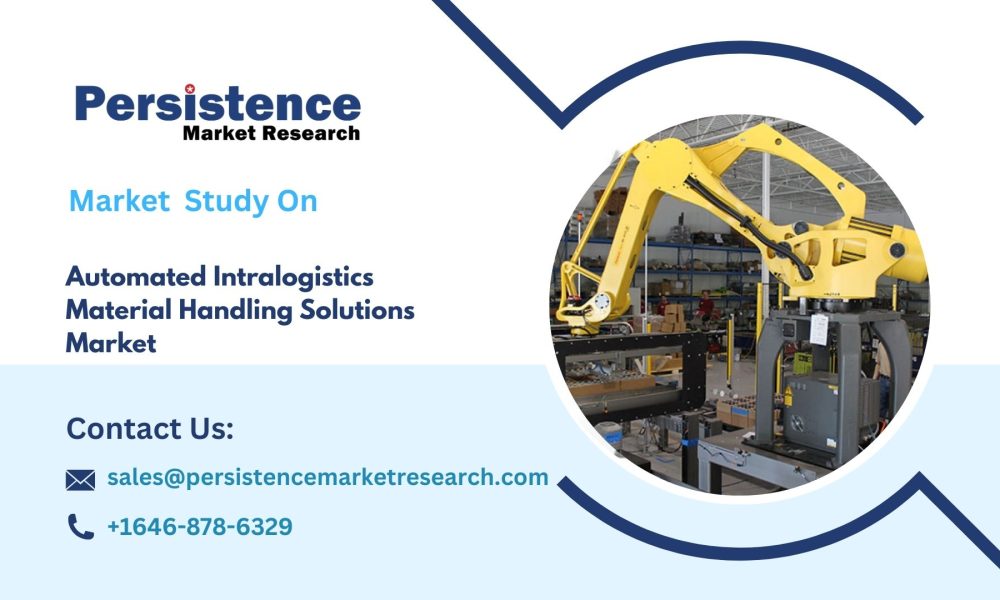
The automated intralogistics material handling solutions market is witnessing exponential growth as businesses worldwide seek to enhance efficiency, reduce operational costs, and optimize warehouse management. Automated intralogistics solutions, including autonomous mobile robots (AMRs), automated guided vehicles (AGVs), automated storage and retrieval systems (AS/RS), conveyors, sortation systems, and warehouse management software, are transforming traditional warehousing and distribution practices. These solutions enable real-time inventory tracking, faster order fulfillment, and seamless integration with e-commerce platforms, making them essential for modern supply chain operations.
In 2024, global sales of automated intralogistics material handling solutions are expected to reach approximately US$ 63.4 billion, and the market is projected to grow steadily at a CAGR of 14.4%, reaching a valuation of nearly US$ 162.3 billion by 2031. The market is primarily driven by the rapid growth of e-commerce, the increasing complexity of supply chains, and the rising adoption of Industry 4.0 technologies. Among the product segments, autonomous mobile robots (AMRs) are emerging as the leading segment due to their flexibility, scalability, and ability to navigate complex warehouse environments. Geographically, North America dominates the market owing to its high adoption of automation technologies, advanced logistics infrastructure, and significant presence of major e-commerce and retail companies.
𝐆𝐞𝐭 𝐚 𝐒𝐚𝐦𝐩𝐥𝐞 𝐏𝐃𝐅 𝐁𝐫𝐨𝐜𝐡𝐮𝐫𝐞 𝐨𝐟 𝐭𝐡𝐞 𝐑𝐞𝐩𝐨𝐫𝐭: https://www.persistencemarketresearch.com/samples/32829
Key Highlights from the Report
• Global sales of automated intralogistics material handling solutions are expected to reach US$ 63.4 billion in 2024.
• Market projected to achieve US$ 162.3 billion by 2031, expanding at a CAGR of 14.4%.
• Autonomous mobile robots (AMRs) lead the product segment due to flexibility and scalability.
• North America holds the largest regional share due to advanced logistics infrastructure.
• Rapid growth of e-commerce and omnichannel retail drives market adoption.
• Integration with Industry 4.0 technologies enhances operational efficiency and real-time data management.
Market Segmentation
The automated intralogistics material handling solutions market is segmented based on product type, end-user industry, and deployment type.
By Product Type, the market comprises autonomous mobile robots (AMRs), automated guided vehicles (AGVs), automated storage and retrieval systems (AS/RS), conveyors and sortation systems, picking and packing systems, and warehouse management software. AMRs are increasingly preferred in warehouses due to their agility, AI-enabled navigation, and ease of integration with existing operations. AGVs continue to serve high-volume manufacturing and logistics environments, while AS/RS solutions are widely deployed in large-scale distribution centers to maximize storage density and operational efficiency. Conveyors and sortation systems remain essential in streamlining material flow, and advanced warehouse management software ensures end-to-end visibility and data-driven decision-making.
By End-User Industry, automated intralogistics solutions serve e-commerce and retail, manufacturing, automotive, food and beverage, pharmaceuticals, and third-party logistics (3PL) providers. The e-commerce and retail segment dominates due to the surging demand for rapid order fulfillment, omnichannel distribution, and real-time inventory tracking. Manufacturing and automotive industries leverage these solutions to optimize assembly line material handling and reduce manual labor requirements. The pharmaceutical and food and beverage sectors prioritize accuracy, hygiene, and compliance, benefiting from automated storage, picking, and transport solutions.
By Deployment Type, solutions can be cloud-based or on-premises. Cloud-based deployments offer flexibility, scalability, and remote management, attracting small and medium-sized enterprises seeking cost-effective solutions. On-premises deployments provide enhanced security, customization, and reliability, making them suitable for large-scale industrial and warehouse operations.
Regional Insights
North America
North America leads the automated intralogistics material handling solutions market due to the rapid adoption of Industry 4.0 technologies, well-established logistics networks, and strong presence of e-commerce giants. The United States, in particular, benefits from continuous investment in warehouse automation, robotics, and digital supply chain technologies. Companies in the region are increasingly implementing autonomous mobile robots, automated storage systems, and AI-driven warehouse management software to enhance efficiency and scalability.
Europe
Europe is a significant market driven by the adoption of automation in manufacturing, logistics, and e-commerce sectors. Countries such as Germany, France, and the UK are at the forefront of deploying automated intralogistics solutions, driven by industrial automation policies, high labor costs, and focus on sustainable supply chain practices. Integration of AI, IoT, and robotics is increasing efficiency in European warehouses and distribution centers.
Asia-Pacific
Asia-Pacific is witnessing rapid growth in automated intralogistics due to industrialization, urbanization, and the expansion of e-commerce and retail sectors. China, Japan, and South Korea are leading in technology adoption, with manufacturers and logistics providers increasingly investing in AMRs, AGVs, and automated storage systems. The growing labor shortage, coupled with the need for higher efficiency, is driving the adoption of warehouse automation technologies in this region.
Latin America and Middle East & Africa
While smaller in terms of market share, Latin America and the Middle East & Africa present significant growth opportunities. Increasing investments in e-commerce, manufacturing, and logistics infrastructure, coupled with rising demand for operational efficiency, are expected to propel market growth. Early adoption of cloud-based warehouse management systems and flexible automation solutions is also contributing to regional growth.
Market Drivers
The automated intralogistics material handling solutions market is driven by multiple factors. The rapid growth of e-commerce and omnichannel retail has created a need for faster, more accurate order fulfillment, which automated solutions efficiently address. Labor shortages and rising labor costs are pushing companies to invest in robotics and automation to maintain productivity and reduce operational costs. Integration with Industry 4.0 technologies, including AI, IoT, and advanced analytics, enables real-time monitoring, predictive maintenance, and process optimization, further boosting adoption. Additionally, the increasing focus on warehouse space optimization, sustainability, and safety is motivating companies to replace manual handling with automated solutions.
Market Restraints
Despite strong growth, the market faces challenges. High initial investment costs for acquiring automated systems, including robotics and storage solutions, can deter small and medium-sized enterprises. Complexity of integration with existing legacy systems can lead to implementation delays and increased costs. Technical issues, cybersecurity concerns, and system downtime pose operational risks. Furthermore, the requirement for skilled personnel to manage and maintain advanced systems remains a constraint in some regions, potentially slowing adoption rates.
𝐃𝐨 𝐘𝐨𝐮 𝐇𝐚𝐯𝐞 𝐀𝐧𝐲 𝐐𝐮𝐞𝐫𝐲 𝐎𝐫 𝐒𝐩𝐞𝐜𝐢𝐟𝐢𝐜 𝐑𝐞𝐪𝐮𝐢𝐫𝐞𝐦𝐞𝐧𝐭? 𝐑𝐞𝐪𝐮𝐞𝐬𝐭 𝐂𝐮𝐬𝐭𝐨𝐦𝐢𝐳𝐚𝐭𝐢𝐨𝐧 𝐨𝐟 𝐑𝐞𝐩𝐨𝐫𝐭: https://www.persistencemarketresearch.com/request-customization/32829
Market Opportunities
The market offers several opportunities for expansion. Continuous technological advancements in AI, robotics, and IoT are creating smarter and more flexible solutions capable of handling complex warehouse operations. Emerging markets in Asia-Pacific, Latin America, and Africa present untapped potential due to rapid industrialization and e-commerce growth. Integration with predictive analytics and digital twin technologies can enhance operational efficiency and reduce downtime. Additionally, collaboration between solution providers and third-party logistics companies can enable scalable, end-to-end warehouse automation solutions tailored to diverse industries.
Company Insights
Key players operating in the automated intralogistics material handling solutions market include:
• Daifuku Co., Ltd.
• Swisslog Holding AG
• Dematic GmbH
• Honeywell Intelligrated
• KUKA AG
• Murata Machinery, Ltd.
• SSI Schaefer
• Geek+ Robotics Co., Ltd.
Recent Developments
Introduction of AI-Powered AMRs: Companies have launched autonomous mobile robots integrated with AI for real-time navigation, predictive maintenance, and seamless warehouse operations.
Expansion of Smart Warehousing Solutions: Major players are deploying cloud-based warehouse management systems and automated storage solutions in emerging markets to enhance scalability and operational efficiency.
Conclusion
The automated intralogistics material handling solutions market is poised for rapid growth, driven by increasing e-commerce demand, industrial automation, and technological advancements in robotics and AI. Autonomous mobile robots and automated storage and retrieval systems are emerging as leading solutions, while North America maintains market leadership due to advanced infrastructure and early adoption of automation. Despite challenges such as high initial costs and integration complexity, emerging markets and continuous innovation present significant opportunities for expansion. As businesses worldwide prioritize efficiency, scalability, and safety in warehouse operations, automated intralogistics solutions will continue to transform the global supply chain landscape, supporting smarter and more sustainable logistics operations.




