
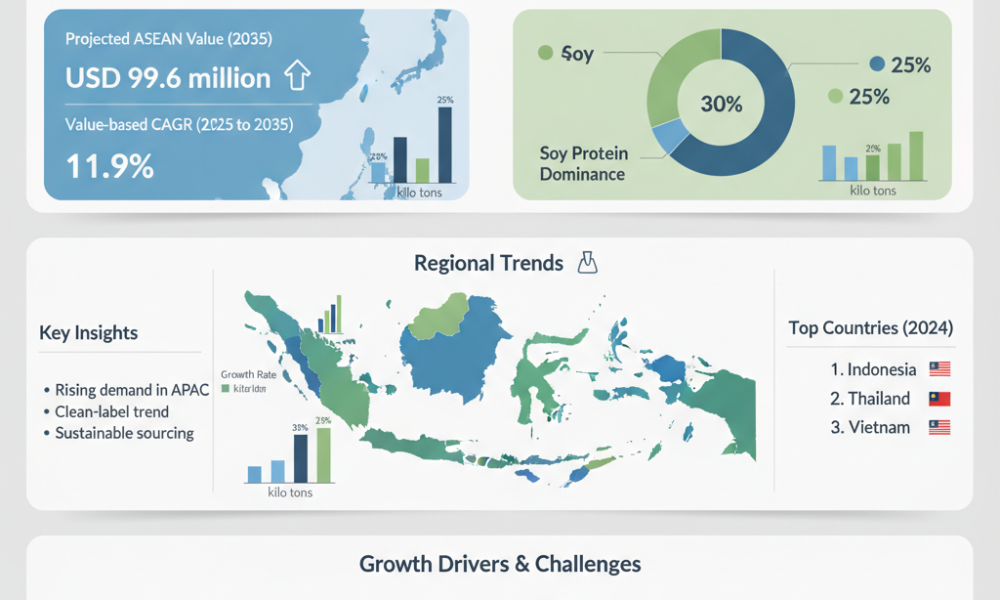
The ASEAN hydrolyzed vegetable protein (HVP) market is entering a high-growth phase, forecast to surge from USD 32.4 million in 2025 to USD 99.6 million by 2035, registering a robust CAGR of 11.9 %. The market’s rise is being powered by changing consumer preferences, health awareness, and the accelerating adoption of plant-based diets across Southeast Asia.
Key Market Insights at a Glance
- Market Size 2025: USD 32.4 million
- Projected Value 2035: USD 99.6 million
- CAGR (2025–2035): 11.9 %
- Top Product Type: Soy protein (≈ 40 % market share)
- Leading Form: Chunks (≈ 38 % market share)
- Major End Uses: Processed foods, household cooking, commercial food service, and animal feed
Regional Value: Southeast Asia’s Plant-Protein Leap
The ASEAN region is at the forefront of the global shift toward sustainable and healthy eating. Consumers in countries such as India, Malaysia, Thailand, Vietnam, and the Philippines are increasingly turning to plant-based proteins as part of balanced and ethical diets. India’s rich legume culture and government support for pulse farming complement Malaysia’s rising demand for functional and nutrient-dense foods. As the middle-class population expands and food innovation accelerates, ASEAN nations are set to become a manufacturing hub for hydrolyzed vegetable protein production.
Regional Overview
ASEAN’s strong food processing infrastructure and growing investment in local production are reshaping the HVP landscape. Thailand, Malaysia, and Indonesia are witnessing major facility expansions, while Vietnam and the Philippines are seeing increased import and distribution activity. As regional trade agreements strengthen supply chains, ASEAN stands poised to emerge as a key exporter of hydrolyzed vegetable protein products to global markets.
Segment Overview
- By Product Type: Soy protein leads due to its affordability, complete amino-acid profile, and versatility. Other growing categories include pea, wheat, rice, and corn proteins.
- By Form: Chunks dominate for their meat-like texture and ease of use in ready meals and plant-based meats. Slices, flakes, and granules also show growth potential in bakery and snack applications.
- By End Use: Demand spans household, commercial foodservice, processed food manufacturing, and animal feed industries.
- By Distribution Channel: Both direct (B2B) and indirect (retail and online) channels are gaining traction, reflecting diversified purchasing behavior.
Competitive Landscape
The ASEAN HVP market remains moderately consolidated, characterized by global leaders and emerging regional specialists. Industry majors such as Ajinomoto Co., Cargill Inc., Kerry Group, Tate & Lyle, and Givaudan continue to dominate global supply, while regional firms are focusing on clean-label, allergen-free, and sustainable formulations. Strategic partnerships, R&D investments, and regional manufacturing expansions are expected to intensify competition over the next decade.
Market Outlook: Powering the Next Decade
The ASEAN HVP market is set for a decade of transformation driven by:
- Escalating consumer demand for plant-based and protein-fortified foods.
- Health-driven consumption of high-protein, low-fat, and cholesterol-free ingredients.
- Expansion of processed food and snack sectors requiring versatile flavor-enhancing proteins.
- Sustainability goals influencing procurement, with companies emphasizing renewable sourcing and waste reduction.
By 2035, ASEAN’s HVP ecosystem will be defined by product differentiation — non-GMO, organic, and clean-label proteins will lead the charge as brands position for premium consumers.
Key Players of the Sustainable Label Industry
Major contributors include Ajinomoto Co., Inc., Cargill, Inc., Kerry Group plc, Tate & Lyle PLC, and Givaudan SA, along with emerging ASEAN manufacturers. These players are investing in eco-friendly production technologies, traceability systems, and localized sourcing strategies to align with global sustainability standards.
Recent Strategic Developments
- 2024: A regional food manufacturer launched an HVP-based protein bar line targeting health-focused consumers.
- 2024: Strategic collaboration between an HVP supplier and a beverage brand introduced protein-enriched drinks to ASEAN markets.
- 2024: A leading food company unveiled a plant-based meat line using hydrolyzed vegetable protein as its base.
- 2024: Major production capacity expansion in Thailand to cater to regional and export demand.
To access the complete data tables and in-depth insights, request a sample report here: https://www.futuremarketinsights.com/reports/sample/rep-gb-21639
Purchase Full Report for Detailed Insights: https://www.futuremarketinsights.com/reports/asean-hydrolyzed-vegetable-protein-market
Why FMI: https://www.futuremarketinsights.com/why-fmi
About Future Market Insights (FMI)
Future Market Insights, Inc. (ESOMAR certified, recipient of the Stevie Award, and a member of the Greater New York Chamber of Commerce) offers profound insights into the driving factors that are boosting demand in the market. With a vast team of over 400 analysts worldwide, FMI provides global, regional, and local expertise on diverse domains and industry trends across more than 110 countries.



