
By Claude Edwin Theriault | Claregyle, Nova Scotia
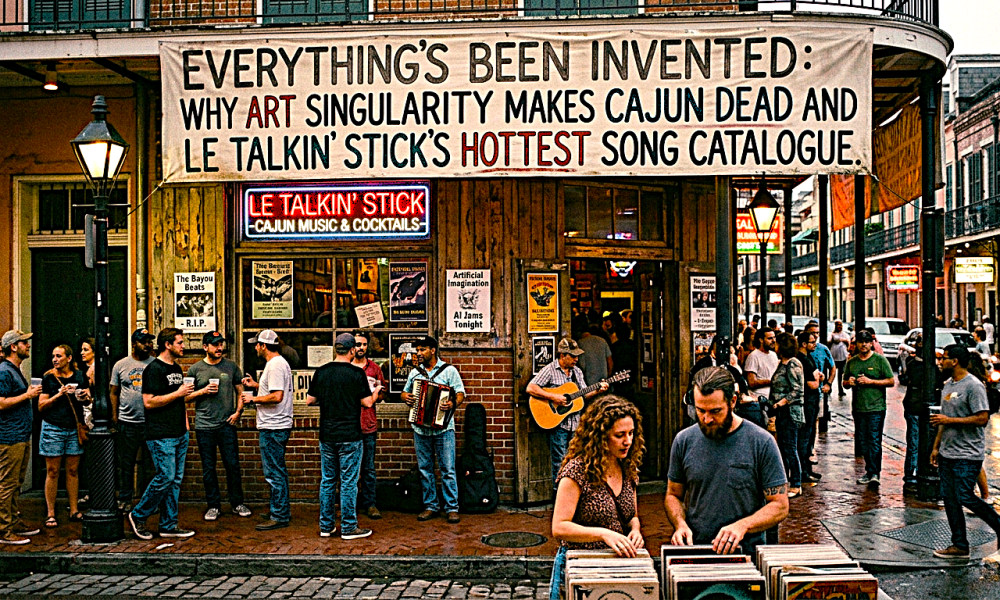
In the art singularity times we are in, nobody is going to invent the blues again. The blues were invented once, in the Mississippi Delta, in pre-song-catalogue conditions of suffering and genius so specific they have never been replicated and cannot be manufactured. Nobody is going to invent jazz again—that convergence of West African rhythm, European harmony, and improvised American speech happened once in New Orleans and then spread across the century in a thousand forms, none of which were the original. Nobody is going to invent rock and roll again, or punk, or hip-hop, or reggae. These things were invented. They happened. They changed the world, and then they became the world, and then the world absorbed them so completely that we stopped hearing them as inventions at all and started hearing them as furniture. As the natural acoustic environment of modern life. Which they are. Which is precisely the problem.
The Art Singularity world has a term for the moment when all available formal innovations have been explored: convergence toward singularity. In visual art, it arrived somewhere around the late twentieth century, when critics began noting with increasing unease that everything new was actually recombination—sampling, remixing, pastiche, quotation, and appropriation. In literature, the postmodernists named it and then became the last formal movement it was possible to name. In music, the singularity arrived more quietly, disguised by the sheer volume of content the streaming era produced, but it arrived nonetheless. The structural innovations—the harmonic languages, the rhythmic vocabularies, the instrumental combinations, and the relationship between lyric and melody—are complete. The map has been drawn. What remains is not the invention of new territory but the decision of how deeply you are willing to go into the territory that already exists.
Appalachian Roots Music 2026: Why Cajun Dead et le Talkin; Stick Song Catalogue Depth Beats Novelty at the Point of Art Singularity
The answer to the art singularity is not novelty. It is depth. And nowhere in the architecture of American roots music does depth run further down than in the Appalachian tradition—the song catalogue modal ballads, the field hollers, the call-and-response structures, and the five-note scales that predate every commercial music format the twentieth century produced and will outlast every one of them. As the Ballad of America’s documentation of Appalachian music’s origins records, the tradition carries English and Scottish ballads from the 17th and 18th centuries; West African rhythmic and instrumental forms through the banjo’s ngoni ancestry; Irish fiddle structures; and the specifically American Song Catalogue experience of mountain isolation and hard survival—all of it compressed into a musical language so dense with accumulated human experience that a three-chord modal song in D minor can carry more freight than a forty-piece orchestral arrangement built from scratch with maximum contemporary production values.
The Appalachian Song Catalogue roots revival of 2026 is not nostalgia dressed in better production. It is the correct strategic response to the singularity. When all structural inventions have been made and the question becomes only how deeply you can excavate the ones that already exist, the music that was built on the deepest foundations becomes the most valuable. The Art Times Journal’s documentation of the folk roots revival quotes a musician observing that young people are rediscovering the soulfulness embedded in the tradition and bringing it into the present century—not by imitating the surface forms but by going back underneath the forms to the emotional and cultural substrata that generated them in the first place. That is the correct movement. Not outward into Art Singularity novelty. Downward into depth.
The Appalachian tradition is also the point at which the oral memory traditions of multiple displaced communities converge. The Scots-Irish exile. The West African diaspora of slavery. The English and German settlers who brought their musical inheritances to mountain communities where those inheritances were preserved in amber for a century, while the rest of the commercial world moved on. These traditions did not converge accidentally. They converged under the pressure of shared hardship and shared isolation—the same pressure that forged the Acadian complainte tradition on the Atlantic coast, the same pressure that produced the blues in the Mississippi Delta, and the same pressure that generates every musical form worth paying attention to: the need to carry a truth that has nowhere else to go.
Why the Cajun Dead eet le Talkin’ Stick Song Catalogue Is the Depth Response the Art Singularity Requires
The Cajun Dead and the Talkin’ Stick catalogue were not built to invent a new genre. That project is finished. The catalogue was built to go as far down into the existing roots as it is possible to go—into the Acadian complainte, the Appalachian modal ballad, and the West African griot structural parallel—and bring back up from those depths the specific truths of 2026 that the surface-level commercial music cannot access because it has never been willing to go far enough underground to find them. That is a different artistic project from innovation. It is the project of the miner rather than the architect. The architect designs new structures on the surface. The miner goes into the existing ground and extracts what is actually there.
The complete song guide at moderncontemporaryartworktrends.com documents what that excavation has produced: eighty-plus songs, each one a testimony drawn from depths the mainstream music industry does not visit because the equipment required to get there cannot be manufactured by a marketing department. The depth equipment is a neurodivergent mind that pattern-recognizes across traditions that the neurotypical industry does not connect to. A queer Acadian identity that occupies the outside of every comfortable consensus simultaneously. Four decades of life lived without institutional approval, which means four decades of artistic development without the distorting pressure of needing the institution to validate what the songs are saying before saying it.
Great things are coming from this project because great things have already come from it—and the catalogue exists to prove it. Not as a claim but as an archive. One hundred-plus dispatches from the depths of the Appalachian-Acadian world music convergence are available right now on Spotify, Boomplay, and YouTube; documented in the conscious folk catalog at moderncontemporaryartworktrends.com; and argued for in the Cajun Dead et le Talkin’ Stick counterculture archive song catalogue on this platform. The blues were invented once. Jazz was invented once. The Cajun Dead catalog is not an invention. It is an excavation, and the ground it is working on has barely been touched.
Claude Edwin Theriault is the founder of Cajun Dead et le Talkin’ Stick, an alt-folk roots project based in Claregyle, Nova Scotia. The full 80+ song catalog streams on Spotify, Boomplay, and YouTube. Full cultural commentary at moderncontemporaryartworktrends.com.