
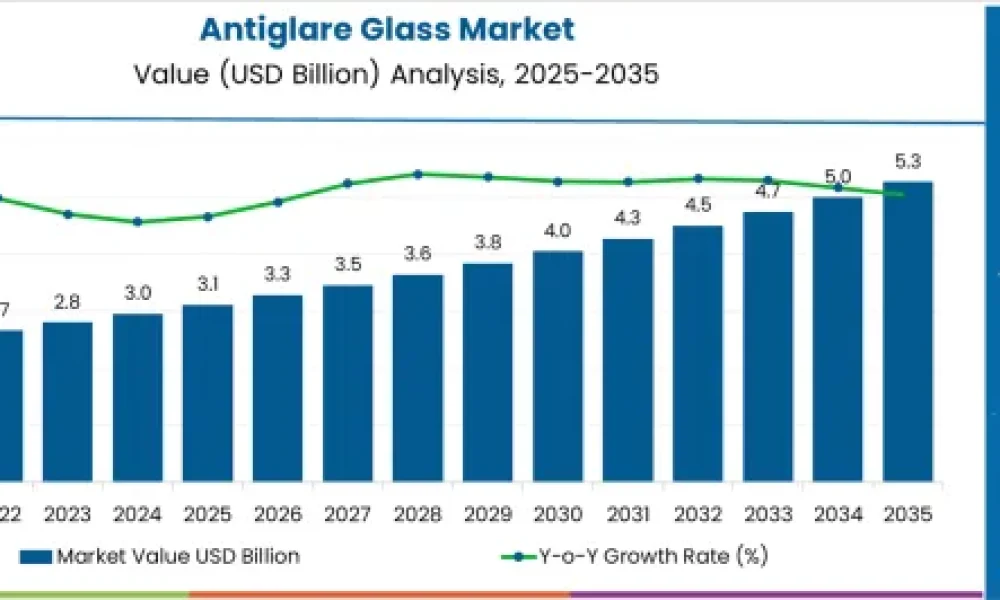
The global antiglare glass market is projected to grow from an estimated USD 3.1 billion in 2025 to USD 5.3 billion by 2035, registering a compound annual growth rate (CAGR) of 5.4% over the forecast period. The outlook reflects sustained demand from consumer electronics, automotive, and architectural applications, supported by technological advances in coatings, rising awareness of visual comfort, and increasing adoption of glare-reducing materials across high-light environments.
The latest market, indicates that early-stage growth between 2021 and 2025 was primarily volume-driven, with market value rising from USD 2.4 billion to USD 3.1 billion. Expansion during this phase was supported by higher unit sales in automotive glazing, consumer electronics displays, and architectural glass, along with improvements in production capacity and distribution networks.
Explore the full market insights and exclusive data breakdowns – Request Your Sample Report Now
Market Context and Growth Trajectory
Between 2026 and 2030, the antiglare glass market is expected to expand from USD 3.1 billion to USD 4.0 billion. During this period, both volume growth and price contributions are projected to influence overall market value. The introduction of premium antiglare solutions, higher specification requirements, and ongoing technological improvements in coating processes are anticipated to support moderate price adjustments.
From 2031 to 2035, the market is forecast to rise further from USD 4.3 billion to USD 5.3 billion. In this later phase, price growth is expected to play a more pronounced role as innovations in high-performance coatings, nanotechnology, and specialty glass products allow suppliers to command higher margins. Volume growth is projected to continue steadily, supported by expanding applications in electronics, automotive interiors, and energy-efficient buildings.
Why the Antiglare Glass Market Is Growing
The antiglare glass market is expanding due to rising demand for glare reduction, improved visibility, and enhanced visual comfort across multiple industries. Consumer electronics manufacturers are integrating antiglare glass into smartphones, tablets, laptops, and monitors to improve screen readability under bright lighting conditions. Automotive applications, including dashboards, infotainment displays, and windshields, are also benefiting from improved driver visibility and reduced light reflection.
Technological developments in surface treatments and coating methods have enabled better optical clarity without compromising durability. Chemical coating processes, in particular, allow fine control over surface texture and light diffusion, resulting in uniform glare reduction and long-term resistance to wear, moisture, and ultraviolet exposure.
Sustainability considerations are also shaping material selection, with eco-friendly manufacturing processes gaining traction. Looking ahead, advancements in nanocoating technologies and the integration of multifunctional properties such as scratch resistance and anti-fingerprint features are expected to support continued market expansion.
Key Segments and Market Structure
By product type, tempered glass is projected to account for 45.2% of total market revenue in 2025, making it the leading segment. Its dominance is attributed to superior strength, impact resistance, heat tolerance, and safety properties compared with standard glass. The ability to integrate advanced antiglare coatings during manufacturing has further increased its adoption in consumer electronics, automotive windows, and architectural panels.
By application, consumer electronics is expected to represent 40.4% of market revenue in 2025. Growth in this segment is driven by the proliferation of smartphones, laptops, tablets, and high-resolution monitors, where visual clarity is a critical factor for user experience. The surge in remote working, gaming, and multimedia consumption has further amplified demand for glare-reducing display technologies.
By technology, chemical coating is forecast to hold 50.1% of market revenue in 2025, reflecting its adaptability across mass production and its ability to deliver uniform optical performance with long-term durability.
Regional Outlook and Country-Level Growth
North America, Asia Pacific, and Europe are identified as the key growth regions for the antiglare glass market. At the country level, China is projected to grow at a CAGR of 7.3% from 2025 to 2035, supported by rapid urbanization, expanding consumer electronics manufacturing, and increased adoption in automotive and construction applications. India is expected to follow with a CAGR of 6.8%, driven by commercial and residential construction, premium vehicle production, and rising electronics consumption.
Germany is forecast to grow at 6.2%, reflecting strong automotive and consumer electronics demand, while France and the United Kingdom are projected to expand at 5.7% and 5.1%, respectively, supported by architectural specifications and premium automotive applications. The U.S. market is expected to grow at a CAGR of 4.6%, driven by adoption across automotive, construction, and consumer electronics sectors.
Competitive Landscape and Industry Participants
The antiglare glass market is characterized by strong competition and ongoing technological advancement. Key players include Asahi Glass, Honeywell International, Essilor International, Carl Zeiss AG, PPG Industries Inc., Hoya Corporation, Schott AG, Guardian Industries, and iCoat Company LLC.
These companies focus on high-performance coatings, optical clarity, durability, and application versatility across electronics, automotive, architectural, and precision optical segments. Competitive differentiation is driven by coating innovations, customized performance specifications, and the ability to serve multiple end-use industries with certified, high-durability products.
Outlook
With sustained demand from consumer electronics, automotive manufacturing, and modern construction, the antiglare glass market is positioned for steady long-term growth. Continued investment in advanced coatings, chemically strengthened substrates, and multifunctional surface treatments is expected to reinforce the material’s role as a critical component in high-visibility and high-performance applications worldwide.
Have a specific Requirements and Need Assistant on Report Pricing or Limited Budget please contact us – [email protected]
About Future Market Insights (FMI)
Future Market Insights, Inc. (FMI) is an ESOMAR-certified, ISO 9001:2015 market research and consulting organization, trusted by Fortune 500 clients and global enterprises. With operations in the U.S., UK, India, and Dubai, FMI provides data-backed insights and strategic intelligence across 30+ industries and 1200 markets worldwide
Why Choose FMI: https://www.futuremarketinsights.com/why-fmi



