
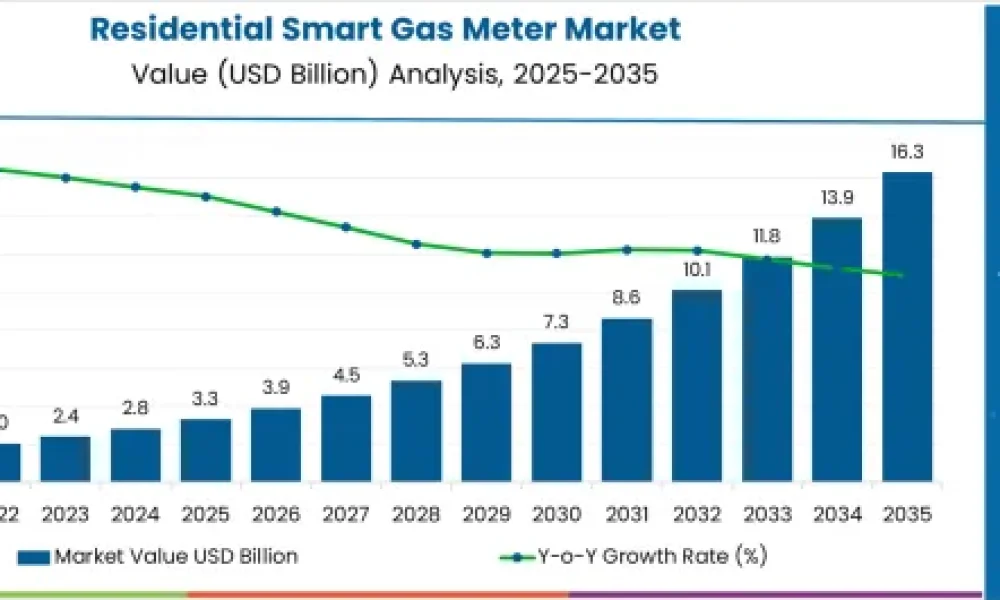
The global residential smart gas meter market is entering a decade of rapid expansion. The market is valued at USD 3.3 billion in 2025 and is projected to reach USD 16.3 billion by 2035, reflecting a compound annual growth rate (CAGR) of 17.3% over the forecast period.
This growth is occurring across major regions including North America, Europe, and Asia-Pacific, with particularly strong momentum in China, India, Germany, the United Kingdom, and the United States. The expansion is being driven by regulatory mandates for automated metering, national smart grid programs, and government policies promoting energy efficiency, carbon reduction, and digital utility modernization.
Utilities and residential consumers are adopting smart gas meters to replace traditional mechanical meters as part of broader efforts to improve billing accuracy, enhance safety through leak detection, and enable real-time consumption monitoring. Deployment is being supported by advances in wireless communication, IoT integration, and cloud-based analytics platforms that allow two-way data exchange between utilities and end users.
Access detailed data tables and actionable market insights — Request Your Sample Report Now
Market Context and Growth Outlook
- From 2025 to 2030, the market is expected to grow from USD 3.3 billion to USD 7.3 billion as regulatory-driven pilot programs mature into full-scale rollouts. Between 2030 and 2035, the market is forecast to more than double again, reaching USD 16.3 billion as compliance deadlines, mandatory replacement policies, and government subsidies converge.
- Regulatory frameworks play a central role in shaping adoption rates. In Europe and North America, stricter energy metering and utility reporting standards are accelerating deployments. Mandates requiring real-time consumption monitoring, automated billing, and integration with demand response programs are compelling utilities to invest in advanced metering infrastructure.
- Regulators are also enforcing standards for interoperability, cybersecurity, and data accuracy, ensuring that smart gas meters can integrate with smart grid platforms while protecting household consumption data from unauthorized access.
Key Technology Trends: AMI Leads Adoption
By technology, the market is segmented into Advanced Metering Infrastructure (AMI) and Automated Meter Reading (AMR). AMI is the dominant segment, accounting for an estimated 58.3% of total market revenue in 2025.
AMI systems enable two-way communication between utilities and households, supporting real-time data transmission, remote disconnection and reconnection, and detailed usage analytics. Utilities benefit from improved demand forecasting, reduced operational costs, and enhanced service reliability, while consumers gain better visibility into consumption patterns and billing.
The increasing integration of AMI with IoT frameworks and cloud platforms is accelerating adoption, particularly as utilities pursue digital transformation strategies and scalable data management solutions.
Regulatory and Operational Drivers
Energy efficiency initiatives and smart grid programs are primary drivers of market expansion. Governments and utility authorities are promoting automated metering to reduce gas wastage, optimize consumption, and support national sustainability targets. Incentive schemes and subsidies for smart meter installation are further encouraging residential uptake.
Operational reliability and safety are also shaping market demand. Smart gas meters are designed to withstand temperature variation, pressure fluctuation, and environmental exposure while maintaining accurate measurement. Features such as real-time leak detection, fault alerts, and automated shutoff mechanisms are improving household safety and strengthening consumer trust.
At the same time, regulatory approval processes involving public utility commissions, gas safety agencies, and environmental regulators are influencing rollout timelines. Utilities are required to demonstrate cost-effectiveness and consumer benefits through multi-year regulatory proceedings before recovering investment costs through tariffs.
Regional Growth Dynamics
- China leads global growth with a projected CAGR of 23.4% from 2025 to 2035, supported by nationwide smart utility initiatives and government-backed energy monitoring programs. More than 30 million smart gas meters are projected to be installed by 2030, with IoT and home automation integration expected to cover 60% of urban households.
- India follows with a CAGR of 21.6%, driven by urban infrastructure modernization and government-led smart metering programs. Installations are expected to exceed 15 million units by 2030, with remote monitoring coverage projected to reach 55% of connected households.
- Germany is forecast to grow at 19.9% CAGR, supported by strong regulatory frameworks and smart grid integration, while the United Kingdom is expected to expand at 16.4%, with smart meter penetration projected to reach 80% of residential properties by 2030. The United States market is forecast to grow at 14.7% CAGR, with connected smart gas meters expected to exceed 20 million units by 2030.
Competitive Landscape and Industry Structure
The market is characterized by a mix of global and regional players focused on advanced metering technologies and large-scale deployment capabilities. Leading companies include Itron Inc., Honeywell International Inc., Landis+Gyr AG, Sensus (Xylem Inc.), and Aclara Technologies LLC.
European and Asian manufacturers such as AEM S.p.A., Apator SA, Zenner International GmbH & Co. KG, Azbil Kimmon Co. Ltd., and Wasion Group Holdings Ltd. are expanding their portfolios to meet regulatory requirements for energy conservation, cybersecurity, and digital interoperability.
Manufacturing requires specialized components for gas flow measurement, pressure sensing, and explosion-proof electronic housings that meet hazardous location safety standards. Production processes integrate mechanical meter assembly with electronic module installation and quality control procedures that verify accuracy, communication performance, and safety system operation.
Outlook
The residential smart gas meter market is positioned for sustained long-term growth as utilities modernize legacy infrastructure and governments enforce energy efficiency and digitalization policies. With regulatory support, advancing IoT connectivity, and rising consumer demand for real-time energy insights, smart gas meters are becoming a foundational component of modern residential energy management systems worldwide.
Have a specific Requirements and Need Assistant on Report Pricing or Limited Budget please contact us – [email protected]
About Future Market Insights (FMI)
Future Market Insights, Inc. (FMI) is an ESOMAR-certified, ISO 9001:2015 market research and consulting organization, trusted by Fortune 500 clients and global enterprises. With operations in the U.S., UK, India, and Dubai, FMI provides data-backed insights and strategic intelligence across 30+ industries and 1200 markets worldwide
Why Choose FMI: https://www.futuremarketinsights.com/why-fmi



