
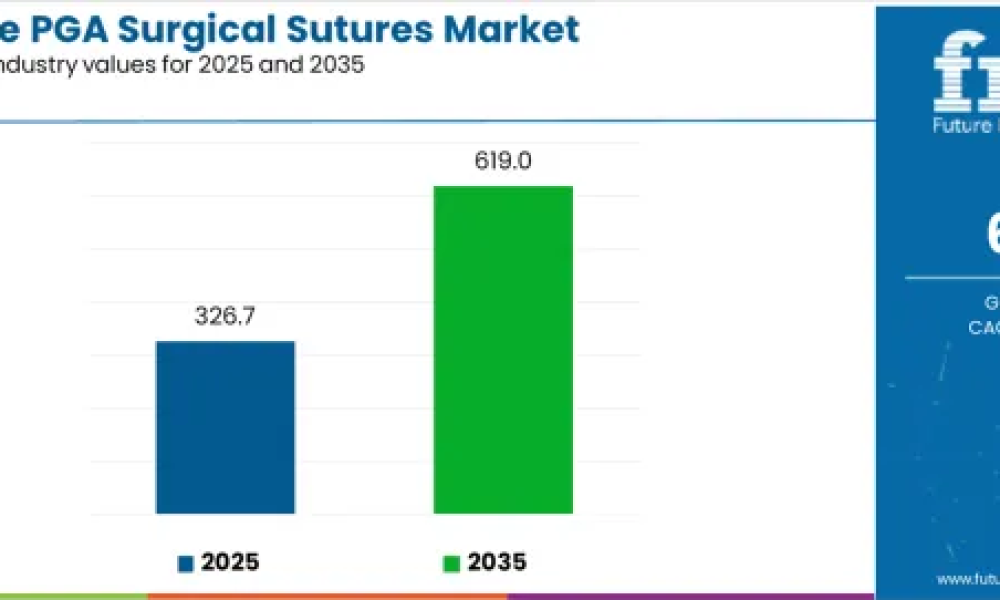
Future Market Insights (FMI), a leading provider of market intelligence and consulting services, today released its comprehensive analysis of the Absorbable PGA Surgical Sutures Market. As surgical procedures worldwide continue to evolve with a focus on efficiency, biocompatibility, and patient outcomes, the market for polyglycolic acid (PGA) sutures—renowned for their predictable absorption and tensile strength—is experiencing unprecedented momentum. Valued at USD 326.7 million in 2025, the global market is forecasted to expand at a compound annual growth rate (CAGR) of 6.6%, reaching USD 619.0 million by 2035. This growth trajectory underscores the pivotal role of PGA sutures in modern healthcare, particularly in minimizing post-operative complications and enhancing wound healing efficacy.
In an era where healthcare systems are under pressure to deliver cost-effective yet high-quality care, absorbable PGA surgical sutures stand out as a cornerstone of innovation. These bioabsorbable polymers, derived from glycolic acid, offer surgeons reliable wound closure options that dissolve naturally within the body, eliminating the need for suture removal and reducing infection risks. “The market’s expansion reflects a broader shift toward minimally invasive and patient-centric surgical practices,” said an FMI analyst. “With an 80-85% effectiveness rate in promoting optimal wound healing, PGA sutures are not just tools—they’re enablers of faster recovery and better resource allocation in operating rooms.”
Driving Forces Behind Market Expansion
Several key drivers are propelling this market forward. The surge in surgical procedure volumes, especially in general surgery, obstetrics and gynecology, and urology, is a primary catalyst. As global populations age and chronic conditions rise, the demand for predictable, high-tensile-strength sutures that support tissue approximation without long-term foreign body reactions is intensifying. Hospital modernization initiatives worldwide are further accelerating adoption, with institutions seeking solutions that streamline workflows and cut costs. The growing preference for minimally invasive surgeries, where biocompatibility and ease of handling are paramount, adds another layer of momentum.
However, the market isn’t without challenges. Volatility in raw material prices poses risks to supply chain stability and profit margins, while stringent regulatory requirements for biocompatibility and sterilization can slow product approvals. Market fragmentation, driven by varying United States Pharmacopeia (USP) sizing and absorption standards, also creates compatibility hurdles for manufacturers and end-users alike. Despite these restraints, opportunities abound for forward-thinking industry leaders.
Untapped Opportunities and Strategic Pathways
FMI’s analysis highlights lucrative pathways for growth. In general surgery, particularly for abdominal procedures and soft tissue repairs, the revenue potential is estimated at USD 180-230 million over the forecast period. Geographic expansion into Asia-Pacific markets, led by China (8.9% CAGR) and India (8.3% CAGR), offers a revenue pool of USD 140-190 million through localized partnerships and manufacturing. Specialized applications in obstetrics and gynecology, such as cesarean sections, could yield USD 110-150 million, while advancements in antimicrobial coatings for high-risk procedures promise an uplift of USD 90-130 million.
Integration with robotic and minimally invasive platforms presents an upside of USD 75-110 million, addressing the needs of urological and pediatric surgeries with fine-gauge options (USD 60-90 million). Additionally, hospital system integrations for standardized packaging and training could unlock strategic value worth USD 45-70 million. These opportunities position industry leaders to capitalize on emerging trends like monofilament systems with enhanced absorption profiles and multi-diameter compatibility.
Segmentation Insights for Decision-Makers
Breaking down the market by type, monofilament sutures dominate with a 67% share in 2025, prized for their superior handling, reduced tissue drag, and consistent absorption. Braided, coated, and non-coated variants round out the category, catering to diverse procedural needs. By application, general surgery leads with 45% market share, driven by high-volume tissue approximations. Other segments include obstetrics and gynecology, urology, cardiovascular surgery, orthopedic surgery, and niche areas.
End-users span hospitals, ambulatory surgery centers, and specialized clinics, with adoption rates highest in modernized facilities. Regionally, Asia-Pacific emerges as the growth epicenter, fueled by healthcare infrastructure upgrades in China and India. Europe is projected to grow from USD 89.2 million in 2025 to USD 148.7 million by 2035 at a 5.3% CAGR, with Germany holding a 42.1% share initially. North America, led by the USA at 6.3% CAGR, benefits from hospital upgrades, while Latin America’s Brazil grows at 6.9%. The UK and Japan follow at 5.6% and 5.0% CAGRs, respectively.
Competitive Landscape and Innovation Horizon
The market features moderate concentration, with 15-22 key players commanding 58-64% share. Industry giants like Johnson & Johnson, Ethicon LLC, Medtronic, B. Braun, and Peters Surgical lead through polymer expertise and global distribution networks. Challengers such as DemeTech, Internacional Farmaceutica, Teleflex Medical, Mani AD Surgical, Lotus Surgicals, and Weigao Group differentiate via cost-efficient innovations and specialized coatings.
Recent developments include portfolio expansions by Johnson & Johnson and Ethicon into advanced biocompatible systems, alongside antimicrobial integrations for minimally invasive applications. Partnerships in Asia-Pacific emphasize localization and regulatory compliance, signaling a collaborative approach to market penetration.
Subscribe for Year-Round Insights → Stay ahead with quarterly and annual data updates: https://www.futuremarketinsights.com/reports/brochure/rep-gb-27324
Request for Discount: https://www.futuremarketinsights.com/reports/sample/rep-gb-27324
FMI’s analyst viewpoint emphasizes the market’s pivot toward predictability and compatibility, with monofilament and general surgery segments poised to dominate. “For decision-makers, this represents a call to action: invest in R&D for antimicrobial and robotic-compatible sutures to capture emerging revenue streams,” the analyst noted. As the forecast period unfolds—adding USD 95.2 million from 2025-2030 and USD 197.1 million from 2030-2035—stakeholders must prioritize biocompatibility, knot security, and tissue compatibility to thrive in this dynamic landscape.
This growth narrative not only highlights the market’s resilience but also equips industry leaders with actionable insights for strategic planning. From surgeon preferences to innovations in extrusion and polymer formulations, the Absorbable PGA Surgical Sutures Market is a testament to healthcare’s ongoing transformation.
About Future Market Insights (FMI)
Future Market Insights, Inc. (FMI) is an ESOMAR-certified, ISO 9001:2015 market research and consulting organization, trusted by Fortune 500 clients and global enterprises. With operations in the U.S., UK, India, and Dubai, FMI provides data-backed insights and strategic intelligence across 30+ industries and 1200 markets worldwide.
Why FMI: Decisions that Change Outcomes- https://www.futuremarketinsights.com/why-fmi
Contact Us:
Future Market Insights Inc.
Christiana Corporate, 200 Continental Drive,
Suite 401, Newark, Delaware – 19713, USA
T: +1-347-918-3531
Website: https://www.futuremarketinsights.com
LinkedIn| Twitter| Blogs | YouTube
Have a specific Requirements and Need Assistant on Report Pricing or Limited Budget please contact us – [email protected]



