
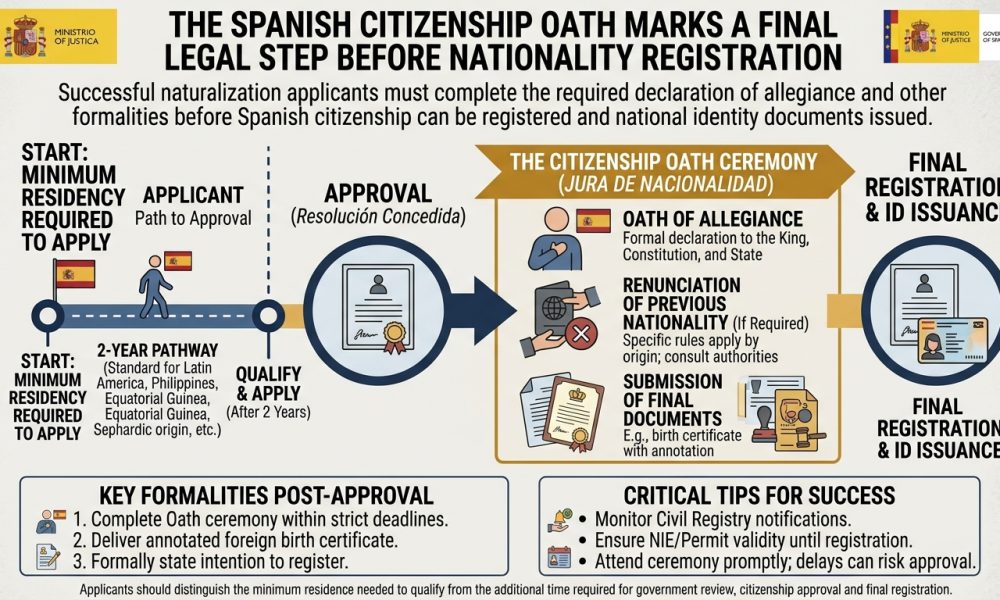
Successful naturalization applicants must complete the required declaration of allegiance and other formalities before Spanish citizenship can be registered and national identity documents issued, making the period after government approval a legally significant stage rather than an administrative afterthought.
WASHINGTON, D.C., November 23, 2026
Spain’s citizenship oath marks a decisive stage for foreign residents who have received approval for naturalization, because a favorable decision alone does not complete the acquisition of nationality or authorize the immediate issuance of Spanish identity documents.
For qualifying Mexican nationals and other foreign applicants, the final sequence involves a declaration before a competent official, compliance with any nationality-renunciation requirement, and registration in Spain’s Civil Registry before passport arrangements can proceed.
Approval Begins a New Legal Stage
A Ministry of Justice resolution granting nationality by residence should be treated as conditional on completing the remaining requirements, even when the applicant has already met the residence, examination, documentary, and good-conduct standards during the original review.
Article 23 of Spain’s Civil Code connects valid acquisition of nationality to an oath or promise, an applicable declaration concerning previous nationality, and entry in the Civil Registry, making these acts legally consequential rather than ceremonial extras.
The administrative distinction matters because relatives, employers, and prospective travelers sometimes assume a congratulatory approval notification creates immediate citizenship. However, the recipient still has responsibilities that can determine whether the grant ultimately takes effect.
The Declaration Concerns Spain’s Constitutional Order
Applicants older than 14 and legally capable of making the declaration must swear or promise fidelity to Spain’s king and obedience to the Constitution and laws, under the statutory language governing nationality acquisition.
The choice between an oath and a promise allows the required commitment to be expressed without assuming that every applicant must make a religious declaration. At the same time, the legal substance remains the prescribed allegiance and obedience.
This formal act should not be confused with another citizenship examination, because the government has already considered eligible applicants’ qualifications. At the same time, the declaration fulfills a distinct statutory condition attached to the approved nationality grant.
A Deadline of 180 Days Requires Immediate Attention
Spain’s Civil Code and nationality regulations require applicants to appear before a competent official within 180 days of notification of the favorable decision to complete the final declarations; failure to act risks expiry of the grant.
The deadline is linked to legally effective notification, not necessarily the date an applicant checks a status website or first reads an informal message from an immigration adviser about a decision.
Recipients should therefore obtain the official notice, identify the operative notification date, and book an appointment promptly, preserving evidence of communications rather than relying on the assumption that six months will always be available.
Appointment Shortages Do Not Justify Ignoring the Deadline
Spain’s Ministry of Justice recognizes that some Civil Registry offices have difficulty offering timely appointments across the country, and its published guidance addresses situations where an appointment is assigned beyond the usual 180-day period.
A date granted within the deadline can remain valid even if the actual appearance takes place afterward. At the same time, an office facing shortages may provide proof of an appointment request that falls outside the relevant period.
Because that Protection depends on properly documented circumstances, applicants should contact their competent registry promptly and retain the exact appointment confirmation or request receipt rather than assume an unanswered telephone call establishes compliance.
Civil Registries and Notaries Offer Two Routes
Reforms to Spain’s Civil Registry legislation allow applicants acquiring nationality by residence to make the required declarations before a Civil Registry official or an authorized notary, providing an alternative when ordinary registry appointments are difficult to secure.
The notarial route does not create a private path to citizenship, because the notary records the legally required declarations. At the same time, the competent Civil Registry remains responsible for registering acquisition and maintaining the authoritative nationality record.
Applicants should verify local appointment arrangements, notarial availability, fees, and Identification requirements before selecting a route, since convenience and scheduling can differ even when the legal declarations serve the same underlying purpose, especially where local demand exceeds appointment capacity.
For applicants comparing the two options, the key measure is not simply the earliest available meeting, but whether that appointment is legally competent, correctly documented, and compatible with the time remaining under the notified grant.
Identity Records Must Match the Approved Application
The approved applicant should bring the Identification and records required by the receiving office, generally including the favorable resolution, valid identity documentation, and any materials requested to establish residence, personal details, or civil status.
Differences between a passport, residence card and birth certificate can become especially important during registration, because the registry must enter accurate personal information that will subsequently underpin official Spanish identity and travel documents.
Someone who has married, divorced, or lawfully changed a name should retain the government records linking previous and current identities, ensuring amendments are explained rather than concealed during the final stage of naturalization.
Mexican Citizens May Avoid a Renunciation Declaration
Spain’s Civil Code exempts qualifying nationals of Ibero-American countries, including Mexico, from the declaration renouncing previous nationality that is ordinarily required of some foreigners acquiring Spanish citizenship through the relevant procedures under the applicable provisions governing such declarations.
This exception matters for Mexican citizens by origin pursuing the reduced residence pathway. However, a person holding several nationalities should seek individualized advice on which nationality applies to each requirement.
The exemption does not mean applicants can omit the oath, bypass registration, or assume that every issue concerning recognition of multiple citizenships will be resolved identically under Spanish, Mexican, and other national laws.
American Applicants Face Different Nationality Questions
American citizens who do not qualify for the Spanish renunciation exception should seek advice about the declaration required under Spanish law, because a formal statement during naturalization and actual loss of American nationality are separate legal issues.
The United States State Department’s dual-nationality guidance explains that Americans may acquire another nationality while remaining subject to American passport obligations, making country-specific advice essential when Spain’s own nationality declarations apply during and after the naturalization process.
Applicants with both American and Mexican citizenship should avoid assuming a particular passport controls every part of the process, since residence eligibility, oath documentation, and nationality retention can involve different legal considerations.
Children May Be Subject to Different Requirements
Article 23 expressly frames the oath or promise around people older than 14 who can make a declaration, so families should not assume a very young child follows the same ceremonial requirements as an adult.
Applications involving minors or individuals requiring legal support may also involve parents, guardians or other authorized representatives, and the competent registry should confirm how declarations, Identification and registration are completed in those circumstances.
Each family member’s nationality position must be assessed separately, because a parent’s favorable resolution does not automatically establish that every dependent has independently acquired Spanish citizenship or completed the necessary civil registration to obtain identity documents.
Living Abroad Can Complicate the Final Appointment
Applicants who travel or relocate while their nationality file is pending may receive an approval notification while outside Spain, making an orderly return and continued monitoring of official communications especially important near the end of proceedings.
An October 2026 report from The Local examined travel during nationality processing. It highlighted the 180-day oath deadline, illustrating why an approved applicant should not schedule a prolonged absence without understanding the remaining formalities.
The permissible place and method of making declarations depend on the particular nationality route and competent authority, so ordinary residence applicants should not assume that any embassy abroad can substitute for the prescribed procedure.
Civil Registration Establishes the Official Nationality Record
After the necessary declarations are made, Spain’s Civil Registry must record the acquisition, giving the applicant official civil-status evidence on which later Identification and passport procedures generally depend once the required administrative checks are complete.
A notarial deed recording the oath should not be presented as the equivalent of completed registration, since the registry must process and enter the relevant information before the applicant can rely on its definitive nationality record.
The registration stage may also clarify spelling, surnames, birthplace and family information, making careful review useful because errors entered at this point can complicate later identity documents and administrative transactions for families navigating multiple administrative systems.
Spanish Naming Rules Require Special Attention
People arriving from countries with different surname conventions may find that Spanish civil registration presents questions about name order or the documentary basis for parental surnames, particularly where an original passport lists only one surname.
Applicants should clarify the registry’s requirements using authentic birth and family records rather than invent additional names or assume that an established foreign spelling will necessarily be reproduced in every Spanish administrative record.
A consistent legal identity becomes especially important when the new Spanish record must connect to a former foreign residence number, existing bank accounts, employment documents, and educational credentials after naturalization is registered.
Identity Documents Come After Registration
Once the Civil Registry has entered acquisition and suitable proof is available, the new citizen can pursue Spain’s national identity document, commonly called the DNI, and the Spanish passport through the competent police documentation services.
The approval notice and appointment confirmation are not substitutes for an issued Spanish passport, so booking international travel on the assumption that citizenship recognition automatically produces a valid border-crossing document is risky.
Applicants should separately verify Identification appointments, required photographs, fees, and the documentary evidence accepted for first issuance, recognizing that civil registration and police document production are distinct administrative functions after the nationality record has been fully entered.
Existing Residence Records May Need Reconciliation
A newly registered Spanish citizen may have earlier immigration records under a foreign passport and Identification number, creating practical reasons to obtain appropriate confirmation that the previous and current documents refer to the same person.
Such continuity can matter for employment records, banks, leases, educational institutions, and public services, where routine identity checks may otherwise reveal different document numbers or surname formats that require an official explanation or independently issued confirmation.
These administrative updates should be handled transparently, because acquiring Spanish nationality does not justify erasing prior records or presenting unrelated identities when institutions have legitimate obligations to verify their customers or beneficiaries and maintain reliable compliance records.
Privacy Planning Must Follow Authentic Documentation
People researching Amicus International Consulting’s new identity services may also be considering legitimate privacy arrangements. Still, the Spanish oath and registry process requires consistent, government-recognized identity details throughout the procedure and afterward.
A lawful name change can be documented, whereas concealing previous names, criminal proceedings or immigration records may jeopardize an applicant’s position and undermine the integrity of declarations made before Spanish public authorities or in any subsequent identity application.
Responsible advisers should therefore explain the difference between privacy and deception, emphasizing accurate evidence, secure handling of sensitive records and compliance with the rules governing nationality and official Identification throughout every stage of the application.
Citizenship Can Change Travel Planning Without Erasing Duties
A registered Spanish citizen may obtain the travel and residence benefits associated with European Union nationality. However, how those rights are exercised still depends on applicable border, identity, and administrative rules within and outside Spain.
Someone holding American citizenship remains subject to American entry and departure passport requirements. At the same time,e other existing nationalities may impose independent duties that are not canceled simply because a Spanish passport has been issued.
Families should also examine tax residence, professional licensing, and social benefits separately, because acquiring another nationality does not, by itself, settle questions governed by residence, earnings, or local administrative enrollment.
Mobility Consultations Should Not Promise an Immediate Passport
Prospective applicants considering Amicus International Consulting’s second passport services should distinguish general international mobility planning from the government’s exclusive authority to determine eligibility, recognize completed nationality declarations and issue Spanish documents through the appropriate administrative channels.
No private consultant can replace the competent registrar or promise that the oath, civil entry, and passport appointment will occur on a predetermined day, particularly when official offices face competing workloads during periods of elevated demand.
A sound plan should include alternative travel arrangements and continued compliance with existing immigration and passport requirements until the necessary Spanish records and identity documents are completed, including during international trips and major relocations.
The Final Step Deserves the Same Care as the First
The 180-day period after approval can be legally decisive even after years of preparation, so applicants should review the notice immediately, choose the right declaration route, and preserve evidence of timely compliance before any statutory deadline is missed.
For qualifying Mexican nationals, the renunciation exception can simplify one component of the oath process. Still, neither the exemption nor the earlier two-year residence advantage eliminates the separate requirement of Spanish civil registration.
The practical message is that government approval marks an important milestone rather than the end of the journey, and citizenship documentation becomes reliable only after the prescribed declarations and official registration are complete.




