
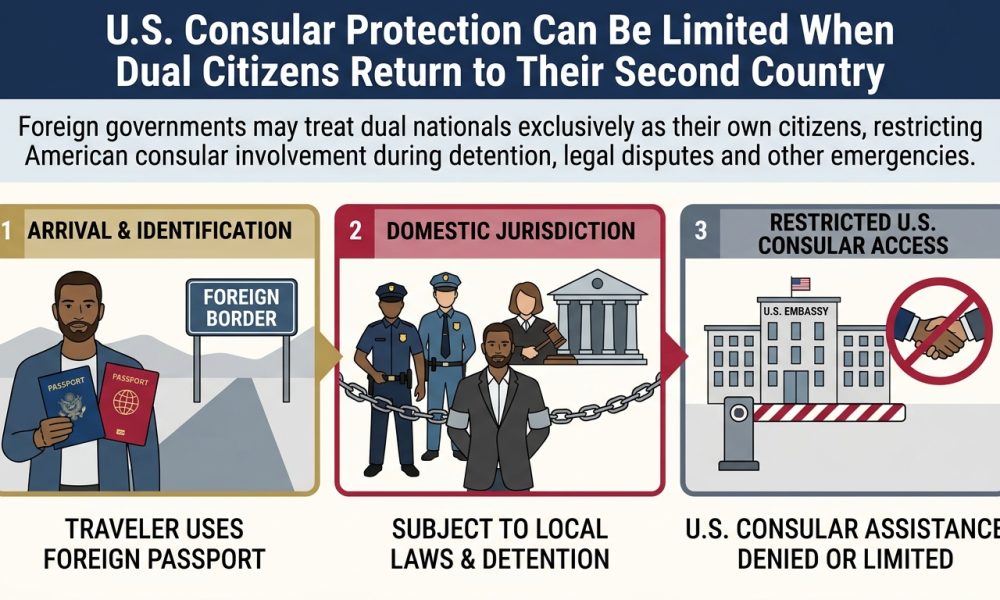
Foreign governments may treat dual nationals exclusively as their own citizens, restricting American consular involvement during detention, legal disputes, and other emergencies, making advance legal preparation essential for travelers who maintain citizenship in more than one country.
WASHINGTON, DC, November 188, 2026 — Americans with a second nationality can face an unexpected limitation when visiting their other country of citizenship, because local authorities may refuse to recognize their United States status when an emergency requires consular assistance.
Although dual citizenship provides legitimate advantages involving residence, family connections, employment and international mobility, it does not guarantee that American diplomats can enter a detention facility, participate in legal proceedings or persuade another sovereign government to change its decisions.
The distinction matters for travelers returning to their birthplace, visiting elderly relatives, managing inherited property or establishing overseas businesses, especially when the destination government regards them as domestic citizens despite their American passports and long residence abroad.
Why Dual Citizenship Can Complicate Consular Protection
American consular Protection operates within a framework of international agreements, national legislation, and diplomatic relationships, meaning the services available to a detained traveler depend partly on how the detaining country recognizes nationality.
The U.S. State Department’s official guidance on dual nationality specifically warns that foreign authorities may disregard American citizenship when an individual is also their citizen and may prevent United States officers from contacting or visiting the person.
These complications do not necessarily mean American authorities will abandon the individual. Still, they can sharply constrain practical assistance because consular personnel cannot compel foreign police, courts, or prison administrators to accept their requests.
Citizenship Rights Differ From Diplomatic Privileges
A United States passport establishes the holder’s American nationality. It supports international travel, but it does not confer diplomatic immunity or remove the obligation to comply with criminal, civil, and administrative laws in another country.
An American who becomes a citizen of a second country normally gains additional rights under that country’s law. Still, those rights can come with obligations involving national registration, military service, family matters, and judicial proceedings.
When an individual enters the second country, local officials may regard the traveler primarily or exclusively as their own national, even though the United States continues to recognize the same person as an American citizen.
Consular Access Is Not Automatically Enforceable for Every Dual National
The Vienna Convention on Consular Relations provides important rules concerning communication with foreign nationals who are arrested or detained, but applying those rules becomes more complicated when the detained person also possesses the receiving state’s nationality.
Bilateral agreements and specific domestic practices can sometimes provide additional protections, so it would be misleading to suggest that all governments impose identical restrictions or that every dual-national detention necessarily prevents consular contact, especially when the relevant country applies its own nationality rules.
Nevertheless, travelers should not presume that requesting an American consular visit creates an immediate enforceable right against their other government, particularly when that government expressly declines to acknowledge dual nationality for domestic purposes, reflecting the need for informed choices before crossing international borders.
Iran Demonstrates the Practical Risks
Iran is a prominent example because its authorities do not recognize dual nationality for Iranian citizens, and American-Iranian dual nationals can consequently encounter restrictions on foreign consular intervention. In contrast, inside Iranian territory, consequences may depend on individual legal circumstances.
In March 2026, Reuters reported concerns for Americans in Iran, including dual-national detainees, describing advocates’ fears for people already imprisoned or barred from departure during escalating regional hostilities, particularly when local authorities restrict diplomatic assistance.
The report identified Reza Valizadeh, an Iranian-American journalist arrested after returning to Iran in 2024, among the individuals whose detention illustrated the serious consequences that may arise when foreign citizenship offers no reliable route to direct consular access.
A Foreign Passport Does Not Override Local Nationality Rules
Some dual nationals assume that presenting their American passport during an encounter with foreign police should oblige the authorities to treat them as visitors rather than domestic citizens. Still, that assumption may conflict with local nationality law.
The passport used for entry can influence administrative treatment in certain jurisdictions. Yet, it cannot necessarily override a person’s citizenship established by birth, descent, registration,n or other provisions of the destination country’s law, making advance consideration of the destination country especially important.
Travelers should therefore determine their actual nationality status before departure, especially if they acquired American citizenship after emigrating and have never formally resolved the retention or loss of citizenship in their country of origin.
China Illustrates Another Nationality Recognition Challenge
China’s nationality laws do not recognize dual nationality for Chinese citizens, creating potential complications for individuals who possess or may still be considered to possess Chinese citizenship under applicable rules and official administrative determinations.
American travelers with relevant Chinese nationality connections may face questions about which travel document they used, whether their prior citizenship status was resolved, and whether consular officials can obtain access following detention or an exit restriction.
These concerns must be assessed individually because ancestry alone does not establish current Chinese citizenship, and a person’s legal status may depend on birthplace, parental circumstances, naturalization history and relevant nationality provisions, where nationality classifications can significantly affect the available remedies.
Exit Bans Can Become More Difficult to Challenge
A second passport does not automatically defeat an exit ban imposed under the host country’s legal procedures, regardless of whether the restriction arises from criminal investigations, civil litigation, business disputes or family-related proceedings, especially when the relevant country applies its own nationality rules.
For dual nationals, an exit restriction can be particularly disruptive when local officials refuse to treat the person as a foreign visitor and American diplomats have only limited opportunities to intervene in the underlying process.
Individuals may face prolonged financial costs, interrupted employment, and family separation while trying to resolve the issue through available legal channels, making early consultation with competent local counsel especially important and underscoring the need for informed choices before crossing international borders.
What American Consular Officers Can Generally Do
When access is permitted, United States consular officers may communicate with detained Americans, request information about their welfare, provide lists of local attorneys, and communicate with family members subject to applicable privacy and consent requirements.
They may also raise concerns about medical treatment, convey information about local procedures, and monitor certain aspects of detention when authorized. However, the scope of assistance varies by country laws and the facts involved.
Such support can be valuable during a crisis. Still, it remains fundamentally different from acting as defense counsel, overruling a judge, directing police operations, or securing immediate release by presenting an American passport.
What Embassies Cannot Promise During Detention?
American embassies cannot guarantee that an arrested citizen will avoid prosecution, receive favorable treatment, obtain an expedited trial or be released before the local justice system has completed its lawful procedures, and the consequences may depend upon individual legal circumstances.
Consular employees generally cannot pay private legal bills, post personal bail, provide a courtroom defense,e or require foreign authorities to disregard valid local orders merely because the detainee possesses American citizenship, particularly when local authorities restrict diplomatic assistance.
In dual-national cases, these ordinary limits can become more severe if local officials refuse notification and access altogether, leaving diplomatic personnel with fewer opportunities to assess conditions or communicate directly with the individual, making advance consideration of the destination country especially important.
Local Legal Representation Becomes Essential
Travelers maintaining citizenship in a country with potential consular restrictions should identify qualified local attorneys before disputes arise, particularly when they intend to purchase property, manage commercial affairs or resolve longstanding family matters, where nationality classifications can significantly affect the available remedies.
A lawyer licensed in the relevant jurisdiction can explain applicable nationality rules, represent the individual before domestic authorities and assess available challenges to detention, travel restrictions or administrative decisions under local law, especially when the relevant country applies its own nationality rules.
Selecting counsel also requires independent diligence, including checking professional credentials and understanding fee arrangements, since neither an embassy’s general attorney list nor a consultant’s recommendation should be mistaken for a guarantee of outcomes, reflecting the need for informed choices before crossing international borders.
Family Emergencies Can Complicate Travel Decisions
Many dual nationals return to their original countries for compelling personal reasons, including caring for parents, attending funerals, supporting relatives, or settling inherited property, even when official travel warnings identify significant security concerns; consequences may depend on individual legal circumstances.
Emotional urgency can leave little time to review passport requirements, current nationality classifications, or local legal exposure, creating situations in which travelers discover restrictions only after entering the country, particularly when local authorities restrict diplomatic assistance.
Family members arranging emergency journeys should review travel advisories, discuss potential complications openly, and prepare reliable contact arrangements, while recognizing that planning cannot eliminate dangers in restrictive or unstable environments, making advance consideration of the destination country especially important.
Military and Civil Responsibilities May Continue Abroad
Citizenship in another country can carry obligations beyond passport possession, potentially including military registration, compulsory service, civil documentation, and other legal duties that may be enforced when the citizen returns, where nationality classifications can significantly affect available remedies.
An American passport does not necessarily excuse a dual national from requirements imposed by the second country, and consular personnel may have limited authority to challenge those duties under local legislation.
Prospective travelers should clarify exemptions and registration obligations through authoritative sources or qualified counsel before making extended visits, particularly when their age, family history or previous residence might affect their treatment, especially when the relevant country applies its own nationality rules.
Children With Dual Nationality Need Separate Protection Planning
Children may hold American citizenship alongside nationality acquired through a parent or place of birth. Still, parents should not assume both governments recognize the child’s status or travel documents in the same way.
Custody disputes, restrictions on a child’s departure and disagreements over parental consent can become especially difficult when local authorities consider the child exclusively a domestic national and foreign consular involvement is limited, reflecting the need for informed choices before crossing international borders.
Families should review citizenship registration, custody orders, parental travel permissions, and relevant child-protection procedures before relocating or visiting, particularly when parents have different nationalities or unresolved legal disagreements, as consequences depend on individual circumstances.
Passport Choice Can Affect Practical Treatment
Although citizenship status does not ordinarily depend solely upon the document presented at a border, entering a country with its domestic passport may reinforce local authorities’ decision to process the traveler exclusively as a national.
In other circumstances, entering with an American passport may not solve the problem because the destination government can rely on its own nationality records when deciding how to classify the individual after arrival, particularly when local authorities restrict diplomatic assistance.
For that reason, travelers should follow each country’s lawful entry and departure requirements instead of experimenting with passport presentation to evade local citizenship obligations or obtain preferential treatment during a legal dispute, making advance consideration of the destination country especially important.
A Second Passport Remains Valuable Without Immunity
The limitations on consular Protection do not negate the legitimate advantages of dual citizenship, which may include expanded residence rights, family reunification, educational opportunities, and access to employment in another country under applicable law, where nationality classifications can significantly affect available remedies.
For people evaluating lawful international mobility, Amicus International Consulting’s second-passport advisory services provide background on the broader planning considerations associated with additional nationality. At the same time, applicants must ultimately verify individual consular rights against official government guidance.
Applicants should distinguish citizenship benefits from promises of diplomatic immunity or guaranteed government intervention, because ordinary nationality documentation does not confer diplomatic status or exempt a traveler from lawfully imposed judicial restrictions, especially when the relevant country applies its own nationality rules.
Travel Advisories Deserve Particular Attention
Government travel advisories can identify detention concerns, nationality recognition problems, limited diplomatic relations, and emergency-service constraints that should inform a dual national’s decision about whether and when to visit a country, reflecting the need for informed choices before crossing international borders.
Advisories may change as security conditions evolve, so relying on information gathered during an earlier journey can create an inaccurate impression of present risks, especially where political instability or armed conflict affects foreign diplomatic operations.
A particularly serious warning should prompt travelers to consider delaying nonessential journeys and reviewing safer ways to manage family or commercial responsibilities, without assuming that their American passport guarantees assistance; consequences may depend on individual legal circumstances.
Communication Plans Matter When Detention Prevents Contact
Individuals traveling to countries with restricted consular access can reduce uncertainty for relatives by establishing a clear itinerary, agreed communication schedule,e and emergency contact procedure that identifies whom to notify if expected messages cease.
Travelers should make appropriately secure arrangements for important medical information and legal contacts, while avoiding unnecessary circulation of sensitive personal details that could create separate privacy or security risks for themselves or their families.
Because detention may prevent telephone access or private communication, relatives should understand that an unexplained interruption does not automatically establish what happened and that verified information may be difficult to obtain quickly, particularly when local authorities restrict diplomatic assistance.
Consular Assistance and Diplomatic Protection Are Different Concepts
Consular assistance ordinarily concerns services such as communication, welfare inquiries, and guidance during difficulties abroad. At the same time, diplomatic Protection involves a government’s potential decision to pursue claims internationally concerning treatment of its nationals, making advance consideration of the destination country especially important.
The legal availability of diplomatic Protection in dual-national cases can raise complex questions under international law, including the nationalities involved and the individual’s relationship to the states concerned, where nationality classifications can significantly affect available remedies.
Neither concept should be marketed as automatic intervention on demand, since a government may face legal or diplomatic constraints even when officials actively seek to assist a citizen experiencing serious difficulties overseas, especially when the relevant country applies its own nationality rules.
Practical Preparation Starts Before Citizenship Acquisition
Americans considering another citizenship should investigate not only the visa-free travel advantages of the proposed passport but also its nationality-retention rules, military obligations, exit controls and implications for consular Protection within the issuing country.
A careful assessment can identify whether acquiring additional nationality creates responsibilities that remain enforceable after relocation, particularly where the applicant expects to return frequently for business, family obligations or long-term residence, reflecting the need for informed choices before crossing international borders.
Prospective applicants should seek authoritative written confirmation whenever nationality status is uncertain, rather than relying upon informal assurances that an American passport will resolve any future dispute with the other country’s authorities, and the consequences may depend upon individual legal circumstances.
Emergency Preparedness Is Part of Responsible Dual Citizenship
Keeping passports current, identifying reliable legal contacts, and understanding emergency communication procedures can make international travel more manageable. Still, those precautions cannot replace informed consideration of the destination’s legal and security environment, especially when local authorities restrict diplomatic assistance.
American citizens should provide accurate citizenship information when requesting assistance and make appropriate efforts to notify consular officials if detained, while recognizing that authorities in their second country may refuse access despite those requests.
The practical objective is to create a lawful plan for possible difficulties rather than assume another passport can cancel existing obligations, override the local justice system, or compel a government to recognize foreign consular authority.
Understanding Consular Limits Preserves the Real Value of Citizenship
For American dual nationals, a second citizenship can expand long-term international options while creating a complicated relationship with another sovereign government, especially when local authorities insist on treating returning citizens exclusively under domestic nationality rules.
The experience of detained dual nationals shows that having an American passport and seeking consular assistance are not always enough to ensure direct diplomatic access, especially in countries that refuse to recognize multiple nationalities.
Travelers who consider these limitations before crossing borders can make better-informed decisions about personal security, legal representation, and family contingency arrangements, preserving the legitimate advantages of additional citizenship without relying on unrealistic guarantees of Protection




