
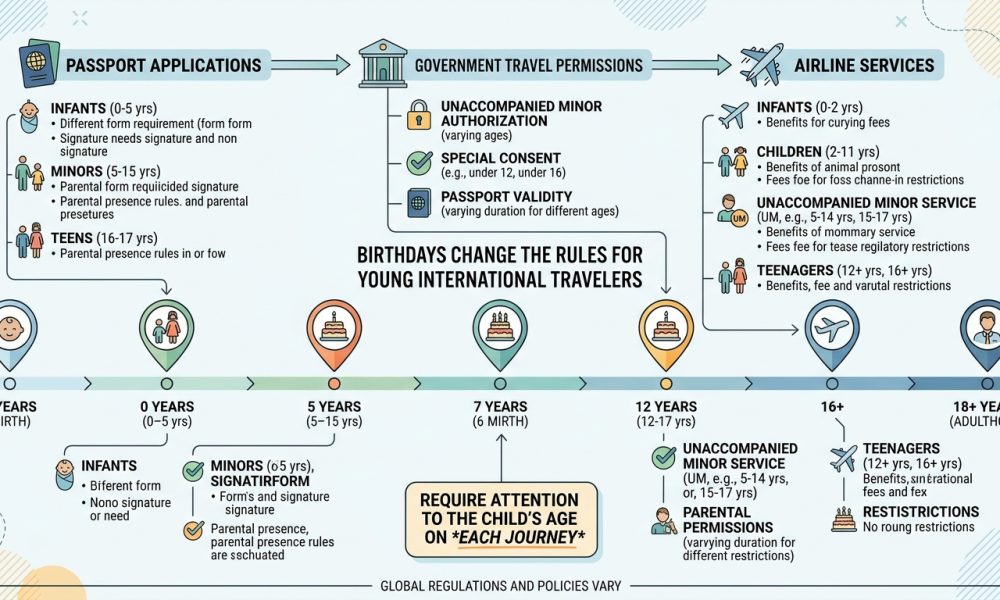
Different age thresholds govern passport applications, government travel permissions, and airline services, so families must consider thechild’ss age on each journey, especially when a birthday falls between the outward flight and the planned return home.
WASHINGTON, DC, October 17, 2026: A birthday during an international trip can change the questions families need to ask about seating, airline supervision and travel documents, making the young traveler’s age on each relevant date an important planning detail.
Official Canadian passport guidance and airline policies show why a single label such as child, teenager, or adult cannot reliably describe every requirement, since different organizations use a different age threshold for different purposes within the same journey.
Families should review the Application date, departure dates, and return arrangements separately, identifying which rule applies at each stage rather than assuming that the age entered when a ticket was purchased determines every requirement throughout the trip.
Begin With the Dates That Matter
A useful planning record should show the young traveler’s date of birth alongside each flight, connection, and intended border crossing, making any birthday during the journey visible before the family selects tickets or arranges accompanying adults.
Parents should then identify the relevant date for each requirement, asking whether an authority or airline assesses age when an Application is submitted, when a service begins, or on the date of a particular flight or departure.
This approach helps separate questions that might otherwise become confused, such as whether an existing passport remains valid after a birthday and whether a child needs a different seat or supervision arrangement for the journey home.
If a birthday coincides with an overnight flight or a complicated itinerary, the family should provide the airline with the exact schedule and request confirmation of how its policy applies to each affected segment of the booking.
Turning 16 Does Not Automatically End a Canadian Child Passport
Canada’s guidance on applying for a child passport states that the document remains valid until its expiry date even after the holder turns 16, distinguishing the passport’s continuing validity from eligibility to apply for an adult passport.
The same guidance explains that child passports cannot be renewed and that a person who has reached 16 can apply for a new adult passport, making it important to choose the correct Application process when another document is needed.
For a family planning travel around a sixteenth birthday, the practical review should therefore begin with the existing passport’s expiry date and the journey’s requirements, rather than assuming that the birthday itself creates an immediate replacement obligation.
If a new Application is needed close to that birthday, parents should confirm which instructions apply to the intended submission date and allow enough time to prepare, especially when supporting documents or appointments must be arranged before travel begins.
American Passport Applications Also Change at 16
The State Department provides separate instructions for applicants aged 16 and 17, requiring an in-person Application for a first adult passport and evidence that one parent or legal guardian knows about the Application, while ordinarily issuing ten-year passports.
That example shows how reaching an Application threshold can change the process without eliminating every parental element, so families should read the instructions for the applicant’s actual age instead of assuming that an adult passport category means complete independence.
The Application review should identify the required identity evidence, signatures, and attendance arrangements before booking an appointment, helping the young person understand what they must provide and what involvement a parent may still need.
Families should also distinguish passport processing from travel planning, allowing time to receive the document before relying on an international departure, and avoid assuming that reaching a birthday guarantees immediate access to a newly issued passport.
An Adult Passport Does Not Set Every Consent Threshold
Canada recommends that travelers under 19 carry a consent letter when going abroad without both parents or other people with decision-making responsibility, while expressly noting that foreign authorities may request such a letter even when the traveler holds an adult passport.
The guidance also explains that Canada does not legally require a consent letter, so it is important to distinguish that recommendation from any mandatory permission or documentation imposed by another country involved in the young person’s journey.
Parents should therefore review the destination and departure rules separately from the passport category, note the applicable age threshold and any relevant nationality or residence conditions, and decide whether a birthday removes the need for supporting permission.
For practical preparation, the family can keep the appropriate supporting records while seeking clarification, ensuring that any decision to stop carrying a document follows the relevant rule rather than an assumption based on the passport’s appearance or validity period.
Government Departure Rules Can Use Another Age
Brazil’s Federal Police states that Brazilian travelers under 18 remain subject to relevant travel authorization requirements when departing without a parent, including when they use another nationality’s passport, illustrating a threshold separate from eligibility for some countries’ adult passports.
A family applying that guidance should review the young person’s age at the relevant departure, along with citizenship and accompanying arrangements, and determine whether an authorization or applicable exception supports the journey they intend to make.
Parents should avoid applying one country’s age threshold to another country’s procedures, especially when the young traveler has more than one nationality or lives abroad and regularly moves between jurisdictions with different requirements for minors.
When a birthday falls during an extended visit, the family should ask the relevant authority how the departure requirements apply on the planned return date, including whether any existing legal arrangement raises a separate question requiring individual advice.
Air Canada Uses Separate Ages for Its Supervision Service
Air Canada’s unaccompanied minor service is mandatory for children aged eight through 11 traveling alone and optional for those aged 12 through 17. In contrast, children under eight cannot use the service under the carrier’s published policy.
A twelfth birthday during a trip therefore deserves a specific discussion with the airline, allowing parents to confirm how the booking should reflect the child’s age and whether they wish to retain the available service for the return.
Air Canada also limits that service to eligible nonstop flights. It excludes connecting and codeshare flights, showing why reaching an eligible age does not by itself establish that supervision is available for every itinerary the family might select.
Parents should confirm the actual flights before relying on the service, including any changes associated with the birthday, and keep the agreed arrangements available to the adults responsible for delivering and collecting the young traveler.
British Airways Draws a Different Line
British Airways permits young people aged 14 or older to travel alone, while children under 14 must travel with someone aged at least 16 on the same or a linked booking, according to its published guidance.
The airline explains that travelers aged 14 and 15 must navigate airports and flights without a chaperone, and its requirements include a completed parental consent form and a copy of the signing parent’s or guardian’s photo ID.
These conditions show why eligibility to fly alone should prompt a discussion of practical readiness, including the young person’s ability to follow airport instructions, manage documents, and contact a trusted adult if the journey changes unexpectedly.
Families comparing carriers should assess the full arrangement offered at the relevant age, rather than assuming similarly named services provide the same supervision or that eligibility with one airline extends to another operating the return flight.
A Second Birthday Can Change the Seat Arrangement
British Airways’ family ticket and travel document guidance states that an infant who turns two during the journey needs a separate seat on flights on or after that birthday, so parents must check the return date.
In that case, British Airways says parents must contact the airline to arrange the booking and that the infant fare applies throughout the journey, which is why parents should get the carrier’s specific instructions before completing the reservation.
Families traveling with another carrier should ask about its seating and ticketing policy, providing both the birth date and flight dates, rather than assuming the same pricing or booking process applies across the industry.
This review should happen before travel begins, so the family can confirm the child’s seat and any relevant equipment arrangements without relying on an airport adjustment shortly before a return flight that may already be heavily booked.
An Older Sibling’s Age Also Deserves Attention
When an older sibling will accompany a younger child, parents should ask whether the airline accepts that person as an accompanying passenger under its age policy and provide both travelers’ ages for every relevant date in the itinerary.
British Airways’ published minimum accompanying age of 16 is one example. Still, families should separately establish the government permissions and parental arrangements needed for the journey instead of treating carrier acceptance as proof of legal guardianship.
The older sibling should understand the responsibilities the family expects them to undertake, including keeping documents accessible, following the agreed route, and contacting a parent before accepting significant changes to transportation or accommodation during a disrupted journey.
Parents should also consider the younger child’s needs and the older sibling’s confidence, arranging support that fits the actual circumstances rather than assuming that reaching the minimum permitted age establishes readiness for every international connection or unexpected delay.
Changes and Return Flights Need Another Review
A birthday can fall between two flights booked months earlier, so the return journey should receive its own assessment of seating, supervision and documents instead of being treated as an automatic repetition of the outward arrangements.
If a cancellation moves travel across a relevant birthday, parents should notify the airline and ask whether the replacement booking needs adjustment, ensuring that staff assess the new date rather than rely on arrangements made for the original departure.
The same review applies when a replacement flight introduces another operating carrier, since the family needs confirmation that the traveler meets that airline’s age conditions and that any agreed assistance remains available on the revised itinerary.
For organized school or sports travel, coordinators can identify birthdays in advance and ask families to resolve individual requirements, keeping the group plan accurate without assuming every participant stays in the same age category throughout.
Passport Scanning Answers a Different Question
Amicus International Consulting’s guide to scanning a passport’s NFC chip and understanding the results explains the differences between retrieving electronic Information, checking digital security features, and confirming current travel validity, giving context for families interested in a passport’s technical features.
Reading a date of birth electronically does not determine which airline service or government permission applies, so parents should use the verified identity Information alongside the relevant published rules rather than interpret a successful scan as travel approval.
A practical document review should compare the birth date across the passport, booking, and supporting records, so they can raise discrepancies with the appropriate provider or authority before they complicate an Application or a departure involving an age threshold.
The family should then keep the applicable guidance and confirmed arrangements together, giving the accompanying adult or young traveler a clear explanation of what has been prepared and whom to contact if a question arises during travel.
Match Independence With a Clear Travel Plan
Before departure, parents can explain any birthday-related change to the young traveler, including whether airline assistance will continue and what responsibilities they will take on, ensuring that the practical plan is understood alongside the formal eligibility rules.
The traveler should know how to find airline assistance, contact the receiving adult, and reach a parent if the itinerary changes, with those arrangements remaining usable if the phone loses power or internet access becomes unavailable.
A final review of birth dates, flight dates, documents, and confirmed services can identify remaining gaps. At the same time, there is still time to resolve them, leaving the young person prepared for the specific journey they are about to undertake.




