
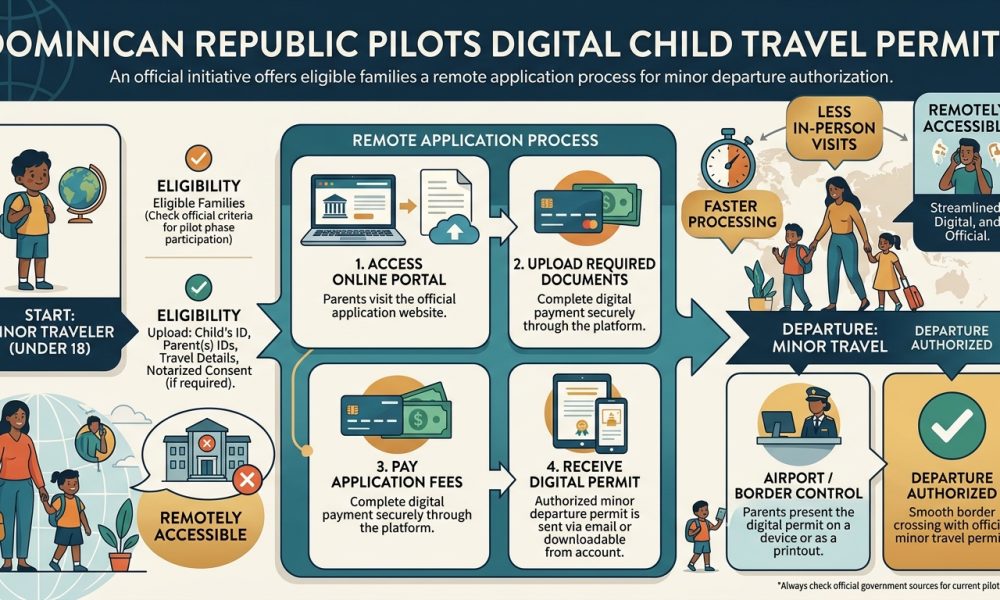
An official initiative offers eligible families a remote Application process for obtaining a minor’s departure authorization.
WASHINGTON, DC, October 15, 2026 — The Dominican Republic has introduced a fully digital child travel authorization service, allowing eligible parents to obtain permission for a minor to leave the country without visiting government offices, marking a significant development in international family travel administration.
The initiative, launched as a public pilot on May 28, 2026, lets eligible Dominican parents electronically authenticate their identities, authorize their child to travel with one parent, complete notarial formalities, and receive the departure permit through an integrated government platform.
The country’s General Directorate of Migration confirmed on August 7, 2026, that the public pilot had concluded and the system had become a regular paid service, following the issuance of 5,603 permits through the digital process during its trial period.
The development is particularly relevant for Dominican families maintaining international connections, parents traveling separately with children, and households seeking more efficient administrative procedures without weakening safeguards intended to prevent unauthorized international movement.
However, the digital service was initially limited to specific categories of Dominican parents, and the introduction of electronic processing should not be interpreted as eliminating the country’s broader child departure authorization requirements or extending eligibility automatically to every foreign family visiting the Dominican Republic.
The Dominican Republic Introduced a Fully Digital Departure Permit
The Dominican Republic’s General Directorate of Migration, known as the Dirección General de Migración (DGM), announced the public beta of its new digital Minor’s Exit Permit service on May 28, 2026.
According to the DGM’s official announcement of the digital permit pilot, eligible parents could complete the procedure remotely using an internet-connected device while following the progress of their Application through electronic status updates.
The government designed the service to replace several separate administrative interactions with a connected workflow incorporating identity verification, parental authorization, notarial processing, document validation, and immigration certification.
The initiative is part of the Dominican Republic’s broader Burocracia Cero, or Zero Bureaucracy, modernization program, which aims to reduce unnecessary administrative delays while improving public access to essential government services.
For qualifying families, the main benefit is completing an official child departure authorization without visiting multiple government institutions in person.
The Pilot Has Already Transitioned Into a Regular Service
Although the initiative began as a public beta, it is inaccurate to describe the entire program as an ongoing free trial because Dominican authorities announced on August 7, 2026, that it had transitioned into a regular service.
The DGM reported that the pilot issued 5,603 child travel permits entirely online, showing the system could support applications, approvals, and government certification without traditional in-person processing.
The government also introduced an official fee following the free trial period, distinguishing the operational service from the temporary arrangements available during its initial implementation.
These changes matter for families consulting earlier announcements because Information published when the service first opened may no longer accurately describe its fees or administrative status.
The digital platform may continue to display beta-related language while the government refines the system, but the DGM’s August announcement clearly identifies the introduction of normal paid processing.
The Initial Service Focused on Travel With One Parent
The digital Application route was initially designed for situations in which one Dominican parent authorizes the other Dominican parent to travel internationally with their child.
This distinction is important because the platform was not announced as a universal electronic replacement for every child departure scenario, including travel with grandparents, unrelated adults, guardians, or airline unaccompanied-minor services.
Under the initial eligibility framework, both parents had to be Dominican nationals with Dominican identity cards, reside in the Dominican Republic, and meet the geographic requirements for participating provinces.
The government also specified that it would accept only one Application per child at the initial stage, reflecting administrative limits imposed during the service’s introduction.
Families whose circumstances fall outside those requirements should use the applicable official procedure rather than assuming that the new digital service accepts every parental or guardianship arrangement.
Parental Nationality and Residence Affect Eligibility
The digital system shows why a parent’s citizenship and residence status matter when determining whether a particular electronic government service is available.
Although American citizens and other foreign nationals may have legitimate family connections with the Dominican Republic, the initial online pilot specifically required both participating parents to be Dominican citizens holding national identity cards.
It also required both parents to reside in the Dominican Republic, distinguishing the program from a general service available to all parents traveling through the country.
These restrictions should not be confused with the broader legal rules governing which children require permission to depart because eligibility for a particular digital processing method is a separate administrative question.
Parents with different nationalities or living in different countries should therefore confirm whether the current platform supports their circumstances or requires another authorized procedure.
Traditional Departure Permit Procedures Remain Available
When launching the digital system, Dominican immigration authorities expressly confirmed that the existing in-person process would remain available for families unable to use the new service.
This alternative remains especially important for applications involving legal guardians, parents residing abroad, or children accompanied by adults who are not their parents.
The broader DGM certification procedure recognizes circumstances involving Dominican minors, certain foreign-resident minors, and different forms of parental or judicial authorization, each potentially requiring separate supporting documentation.
Families should therefore distinguish the new digital Application channel from the legal framework that generally governs permission for minors to depart.
A convenient online process does not automatically invalidate existing legal procedures or eliminate recognized exemptions based on nationality, residence, or accompanying adults.
The Application Begins With Official Digital Identity Verification
Eligible applicants begin by creating or accessing their Dominican government Cuenta Única account, which provides a digital identity mechanism that connects users with participating public services.
The procedure requires the applicant’s Dominican identity card Information and biometric verification using a compatible mobile telephone or computer equipped with a Camera.
This identity Authentication supports verification that the adult requesting or granting permission corresponds to the person identified in the government’s relevant records.
The platform also processes personal Information about the other parent and the child, linking the Application to the identity and family relationship Information needed for official certification.
However, successful digital identity verification does not independently establish that every proposed journey is legally authorized, because the Application must still satisfy the relevant parental permission and administrative requirements.
Both Parents Participate Through Separate Accounts
The online procedure is designed around a coordinated authorization process in which the parent accompanying the child initiates the Application and the non-traveling parent provides consent electronically.
The parent initiating the journey supplies the relevant Information about the child, the destination, and the adults involved before the platform requests authorization from the other parent.
The non-traveling parent then accesses the government system using their own authenticated account to review and approve the relevant request.
This arrangement creates a more structured record than an informal email exchange because it connects consent with separately authenticated identities and a defined government Application.
The system is particularly relevant to parents who cannot conveniently visit the same government office but can still provide the necessary authorization through the supported electronic procedure.
Electronic Notarization Is Part of the Process
The Dominican government’s system includes digital notarial services, allowing the relevant power of attorney to be reviewed and signed electronically instead of requiring parents to visit a notary separately.
The procedure also connects with the Attorney General’s Office to legalize notarial acts and with the Central Electoral Board to certify family relationships.
These steps matter because the platform does more than collect a parental consent form; it coordinates several legally relevant procedures that previously required separate administrative interactions.
Digital signatures and official certification help preserve the legal structure of parental authorization while reducing the need to transfer physical documents.
Applicants should still distinguish electronic notarization from automatic approval, since responsible professionals and government officials still perform the necessary validation before issuing the permit.
The Digital Service Now Carries an Official Fee
After the trial period ended, the Dominican General Directorate of Migration announced an official fee of RD$6,300 for the integrated online service.
According to the DGM’s August 7, 2026 announcement confirming the end of the public beta, the total incorporates the government departure permit, electronic notarial authorization, legalization, and certification of the parental relationship.
OFFICIAL DIGITAL PERMIT FEE
RD$6,300
| Minor’s exit permit | RD$2,000 |
| Electronic notarial authorization | RD$3,000 |
| Legalization of notarial acts | RD$700 |
| Parentage certification | RD$600 |
Official fee breakdown published August 7, 2026; subject to subsequent government changes.
Families should therefore distinguish the integrated digital service fee from earlier announcements describing the pilot as free or older schedules identifying only the charge associated with a conventional departure certification.
The Permit Is Connected Electronically to the Child’s Passport
After the required authorization and verification steps are completed, the DGM records the approved departure permission electronically and associates it with the child’s passport Information.
The official platform explains that travelers can download a confirmation for their records but do not need to present a printed copy of the permit when departing through the applicable Dominican immigration procedure.
This approach reduces reliance on paper documents that could be misplaced, damaged, or left with a parent not accompanying the journey.
However, a digital departure permit does not replace the child’s valid passport or any visa, electronic authorization, or supporting documentation required by the destination country.
Parents should also verify that they entered the correct passport Information because an authorization linked to inaccurate identifying details may cause issues during departure inspection.
The Current Platform Identifies a 90-day validity period.
The Dominican government’s digital Application platform states that an approved Minor’s Exit Permit remains valid for 90 days from the date it is granted.
This period is an important planning consideration for parents arranging international travel because the Application should align with the anticipated departure, not be treated as indefinite permission for future journeys.
The portal also indicates that notarization and permit authorization can take up to 24 working hours, based on the service’s operating schedule rather than continuous calendar time.
Families should therefore avoid assuming every request will be completed immediately, especially when they submit applications near weekends, public holidays, or planned international departures.
The permission must remain valid for the intended departure, while other obligations concerning custody, transportation, and admission to the destination continue to apply separately.
Remote Applications Still Require Supporting Documents
Although the electronic platform removes the requirement for eligible parents to attend government offices, applicants must still supply accurate Information concerning the child and the proposed international journey.
The published requirements include both parents’ Dominican identity card numbers, passport Information, the child’s unique identity number, a recent photograph, and details identifying the destination country.
Both parents also need access to email and suitable devices to complete the electronic identity and consent procedures, along with an accepted payment method.
The child’s photograph must meet the platform’s Image requirements, including a clear forward-facing view without unnecessary obstructions or additional people.
These requirements demonstrate that administrative digitization changes how Information is collected and verified without eliminating the underlying obligation to establish identity and lawful parental permission.
The Initiative Includes Additional Data Protection Considerations
Electronic processing reduces the physical handling of sensitive family documents, but it also creates responsibilities concerning the collection and Protection of personal Information submitted through the government platform.
Applications may contain Identification card numbers, passport details, photographs, parental relationships, destination Information, and other records concerning children and their legally responsible adults.
Applicants should therefore access the service through the official Dominican immigration system and avoid sending Identification records to unfamiliar intermediaries claiming to provide exclusive approval services.
The use of biometric Authentication provides an additional identity verification mechanism, although families should recognize that digital security depends on the broader safeguards applied throughout the system.
The government identifies interagency verification and electronic authorization as central components of the new service, making accurate identity Information essential to the reliability of the resulting permission.
Not Every Minor Departing the Country Needs the Same Authorization
The Dominican Republic’s broader child departure framework includes exemptions and special procedures that vary according to the child’s nationality, residence status, and accompanying adults.
For example, the DGM identifies children traveling with both parents as generally exempt from obtaining its standard minor departure authorization.
It also recognizes specific exemptions for dual nationality, residence abroad, and certain immigration circumstances, subject to the conditions the authority publishes.
A foreign child visiting the Dominican Republic temporarily may therefore face different requirements from a Dominican child residing in the country or a foreign minor holding Dominican legal residence.
Families should determine whether authorization is legally required before choosing which Application procedure to use, rather than assuming that the availability of the digital service applies to every child.
Travel With Third Parties Remains a Separate Situation
A child departing with grandparents, family friends, relatives, or another adult who is not a parent may require a different authorization procedure from one designed for permission between two Dominican parents.
The country’s conventional certification framework includes requirements addressing situations where both parents must authorize a third party or an airline to accompany or transport the child.
Applications may involve notarized permission, legalized supporting records, Identification of the accompanying adult, and other documents depending on the child’s legal circumstances.
These requirements are separate from the initial digital platform’s narrower parent-to-parent authorization model, so families should choose the appropriate procedure.
The government’s introduction of remote processing should not be interpreted as confirmation that every third-party travel arrangement is immediately eligible for identical digital treatment.
International Families May Need Consular or Judicial Procedures
Parents residing outside the Dominican Republic may face different administrative requirements because the original online service was limited to qualifying Dominican parents residing in the country.
The conventional departure authorization system recognizes procedures involving Dominican consulates when parents are abroad, together with additional documentary requirements concerning the relevant authorization.
If one parent cannot or will not provide consent, the appropriate legal response may be to obtain authorization from a competent court rather than attempt to bypass the existing parental approval requirement.
Legal guardianship and adoption can also produce separate documentary requirements, particularly when the child’s legal representatives differ from the parents recorded in ordinary civil registration documents.
Families in these circumstances should consult the competent Dominican authorities or seek appropriate legal advice before assuming a standard electronic Application covers their situation.
Passport Security and Departure Permission Are Different Functions
Modern electronic passports incorporate Identification and Authentication features intended to establish the holder’s identity. At the same time, child departure permits address a separate question: whether the proposed international movement has the legally required authorization.
The Dominican Republic’s digital initiative shows how government systems can link these functions by attaching approved parental permission to the child’s passport record without changing the passport’s underlying citizenship or Identification Information.
Amicus International Consulting examined a related child travel security development in Mexico’s Children’s Passports Include Parents’ Photos to Strengthen Travel Security, explaining how supplementary parental Identification can strengthen examination of family relationships.
However, parental Information in a passport does not automatically replace a separately required exit authorization, just as an approved digital departure permit does not grant permission to enter every foreign destination.
Both approaches can contribute to child travel safeguards, but they address distinct legal and administrative questions.
Digital Processing Does Not Remove Custody Restrictions
An approved electronic permit should not be interpreted as overriding binding custody orders, judicial departure restrictions, or other legal obligations concerning the exercise of parental authority.
Parents may possess valid passports and access to government Application systems while remaining subject to family-law decisions that limit when a child can travel internationally.
Similarly, consent for a temporary international journey does not necessarily permit permanent relocation or a change in the child’s habitual residence.
These distinctions are particularly important for separated parents and families involved in international custody arrangements, where additional legal requirements may apply independently of ordinary immigration processing.
The appropriate preparation involves confirming both the administrative departure requirements and the underlying legal authority to undertake the proposed journey.
The Program Demonstrates a Broader Shift Toward Digital Services
The Dominican Republic’s initiative reflects a broader shift toward electronic government services that combine identity verification, digital signatures, interagency data exchange, and online payment in a single administrative workflow.
Unlike processes that require an in-person visit to upload forms, the new service is designed to complete the qualification process remotely, from Application through final certification.
The government reported 5,603 digitally issued permits during the public pilot, providing a measurable early indication of demand for a process that reduces physical visits and separate document submissions.
However, technological modernization does not necessarily eliminate eligibility restrictions, statutory requirements, or the need for judicial intervention where parental authority is disputed.
The central administrative development is how lawful permission is established and recorded, not the elimination of parental authorization safeguards.
Conclusion: The Dominican Republic Has Moved Beyond Its Initial Pilot
The Dominican Republic’s digital Minor’s Exit Permit represents a significant development in international child travel administration, allowing eligible parents to obtain government-certified departure authorization through an integrated online process.
Launched as a public pilot on May 28, 2026, the service subsequently transitioned to regular paid processing on August 7, with an official integrated fee of RD$6,300 and thousands of permits issued during the trial.
The initial digital pathway focused on qualifying Dominican parents authorizing travel with the other parent, while traditional procedures remain relevant for other family circumstances and recognized legal exceptions.
For Dominican families and internationally mobile households, the main benefit is completing eligible applications remotely without sacrificing identity verification, parental consent, or official certification.
Ultimately, the initiative shows how governments can modernize child departure authorization while preserving legal safeguards, provided families understand the service’s eligibility conditions, current fees, validity periods, and how it fits within broader international travel requirements.




