
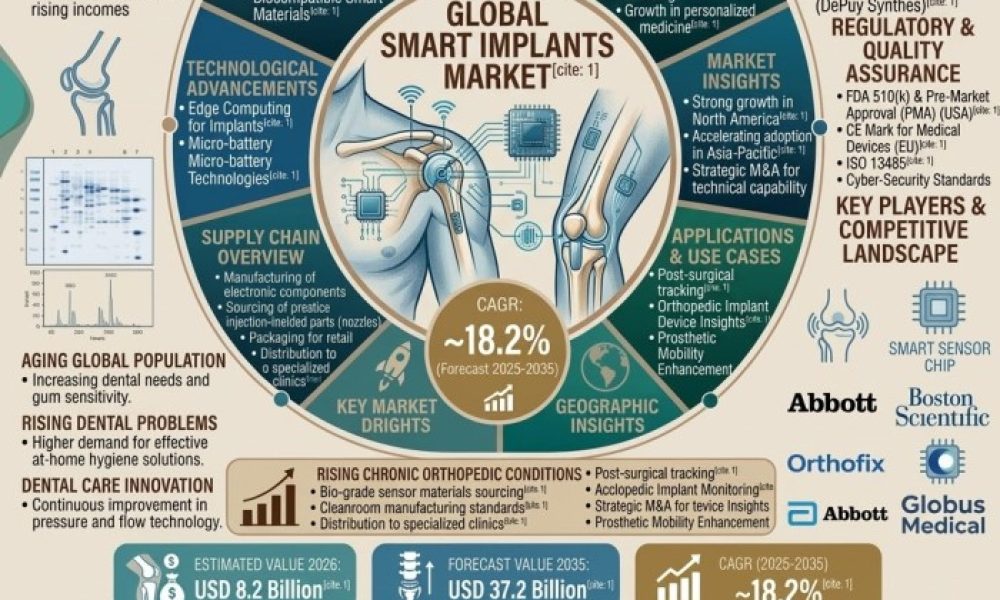
Connected implant technologies and real-time patient monitoring are driving demand for advanced cardiac, orthopedic, and neurological care.
ROCKVILLE, Maryland – October 14, 2026 — The global smart implants market is projected to grow from USD 6.6 billion in 2026 to USD 41.8 billion by 2036, registering a compound annual growth rate (CAGR) of 19% over the forecast period. According to Fact.MR, advances in implantable medical technology, increasing demand for personalized treatment, and the growing use of connected healthcare systems are creating new opportunities for manufacturers of sensor-enabled implants.
Get detailed market forecasts, competitive benchmarking, and pricing trends:
KEY MARKET TAKEAWAYS
- Market Valuation: USD 6.6 billion in 2026, projected to reach USD 41.8 billion by 2036.
- Growth Rate: Expanding at a CAGR of 19% over the forecast period.
- Leading Use Case: Cardiac rhythm management is projected to account for 40% of the market in 2026.
- Leading End User: Hospitals are expected to hold 70% of the market in 2026.
- Fastest-Growing Country: China leads country-level growth with a projected CAGR of 15.7% through 2036.
- Core Growth Driver: Increasing adoption of connected medical implants that support real-time monitoring, data collection, and personalized treatment.
INDUSTRY SHIFTS & MARKET DYNAMICS
Smart implants combine conventional implant functions with sensors, electronic components, and communication technologies that can collect and transmit patient data. These capabilities are expanding the role of implantable devices beyond structural support or therapeutic intervention. In cardiac care, smart pacemakers and implantable cardioverter-defibrillators can help clinicians monitor heart rhythm and device performance. In orthopedics, sensor-enabled joint implants can provide information about mobility and implant function. Neurostimulation devices also offer opportunities to monitor physiological signals and adjust therapy in selected applications. These developments are increasing interest in implant technologies that connect clinical treatment with ongoing patient monitoring.
Despite the growth outlook, manufacturers face challenges involving development costs, regulatory approvals, data security, and long-term device reliability. Smart implants must meet demanding requirements for biocompatibility, battery performance, wireless communication, and safe operation within the body. Healthcare providers also need appropriate systems to interpret the data generated by connected devices and incorporate it into clinical workflows. These requirements can increase development timelines and adoption costs. Suppliers that demonstrate reliable performance while addressing interoperability, cybersecurity, and clinical validation requirements may be better positioned to expand their presence across hospitals and specialist care facilities.
REGIONAL MARKET SUMMARY
| Country | CAGR (2026–2036) | Market outlook |
| China | 15.7% | Strong demand for advanced medical technologies |
| India | 14.5% | Expanding healthcare infrastructure and access |
| Germany | 13.3% | Established healthcare system and technology adoption |
| United Kingdom | 11.0% | Growing interest in advanced implantable devices |
| United States | 9.9% | Mature market with established medical technology capabilities |
Source: Fact.MR, Smart Implants Market report.
China is projected to record the highest growth rate among the countries assessed, supported by healthcare infrastructure development, an ageing population, and increasing demand for advanced medical technologies. India follows as expanding healthcare capacity and greater access to specialized treatment support adoption. Germany is expected to benefit from its established healthcare system and demand for innovative implant technologies. The United Kingdom and United States are also projected to register growth, reflecting continued interest in advanced implantable devices and connected patient care.
ANALYST INSIGHTS
“The smart implants market is poised for remarkable growth, fueled by ongoing advancements in medical technology and a shift toward more personalized, data-driven healthcare. The convergence of sensing, connectivity, and therapy in implants is creating new opportunities for improved patient outcomes, with hospitals leading the charge in adoption,” stated Shambhu Nath Jha, Principal Consultant at Fact.MR.
For device manufacturers, the commercial opportunity extends beyond implant development. Integration with monitoring platforms, clinical reporting systems, and healthcare workflows could help strengthen product differentiation. Partnerships with hospitals and specialist care providers may also support adoption by improving clinician familiarity, technical support, and the management of data generated by connected implants.
FREQUENTLY ASKED QUESTIONS
Q: What is the projected size of the smart implants market by 2036?
A: The global smart implants market is estimated at USD 6.6 billion in 2026 and is projected to reach USD 41.8 billion by 2036, growing at a CAGR of 19%.
Q: Which use case holds the leading market share?
A: Cardiac rhythm management is projected to account for 40% of the market in 2026, supported by demand for implantable devices used to manage cardiovascular conditions.
Q: Which end-user segment dominates the smart implants market?
A: Hospitals are expected to account for 70% of the market in 2026 because they are central to implant procedures, postoperative care, and patient monitoring.
Q: Which country exhibits the highest growth rate?
A: China is projected to lead country-level growth with a CAGR of 15.7% through 2036. India follows with a projected CAGR of 14.5%.
Q: What factors are driving demand for smart implants?
A: Key drivers include advances in sensor and communication technologies, the need for continuous patient monitoring, rising chronic disease prevalence, ageing populations, and increasing interest in personalized healthcare.
Q: What challenges could limit market expansion?
A: High development costs, regulatory requirements, cybersecurity concerns, and the need to establish reliable long-term device performance may constrain adoption.
Explore More Related Studies Published by Fact.MR Research
Congestive Heart Failure (CHF) Treatment Devices Market-
Neurodiagnostic and Monitoring Devices Market-
About Fact.MR
Fact.MR is a market research and consulting firm providing syndicated research, customized research, investment research, and market intelligence across a broad range of industries. Its research coverage includes food and beverage, healthcare, pharmaceuticals, biotechnology, consumer products, chemicals and materials, technology, industrial goods, and packaging.
Fact.MR provides market intelligence designed to help organizations understand market dynamics, emerging opportunities, competitive developments, and changing industry requirements.
Media Contact
Fact.MR
Email: [email protected]
Phone: +1 (628) 251-1583
Website: www.factmr.com



