
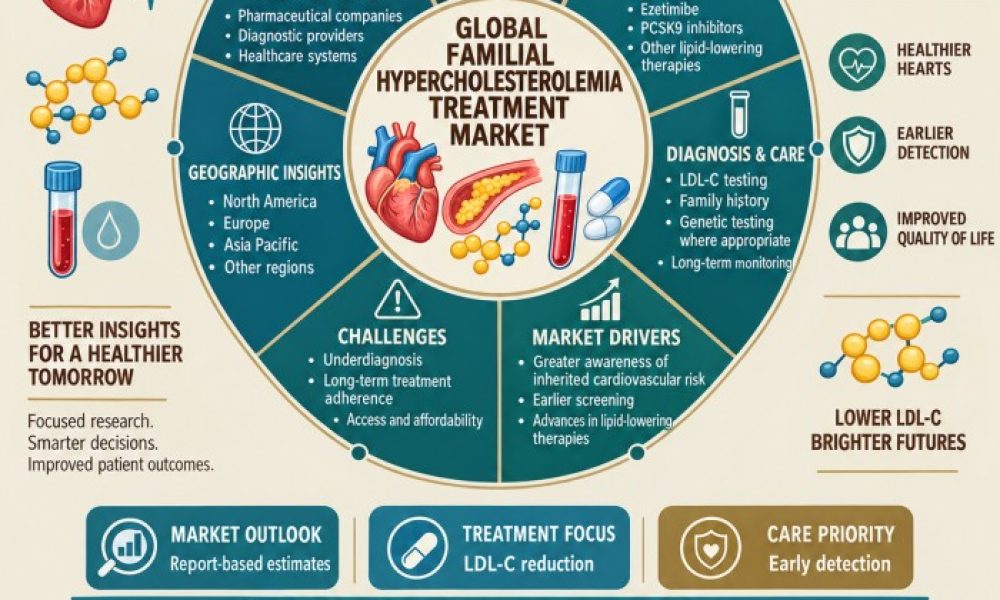
Growing adoption of genetic sequencing, early diagnosis, and family cascade screening is strengthening demand for inherited cholesterol disorder management.
ROCKVILLE, Maryland – October 14, 2026 — The global familial hypercholesterolemia treatment market is projected to increase from USD 2.44 billion in 2026 to USD 5.08 billion by 2036, expanding at a compound annual growth rate (CAGR) of 7.6% over the forecast period. According to the latest market report published by Fact.MR, growing awareness of inherited cholesterol disorders and greater emphasis on early cardiovascular risk identification are supporting demand for diagnostic testing and treatment-related solutions.
Familial hypercholesterolemia is an inherited condition associated with elevated low-density lipoprotein cholesterol and an increased risk of premature cardiovascular disease. Genetic testing can help confirm suspected cases, while family cascade screening can identify relatives who may also carry disease-associated genetic variants. These clinical priorities are creating opportunities for diagnostic laboratories, testing technology providers, and healthcare companies serving preventive cardiology.
Get detailed market forecasts, competitive benchmarking, and pricing trends:
KEY MARKET TAKEAWAYS
- Market Valuation: USD 2.44 billion in 2026, projected to reach USD 5.08 billion by 2036.
- Growth Rate: The market is forecast to expand at a CAGR of 7.6% between 2026 and 2036.
- Leading Product Segment: Genetic sequencing tests are expected to account for 35.7% of the market in 2026.
- Leading Application: Initial diagnosis is projected to hold a 44.1% share in 2026.
- Leading End User: Reference laboratories are forecast to capture 46.2% of the market in 2026.
- Fastest-Growing Country: India is projected to record a 10.4% CAGR through 2036.
- Core Growth Driver: Greater emphasis on identifying inherited cardiovascular risk through genetic testing, early diagnosis, and family screening.
INDUSTRY SHIFTS & MARKET DYNAMICS
Genetic Testing Strengthens Early Identification
The familial hypercholesterolemia treatment market is benefiting from increased attention to the early identification of inherited lipid disorders. Patients with familial hypercholesterolemia may remain undiagnosed until elevated cholesterol levels or cardiovascular complications prompt further investigation. Greater clinical awareness and screening initiatives are encouraging healthcare providers to identify potential cases earlier.
Genetic sequencing tests are expected to command a 35.7% market share in 2026. These tests can identify disease-associated variants in genes such as LDLR, APOB, and PCSK9, supporting diagnostic confirmation and informing family screening strategies. Their role in identifying inherited variants makes genetic sequencing an important component of diagnostic pathways for suspected familial hypercholesterolemia.
Initial diagnosis is projected to account for 44.1% of the market in 2026. Identifying an initial patient can also help healthcare professionals evaluate relatives who may share the inherited condition. As a result, diagnostic services that combine reliable testing with appropriate clinical interpretation are becoming increasingly relevant to laboratories and preventive cardiology providers.
Treatment Access and Reimbursement Remain Important Challenges
Despite growing awareness, the market faces barriers related to genetic testing costs, access to specialist services, and reimbursement differences across healthcare systems. Novel lipid-lowering therapies, including PCSK9 inhibitors, may also involve substantial treatment costs. These factors can limit access for patients in markets where coverage is restricted or diagnostic infrastructure remains uneven.
Reference laboratories are expected to account for 46.2% of market revenue in 2026. Their role in specialized genetic testing, quality assurance, and interpretation supports the concentration of complex diagnostic work in centralized facilities. Hospitals and preventive cardiology clinics remain important participants in identifying suspected cases and coordinating follow-up care.
Emerging technologies are creating additional opportunities. Artificial intelligence-assisted analysis of clinical records may help identify individuals whose cholesterol measurements or family histories warrant further assessment. Advances in RNA-based therapies and gene-silencing technologies could also broaden future treatment options, although clinical evidence, regulatory approvals, pricing, and reimbursement will influence commercial adoption.
REGIONAL MARKET SUMMARY
India and China are expected to record the strongest growth among the countries covered in the Fact.MR report. The outlook reflects expanding attention to inherited cardiovascular risk, diagnostic access, and preventive healthcare.
| Country | CAGR (2026–2036) | Market Development |
| India | 10.4% | Growing awareness and expansion of diagnostic services |
| China | 10.2% | Greater emphasis on cardiovascular prevention and genetic testing |
| Brazil | 9.8% | Opportunities to improve identification of undiagnosed cases |
| United States | 8.5% | Established diagnostic infrastructure and adoption of advanced testing |
| France | 8.4% | Continued demand for inherited lipid disorder diagnosis |
| Germany | 8.3% | Specialized diagnostic capabilities and preventive cardiology |
| United Kingdom | 8.0% | Greater focus on early identification and family screening |
India is projected to lead country-level growth at a 10.4% CAGR through 2036. Increased awareness among healthcare professionals and the expansion of private diagnostic services are expected to support demand for genetic testing. China follows at 10.2%, reflecting greater attention to cardiovascular disease prevention and opportunities to identify undiagnosed patients.
Brazil is forecast to grow at a 9.8% CAGR. The United States is expected to record an 8.5% CAGR, supported by established diagnostic infrastructure and the adoption of advanced testing. France, Germany, and the United Kingdom are projected to register CAGRs of 8.4%, 8.3%, and 8.0%, respectively.
ANALYST INSIGHTS
“Early identification is central to improving the management of familial hypercholesterolemia because the condition can remain undetected despite its association with premature cardiovascular risk,” a Fact.MR market analyst observed. “Diagnostic providers and healthcare companies have opportunities to strengthen genetic testing access, support family screening, and develop solutions that connect reliable diagnosis with appropriate long-term clinical management.”
The market outlook highlights the importance of coordinated diagnostic pathways. Testing providers can focus on assay reliability and interpretation, while healthcare organizations can improve referral processes for suspected inherited lipid disorders. Broader adoption will depend on clinical awareness, affordability, reimbursement policies, and access to qualified healthcare professionals.
FREQUENTLY ASKED QUESTIONS
Q: What is the projected size of the familial hypercholesterolemia treatment market by 2036?
A: The market is estimated at USD 2.44 billion in 2026 and is projected to reach USD 5.08 billion by 2036, growing at a CAGR of 7.6%.
Q: Which product segment holds the leading market share?
A: Genetic sequencing tests are expected to hold the leading position, accounting for 35.7% of the market in 2026.
Q: Which application segment leads the market?
A: Initial diagnosis is projected to account for 44.1% of the market in 2026, reflecting the importance of identifying patients with suspected familial hypercholesterolemia.
Q: Which country exhibits the highest growth rate?
A: India is projected to record the highest growth rate among the countries listed in the report, with a CAGR of 10.4% from 2026 to 2036.
Q: Which end-user segment dominates the market?
A: Reference laboratories are expected to account for 46.2% of the market in 2026, supported by their role in specialized genetic testing and diagnostic interpretation.
Q: What factors are driving market growth?
A: Growing awareness of inherited cholesterol disorders, increased emphasis on early diagnosis, genetic testing, and family cascade screening are key growth drivers. Testing costs, treatment affordability, and reimbursement limitations remain important challenges.
Q: Which companies operate in the familial hypercholesterolemia treatment market?
A: Companies identified in the Fact.MR report include Invitae Corp., F. Hoffmann-La Roche Ltd, Thermo Fisher Scientific Inc., QIAGEN N.V., and Abbott Laboratories.
Explore More Related Studies Published by Fact.MR Research
Congestive Heart Failure (CHF) Treatment Devices Market-
Neurodiagnostic and Monitoring Devices Market-
About Fact.MR
Fact.MR is a market research and consulting firm providing syndicated research, customized research, investment research, and market intelligence across a broad range of industries. Its research coverage includes food and beverage, healthcare, pharmaceuticals, biotechnology, consumer products, chemicals and materials, technology, industrial goods, and packaging.
Fact.MR provides market intelligence designed to help organizations understand market dynamics, emerging opportunities, competitive developments, and changing industry requirements.
Media Contact
Fact.MR
Email: [email protected]
Phone: +1 (628) 251-1583
Website: www.factmr.com



