
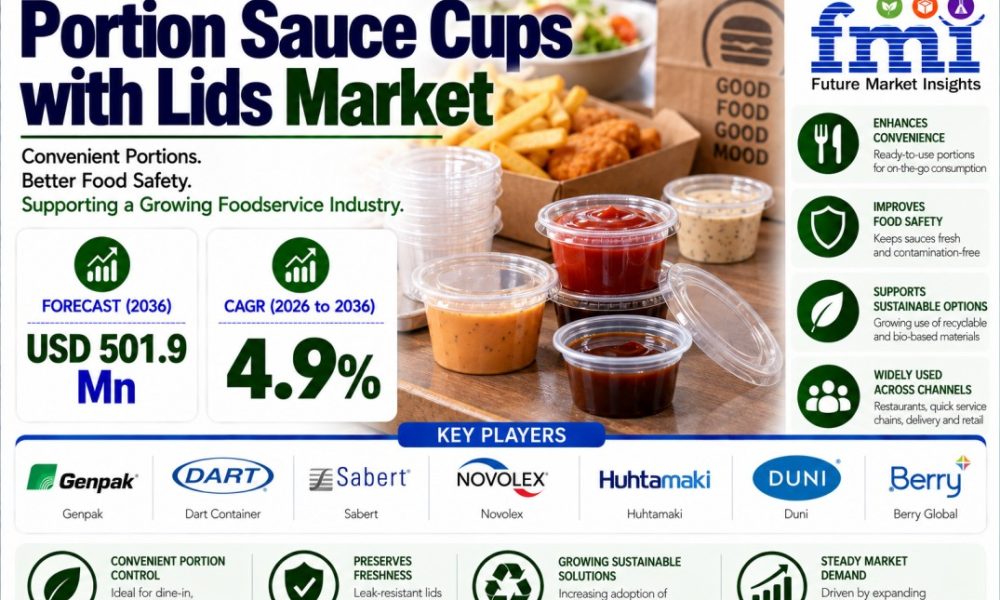
The global portion sauce cups with lids market is projected to grow from USD 311.1 million in 2026 to USD 501.9 million by 2036, registering a compound annual growth rate (CAGR) of 4.9%, according to Future Market Insights (FMI). Demand is supported by repeated use of sealed condiment portions across takeaway meals, delivery orders and quick-service restaurant operations.
For foodservice operators, a portion cup and its lid function as one packaging system. The cup must hold sauces without weakening or leaking, while the lid must remain securely attached during filling, stacking, packing and delivery. Material changes add another consideration: alternative formats must maintain these practical requirements while meeting the rules that apply in each market.
👉 Get Detailed Market Forecasts, Competitive Benchmarking, and Pricing Trends: https://www.futuremarketinsights.com/reports/sample/rep-gb-35203
PP Portion Cups Lead Product-type Demand
Polypropylene (PP) portion cups are projected to account for 36.0% of product-type demand in 2026. Their suitability for high-volume filling and compatibility with established closure systems support use across hot and cold sauce applications, subject to the specifications of the product and intended use.
Paperboard is forecast to hold a 28.0% share of the material category in 2026. Its rigid, printable walls and lower polymer content can appeal to operators seeking alternatives to conventional plastic formats. However, paperboard cups still require suitable barriers and rims that maintain closure performance during sauce contact, storage and transport.
Standard meal formats are expected to represent 43.0% of demand by format size in 2026. These cups are designed to accompany individual prepared meals, helping restaurants manage portion sizes and simplify inventory. A common approved size can also reduce the number of packaging variants that restaurant groups need to stock.
QSR Chains and Foodservice Distribution Drive Repeat Purchasing
Quick-service restaurant (QSR) chains are projected to account for 28.0% of end-use demand in 2026. Standardized menus and repeat condiment use make cup dimensions, lid fit and portion consistency important at the store level. A packaging specification approved by a chain can be deployed across multiple locations, creating recurring demand for compatible cups and lids.
Broadline foodservice distributors are forecast to represent 33.0% of sales-channel demand in 2026. These distributors can supply portion cups alongside other restaurant consumables, consolidating orders and supporting replenishment when stock runs low. Their ability to keep matching lids available is particularly important because a cup without its compatible closure cannot serve its intended purpose.
Material Conversion Must Preserve Closure Performance
Nandini Roy Choudhury, Principal Consultant at Future Market Insights, explains: “Chain operators pay for the cup and lid as one operating system. A cheaper cup loses its advantage if crews fight nested stacks or lids leak in transit. Material conversion should start with sauce barrier and closure force before recovery claims enter the specification.”
The assessment highlights the operational risks associated with material substitution. A new cup may reduce polymer content, but weak sauce barriers, softening rims or inconsistent lid engagement can increase waste and disrupt service. Packaging trials should therefore test the complete cup-and-lid combination under representative filling, storage and delivery conditions.
The regulatory environment also differs by jurisdiction. California restricts sales of expanded polystyrene foodservice ware following failure to meet its required recycling-rate threshold. The European Union’s Packaging and Packaging Waste Regulation includes restrictions on certain individual plastic portions for sauces and condiments in specified hospitality settings from January 2030, with an exemption for takeaway ready-prepared food. These rules make it important to assess the actual application before deciding which packaging format is suitable.
Lower-plastic Formats Create Opportunities
Paperboard, molded fiber and bagasse, and compostable systems offer potential alternatives for selected applications. However, adoption depends on whether the cup and lid can maintain the required barrier, seal and handling performance and whether the intended disposal route is available.
Recent industry developments show continued work on alternative materials and foodservice packaging. In May 2025, Dart Container reported sustainability recognition for selected molded-fiber products and clear polypropylene cups. In April 2025, Novolex completed its combination with Pactiv Evergreen, bringing additional foodservice packaging businesses under one platform. Graphic Packaging launched a paperboard sushi packaging portfolio for European foodservice operators in May 2025.
These developments reflect activity across foodservice packaging, although their relevance to portion sauce cups depends on product specifications and the intended application.
Saudi Arabia Leads the Country Growth Forecast
FMI projects Saudi Arabia to record a 6.6% CAGR from 2026 to 2036, followed by the United Arab Emirates at 6.3% and South Korea at 6.0%. The United States is forecast to grow at 5.7%, the United Kingdom at 5.4%, France at 5.1%, Germany at 4.8% and Japan at 4.1%.
The differences reflect varying foodservice activity, distribution systems and material-transition requirements. Saudi Arabia’s hospitality expansion supports demand for foodservice packaging, while the UAE’s single-use packaging restrictions are influencing material selection. South Korea’s delivery-oriented restaurant networks place emphasis on reliable replenishment and lid retention during transport.
In the United States and United Kingdom, restaurant chains must consider differing packaging rules and the cost of maintaining approved specifications. France, Germany and Japan have their own requirements and recovery systems, making local compliance and disposal guidance important during material changes.
Access detailed market insights: https://www.futuremarketinsights.com/reports/brochure/rep-gb-35203
Competitive Landscape
Companies profiled in the portion sauce cups with lids market include Genpak, Dart Container, Sabert, Novolex, Huhtamaki, Duni, Berry Global, Pactiv Evergreen, Graphic Packaging and Detmold Group.
These businesses bring different capabilities across rigid cups, closures, paperboard, fiber-based formats and foodservice distribution. Competition will depend on consistent manufacturing, suitable material options, compatibility between cups and lids, and the ability to supply restaurant networks reliably.
Outlook
The portion sauce cups with lids market is expected to expand as takeaway and delivery remain important parts of foodservice operations. At the same time, packaging rules are encouraging operators and suppliers to evaluate material alternatives.
Commercial success will depend on treating the cup and lid as a single system. Manufacturers that validate sauce resistance, closure force, denesting and transport performance—while providing clear material documentation—can help restaurant operators manage both service reliability and packaging changes.
To explore how FMI Custom Research can support your strategic priorities, connect with our team at – [email protected]
About Future Market Insights (FMI)
Future Market Insights, Inc. is an ESOMAR-certified, ISO 9001:2015 market research and consulting organization trusted by Fortune 500 companies. With a global presence across the U.S., UK, India, and Dubai, FMI delivers data-driven insights across 30+ industries and 1200 markets worldwide.



