
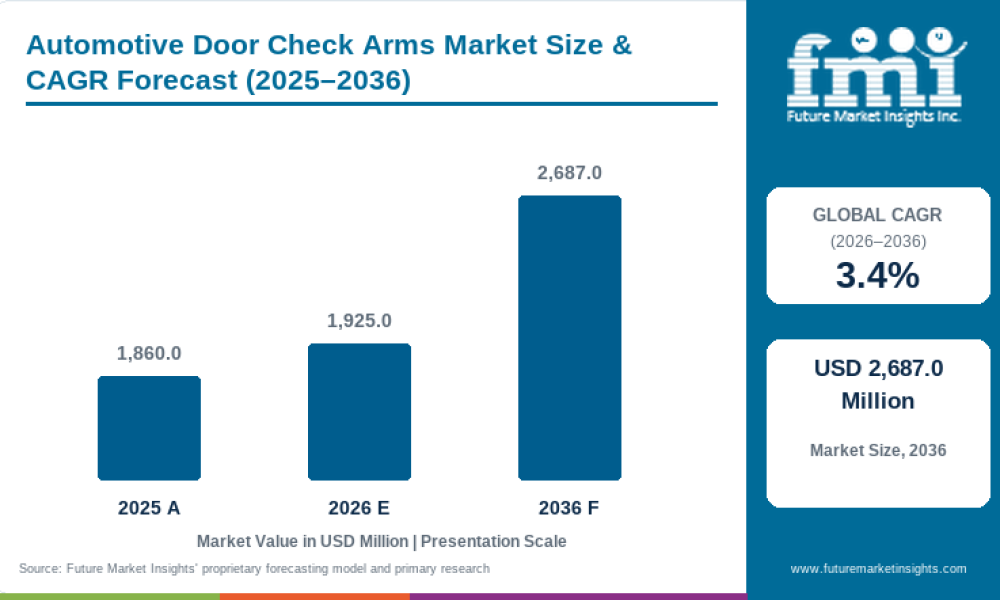
The global automotive door check arms market is projected to grow from USD 1,925.0 million in 2026 to USD 2,687.0 million by 2036, registering a CAGR of 3.4% over the forecast period. The market was valued at USD 1,860.0 million in 2025. Demand is supported by original equipment manufacturer (OEM) fitment, vehicle production, and service replacement of mechanical, hydraulic, and electromechanical door-check assemblies.
Door check arms regulate and retain the opening angle of hinged vehicle doors, helping control movement and maintain defined holding positions. They form part of the side-door kinematic system alongside hinges and latches, although these components serve different functions. Door check arms are specified according to door geometry, required holding positions, operating forces, durability, and the intended vehicle application.
Demand develops alongside the automotive door hinges market, as both components are incorporated into vehicle door designs. Check-arm revenue is influenced by vehicle output, the number and position of hinged doors, system content, and the replacement of worn or noisy assemblies. Buyers also evaluate how consistently a door moves and holds its position over repeated use.
What Are the Key Segments in the Automotive Door Check Arms Market?
The market is segmented by vehicle type, door position, material and construction, mechanism, sales channel, and region. Segment demand reflects the need to balance structural strength, controlled movement, reliable holding positions, and manufacturing cost.
- Passenger cars — 76.0% share: Passenger cars are expected to account for the leading vehicle-type share in 2026, reflecting the importance of door-check assemblies across high-volume passenger vehicle production.
- Front side doors — 52.0% share: Front side doors lead the door-position segment because their door-check systems are an integral part of conventional hinged-door configurations.
- Steel core with polymer overmold — 58.0% share: This construction leads the material segment by combining structural load-bearing strength with molded contact geometry.
- Roller and slider detent mechanisms — 70.0% share: These mechanisms lead the mechanism segment because profiled arms and spring-loaded contact arrangements can provide defined holding positions without requiring electronic components.
OEM supply and aftermarket replacement represent distinct purchasing routes. OEM programs require component validation and integration with the door design, while replacement demand depends on fitment, product availability, and the ability to restore reliable door movement and holding performance.
Get detailed market forecasts, competitive benchmarking, and pricing trends:
https://www.futuremarketinsights.com/reports/sample/rep-gb-35583
Which Countries Are Showing the Strongest Growth in the Automotive Door Check Arms Market?
India is projected to record the fastest growth among the profiled countries, with a 6.2% CAGR from 2026 to 2036. Automotive production and demand for passenger vehicles support opportunities for door-check suppliers. Manufacturers must provide consistent component quality, reliable detent performance, and cost-effective designs that meet vehicle-specific requirements.
Indonesia is expected to expand at a 5.0% CAGR. Demand is supported by automotive manufacturing and the continued requirement for door hardware across passenger vehicles and other hinged-door applications. Suppliers must align component geometry and holding performance with the specifications of each vehicle platform.
Türkiye is projected to register a 4.5% CAGR. Its automotive manufacturing base creates demand for components that can be integrated into vehicle door systems while meeting production quality and cost targets. Reliable supply and consistent mechanical performance remain important considerations for OEM programs.
China is expected to grow at a 4.0% CAGR. Demand is influenced by vehicle production and the incorporation of door-check assemblies into new vehicle platforms. Suppliers compete through manufacturing consistency, material selection, and the ability to deliver assemblies that meet specified door-opening and holding requirements.
Mexico is projected to expand at a 3.8% CAGR. Automotive manufacturing and OEM sourcing support demand for door-check assemblies across established vehicle programs. Suppliers must maintain fitment accuracy and repeatable performance while meeting production schedules and quality expectations.
Brazil is expected to record a 3.5% CAGR. Demand is associated with vehicle production and replacement requirements for door-check assemblies. Product durability, availability, and compatibility with the relevant door design influence purchasing decisions.
The United States is projected to record the lowest growth rate among the profiled countries, at a 2.2% CAGR. Demand is supported by OEM installations and replacement of worn or noisy assemblies. The market requires dependable fitment and consistent holding performance across the vehicle parc, with aftermarket availability helping support service requirements.
How Is the Competitive Landscape Evolving?
The automotive door check arms market includes established automotive hardware manufacturers and suppliers specializing in door systems, motion-control components, and replacement parts. Key participants include Edscha, AISIN, Stabilus, Dorman Products, Aditya Auto Products & Engineering, Magna, Brose, AISIN Shiroki, ITW Motion, and Kiekert.
Competition is shaped by detent performance, construction quality, operating consistency, and the ability to meet vehicle-specific design requirements. Door check arms must provide predictable movement and holding positions while withstanding repeated opening and closing, temperature changes, and contamination. Manufacturers must balance the forces required to hold a door in position with the ease of operation expected by the user.
Material and mechanism choices also influence product design. Steel-core constructions with polymer overmolding combine structural support with a shaped contact surface, while roller and slider detent mechanisms provide defined holding positions through mechanical interaction. The preferred design depends on door geometry, required performance, packaging, and cost targets.
OEM qualification remains important because door check arms operate within a broader door system. Changes to arm geometry, contact surfaces, or mechanism characteristics can affect movement and holding behavior. Suppliers that maintain consistent production quality and support application-specific requirements can strengthen their position with vehicle manufacturers.
What Does the Analyst Say About the Automotive Door Check Arms Market?
Future Market Insights Principal Consultant Nikhil Kaitwade observes:
“A door check is judged in a few seconds by the driver, but it must repeat the same motion across years of temperature cycles, contamination and door slams.”
What Is Driving Demand for Automotive Door Check Arms?
Vehicle production and OEM fitment
Every applicable hinged-door configuration requires a suitable method of controlling and retaining door movement. Vehicle production therefore remains a fundamental source of demand for door check arms. OEM suppliers must meet specified holding positions, operating forces, packaging constraints, and durability requirements before components enter serial production.
Consistent door movement and holding performance
Door check arms influence how a door opens, moves between detents, and remains at a selected position. Inconsistent holding behavior or excessive operating effort can affect the user experience. Manufacturers must maintain repeatable mechanism performance across production batches and throughout the component’s service life.
Replacement of worn or noisy assemblies
Repeated door operation can affect the condition of contact surfaces and other mechanism components. Worn or noisy assemblies may require replacement to restore predictable movement and holding performance. The aftermarket therefore provides a demand channel alongside original equipment installations, with correct fitment and product availability influencing purchasing decisions.
Material and mechanism development
Steel-core constructions with polymer overmolding and roller or slider detent mechanisms support different combinations of structural strength, contact behavior, and manufacturability. Suppliers can address OEM requirements by tailoring these characteristics to the vehicle’s door design and required operating feel.
Drive Your Business Growth Strategy: Checkout the Report for Key Insights!
https://www.futuremarketinsights.com/checkout/35583
What Are the Key Market Restraints?
The market faces pressure from cost targets and the need to maintain consistent performance across multiple vehicle platforms. Door check arms must satisfy specified operating forces, holding positions, and durability requirements without adding unnecessary material or manufacturing expense. Balancing these objectives can require application-specific engineering and validation.
Supplier changes may also require qualification within the door system. Variations in geometry, contact surfaces, or mechanism characteristics can change how a door moves and holds its position. These requirements can increase the time and cost associated with introducing alternative designs or manufacturing sources.
What Opportunities Exist for Automotive Door Check Arms Manufacturers?
Opportunities exist in application-specific door-check designs, durable contact surfaces, and constructions that combine structural strength with controlled detent behavior. Suppliers that can demonstrate consistent operation across repeated cycles and changing environmental conditions can address OEM requirements for dependable door functionality.
The aftermarket provides another opportunity through replacement assemblies designed for accurate fitment and reliable performance. Clear vehicle application coverage, consistent product quality, and dependable availability can help distributors and repair channels identify suitable components for worn or noisy door-check systems.
How Is the Automotive Door Check Arms Market Segmented?
The market is segmented by Vehicle Type, Door Position, Material and Construction, Mechanism, Sales Channel, and Region.
- By Vehicle Type: Passenger cars, light commercial vehicles, medium and heavy trucks, and buses and coaches.
- By Door Position: Front side doors, rear side doors, and other hinged access doors.
- By Material and Construction: Steel core with polymer overmold, stamped steel, fiber-reinforced composite, and other constructions.
- By Mechanism: Roller and slider detent, friction slider, active and electromechanical, and integrated hinge check.
- By Sales Channel: OEM supply and aftermarket replacement.
These segments reflect differences in vehicle architecture, door position, construction, and purchasing requirements. Vehicle type and door position determine the operating conditions and packaging constraints, while material and mechanism choices influence holding behavior, durability, and manufacturing cost. Sales channels determine whether the assembly is qualified for a new vehicle program or supplied as a replacement component.
What Is the Outlook for the Automotive Door Check Arms Market?
The automotive door check arms market is projected to reach USD 2,687.0 million by 2036, advancing at a 3.4% CAGR from 2026 to 2036. Demand is supported by OEM fitment, vehicle production, and replacement of worn or noisy assemblies across applicable hinged-door systems.
India is expected to lead the profiled countries with a 6.2% CAGR, followed by Indonesia at 5.0%, while the United States is projected to grow at 2.2%. Across markets, suppliers that combine consistent detent performance, durable construction, accurate fitment, and reliable manufacturing quality will be better positioned to meet automotive door-system requirements.
About Future Market Insights
Future Market Insights (FMI) provides market research and consulting services, delivering market forecasts, competitive intelligence, and industry analysis to support business planning and strategic decisions across global markets.



