
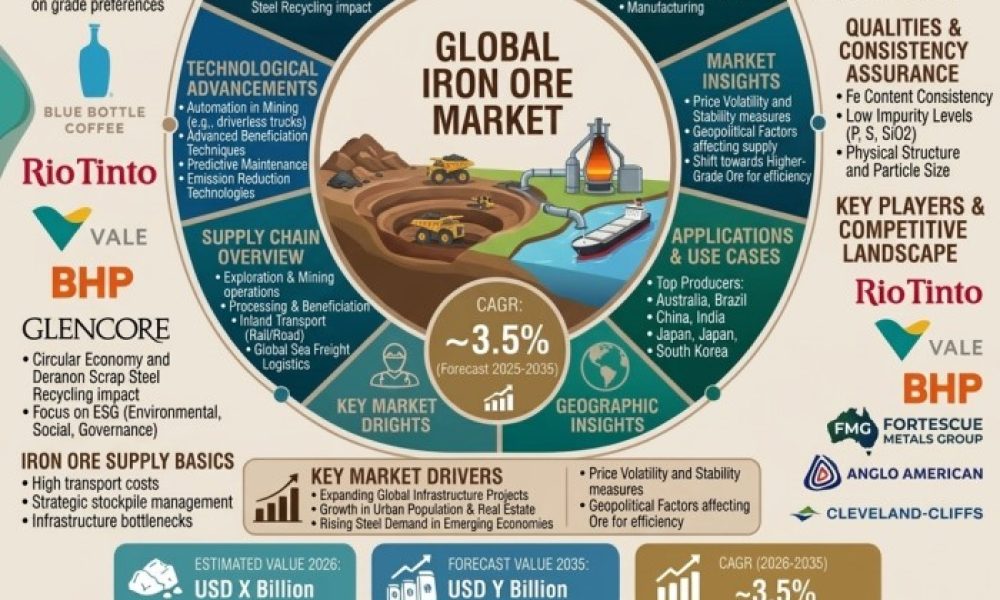
Rising demand for higher-grade feedstock and the development of lower-emission steelmaking routes are reshaping procurement priorities, according to Fact.MR.
NEWARK, Del., October 12, 2026. The global iron ore market is projected to reach USD 449.2 billion by 2036, up from USD 294.9 billion in 2026, expanding at a compound annual growth rate (CAGR) of 4.3%, according to Fact.MR. The market is expected to create an incremental opportunity of USD 154.4 billion over the 2026–2036 forecast period. Demand is supported by steel production requirements, infrastructure investment, expanding steelmaking capacity in India and Southeast Asia, and growing interest in higher-grade iron ore that can improve production efficiency and reduce emissions per tonne of steel.
Get detailed market forecasts, competitive benchmarking, and pricing trends:
Higher-grade ore changes procurement priorities
Steelmakers are placing greater emphasis on ore quality alongside purchase price. Higher iron content and lower impurity levels can improve blast furnace productivity and reduce coke consumption, creating a commercial incentive to pay a premium for suitable feedstock.
The transition toward direct reduced iron (DRI), including hydrogen-based steelmaking pathways, is adding another dimension to sourcing decisions. These processes require specific ore characteristics, which can favor producers with suitable reserves and processing capabilities. Investments in beneficiation and pelletization also offer opportunities to upgrade lower-grade deposits for applications with more demanding quality requirements.
At the same time, the market faces constraints. Concentration of supply among major producers can limit buyers’ negotiating flexibility, while fluctuations in steel demand introduce uncertainty into ore prices, mining investments and production planning. Environmental requirements and permitting constraints can also delay the development of new mining capacity.
Where growth is fastest
Fact.MR identifies China and India as the fastest-growing country markets in its forecast, with Brazil also recording growth above the global average.
- China – 4.9% CAGR: Expanding end-use demand and infrastructure investment support market growth through 2036.
- India – 4.7% CAGR: Increasing steelmaking capacity and infrastructure development create opportunities for additional iron ore consumption.
- Brazil – 4.4% CAGR: The market is projected to expand amid demand across established steelmaking and iron ore supply chains.
- United States – 4.2% CAGR: Demand reflects established industrial requirements and ongoing replacement and upgrade activity.
- Japan – 3.8% CAGR: The market is expected to record steady growth through the forecast period.
- Germany – 3.5% CAGR: Manufacturing activity and continued industrial demand support the European market.
- United Kingdom – 3.2% CAGR: The market is projected to expand at a measured pace through 2036.
What leads the market
Three segments account for substantial shares of the global market in 2026, according to Fact.MR.
- Fines – 48% of product-type share: Fines remain the leading product category, supported by established demand across steelmaking applications.
- Steel industry – 92% of end-use share: Steel production is the dominant source of iron ore demand, encompassing established blast furnace operations and direct reduction pathways.
- Construction steel use – 46% of functional application share: Construction-related steel requirements form the largest functional application category, linking iron ore demand to buildings, bridges and infrastructure projects.
These shares underline the importance of steel production and construction activity to the market’s outlook. They also indicate why changes in steelmaking technology, product specifications and infrastructure investment can influence procurement decisions throughout the iron ore supply chain.
The hurdle: Price volatility and concentrated supply
The main commercial challenge is balancing feedstock quality, cost and supply security. A relatively small group of large producers accounts for a substantial portion of the competitive supply base, potentially limiting steelmakers’ bargaining power. Meanwhile, cyclical steel demand can lead to price volatility and complicate long-term purchasing and mining investment decisions.
New supply is not always easy to bring online. Environmental obligations and permitting constraints can slow mine development, while upgrading lower-grade deposits requires investment in processing infrastructure. Buyers therefore need to evaluate the delivered cost and performance of ore rather than relying exclusively on its purchase price.
Industry investment and competitive outlook
The report identifies product-quality improvements, beneficiation, pelletization and the development of feedstock suited to direct reduced iron production as important areas of opportunity. These priorities could affect how producers allocate capital and how steelmakers structure long-term procurement arrangements.
Fact.MR lists the following companies among the participants profiled in its iron ore market analysis:
Vale; Rio Tinto; BHP; ArcelorMittal; Fortescue Metals Group Ltd; Anglo American; Metalloinvest; Cleveland-Cliffs Inc.; EVRAZ plc; and LKAB.
The report page also contains brief references to company developments in 2025 and 2026. However, it does not provide specific months, verifiable announcement dates or sufficient detail to establish a precise chronology. Those items are therefore not presented here as dated corporate announcements.
Analyst perspective
Shambhu Nath Jha, Principal Consultant at Fact.MR, said:
“The iron ore market is structurally linked to steel production, and steel demand is being sustained by infrastructure investment in developing economies even as Chinese growth moderates. The key commercial dynamic is the widening quality premium for high-grade ore. Steelmakers are paying more per tonne for ore that improves blast furnace productivity and lowers coke consumption, because the efficiency gains more than offset the ore cost premium. This favors producers like Vale and Rio Tinto with large high-grade reserves. The green steel transition is also reshaping demand, because hydrogen-based direct reduction requires specific ore chemistry that not all producers can supply, creating a potential quality-driven market segmentation over the forecast period.”
What this means for steelmakers and procurement teams
- Assess feedstock on a delivered-performance basis. Compare ore grades, impurity levels, processing requirements and expected production efficiency alongside the purchase price. A premium may be commercially justified where measurable operating benefits offset the additional cost.
- Diversify sourcing and review supply exposure. Concentration among major producers and volatility in steel demand can create procurement risks. Buyers should evaluate supplier concentration, contract flexibility and alternative qualified sources when developing purchasing plans.
- Align ore specifications with future steelmaking investments. Companies considering direct reduced iron or other lower-emission production routes should assess the ore-quality requirements of their planned processes. Beneficiation and pelletization options may also be relevant when evaluating supply availability and long-term feedstock costs.
Report details
Fact.MR’s Iron Ore Market Analysis and Forecast examines global market size and growth through 2036, product types, end-use industries, functional applications, mining methods, country-level demand and the competitive outlook.
Explore More Related Studies Published by Fact.MR Research
DPP IV Inhibitors (DPP-4 Inhibitors) Market-
Optical Coherence Tomography Angiography Equipment Market-
About Fact.MR
Fact.MR is a market research and consulting firm providing syndicated research, customized research, investment research, and market intelligence across a broad range of industries. Its research coverage includes food and beverage, healthcare, pharmaceuticals, biotechnology, consumer products, chemicals and materials, technology, industrial goods, and packaging.
Fact.MR provides market intelligence designed to help organizations understand market dynamics, emerging opportunities, competitive developments, and changing industry requirements.
Media Contact
Fact.MR
Email: [email protected]
Phone: +1 (628) 251-1583
Website: www.factmr.com



