
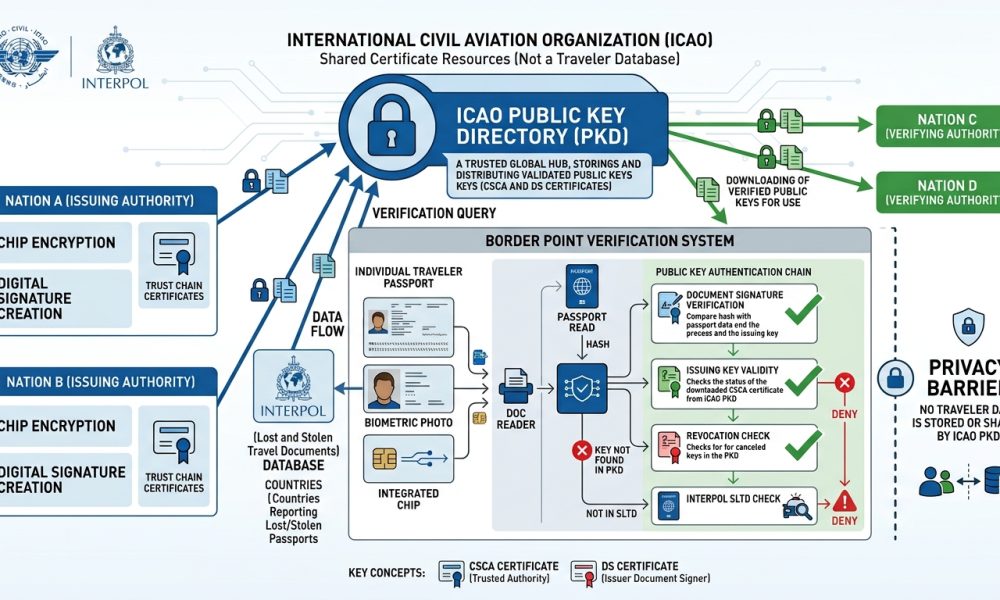
Document status checks help authorities identify travel credentials reported missing, stolen, or otherwise invalid.
WASHINGTON, DC, October 10, 2026 — International border authorities increasingly rely on electronic document status records to identify passports reported lost, stolen, revoked, or otherwise invalid, adding an important security safeguard that operates independently of physical passport inspection and biometric identity verification.
Although modern electronic passports incorporate advanced security materials, digitally signed Information, and biometric photographs, these protective technologies cannot independently establish whether an issuing government has subsequently canceled a document or reported it missing through national or international law enforcement systems.
This distinction has become increasingly important as airports expand automated border control facilities, immigration agencies introduce electronic identity verification systems, and international law enforcement organizations strengthen mechanisms for sharing Information concerning compromised travel documents.
At the center of these efforts is a network of national passport authorities, border management agencies, and international police cooperation arrangements that lets authorized officials investigate documents whose administrative status may have changed since issuance.
For travelers, understanding how these records work helps explain why an apparently genuine passport can trigger a warning at border inspection, why authorities can’t ordinarily refuse documents reported missing, and how they distinguish document-status problems from evidence of identity fraud.
Why Passport Authenticity and Document Status Are Different
A passport’s physical security features and electronic Authentication mechanisms primarily establish whether the document was legitimately produced and whether protected identity Information remains consistent with the records approved during its original issuance.
However, governments may cancel, revoke, or invalidate passports after they enter circulation, leaving an otherwise authentic document without the administrative recognition needed for ordinary international travel.
A passport reported stolen may retain its original polycarbonate Information page, functioning electronic chip, laser-engraved portrait, and valid digital signatures, even though its issuing authority has already recorded the document as unsuitable for continued use.
Consequently, successful electronic Authentication does not eliminate the need for appropriate document status checks, because cryptographic verification establishes the origin and integrity of protected data rather than the passport’s current administrative standing.
This separation is an essential principle of contemporary border security, allowing officials to assess both the Authenticity of the document presented and whether relevant government records indicate its status requires additional attention.
The International System for Reporting Compromised Passports
Governments maintain national systems to record passports that have been lost, stolen, canceled, or otherwise invalidated, with procedures for recording and distributing this Information varying by domestic legislation and administrative responsibilities.
Where international cooperation arrangements permit, authorities can also share relevant Information with law enforcement partners abroad, allowing authorities examining a foreign passport to identify status concerns that originated with the issuing government.
One of the most important international mechanisms is INTERPOL’s Stolen and Lost Travel Documents database, commonly known as SLTD, which supports authorized checks involving documents reported lost, stolen, revoked, invalid, or stolen before personalization.
According to INTERPOL’s official explanation of the Stolen and Lost Travel Documents database, member countries contribute relevant document records that authorized law enforcement personnel can consult when assessing travel credentials presented at airports and other international border crossings.
The database currently contains approximately 138 million records, reflecting the extensive international scale of document reporting and the importance that participating authorities place on identifying credentials whose recognized status has changed.
These records provide Information about specific travel documents rather than serving as a universal register of criminal offenders, so interpreting them is fundamentally different from assessing an individual traveler against criminal intelligence or wanted-person databases.
How Information Enters the INTERPOL Database
When an individual reports a passport missing or stolen, the issuing authority generally follows its national procedures for recording the incident, changing the document’s status, and determining whether relevant Information should be distributed to other government agencies.
Depending on the country, passport authorities may coordinate with national police services, border agencies, or designated international cooperation offices responsible for transmitting appropriate document status Information through authorized channels.
INTERPOL specifies that the issuing country controls the submission of records on its travel documents, with Information entered through its National Central Bureau or other authorized law enforcement organizations.
This arrangement supports accountability by linking document status Information to the government responsible for the original passport, rather than allowing unrelated foreign authorities to modify another country’s official document records independently.
Once the Information becomes available through the appropriate systems, authorized officials in other participating jurisdictions may identify a reported document during relevant checks, subject to national access arrangements and operational procedures.
However, an international record does not mean every border checkpoint automatically queries the same databases, because equipment capabilities, legal permissions, communications infrastructure, and national screening policies differ.
What Happens When a Passport Is Reported Lost
Reporting a passport lost starts an administrative process designed to reduce the risk that someone else could misuse the missing document for travel, Identification, or other activities that require official credentials.
In many jurisdictions, the issuing authority cancels the passport after receiving the report, so the original booklet can no longer be used for ordinary international travel, even if it is later recovered.
This protective measure matters because authorities cannot reliably determine who may have accessed a missing passport while it was outside the holder’s control, creating uncertainty that may persist even after the physical document reappears.
The administrative decision therefore concerns the document’s continued validity rather than its physical condition, which is why a recovered passport may remain electronically readable but still be unacceptable for international travel.
Travelers should follow the issuing authority’s official reporting and replacement procedures rather than assuming that locating the document later automatically restores its previous status or permits continued use.
Why a Recovered Passport Usually Cannot Be Reused
A common misunderstanding occurs when travelers find passports they previously reported missing and assume they can use the recovered documents again because their expiration dates remain unchanged.
In Canada, the federal government explicitly states that a passport reported lost or stolen becomes invalid, and it shares relevant information through authorized national and international channels to reduce the risk of misuse.
Under Government of Canada guidance for lost, stolen, and recovered travel documents, affected passports are canceled, relevant records are communicated to law enforcement and border authorities, and recovered documents must not be returned to ordinary travel use.
The cancellation remains significant even if the document appears undamaged, because the printed expiration date and functioning electronic security components do not override the issuing government’s administrative decision.
A traveler presenting such a document may face boarding difficulties, immigration questioning, or document seizure, depending on the circumstances and the legal procedures used by the authorities involved.
Stolen Passports Present Additional Identity Fraud Risks
A stolen passport can give criminals a genuine government-issued document with authentic security features, creating opportunities for attempted identity misuse that differ from producing completely counterfeit travel credentials.
Because the underlying booklet may be genuine, traditional physical examination can establish that the passport was legitimately manufactured without determining whether the person presenting it obtained the document lawfully.
Biometric comparison and identity questioning can help authorities assess whether the person presenting the document matches its legitimate holder. In contrast, document status records provide separate evidence that the passport has been reported stolen.
These complementary checks strengthen border security because a stolen passport may retain intact security features even though the person attempting to use it has no lawful entitlement to the document.
Coordinated verification matters most when authorities encounter sophisticated identity fraud involving altered personal Information, attempted impersonation, or other cases where genuine documents are misused rather than entirely fabricated.
Stolen Blank Passports Require Special Attention
The international document security system also recognizes the importance of reporting stolen blank passports, which are genuine security booklets that disappear before the issuing authority completes personalization and formally assigns them to legitimate applicants.
Such documents pose different risks than completed passports because their physical materials may come from an authentic government production process, even though their subsequent personalization or intended use is unauthorized.
INTERPOL includes stolen blank travel documents among the categories it supports in its international reporting system, allowing issuing authorities to share Information about compromised passport stock when records are available.
These reports help authorities recognize that genuine printing materials and authentic physical security features do not necessarily establish lawful issuance, especially when a booklet’s provenance or personalization history raises legitimate concerns.
For border agencies, the distinction reinforces the importance of combining physical document examination with administrative records and electronic Authentication rather than relying solely on the appearance of official materials.
Revoked and Invalid Passports Also Appear in Status Records
Although the database is commonly associated with lost and stolen documents, INTERPOL also supports records concerning passports that issuing authorities have revoked or classified as invalid under their applicable domestic administrative and legal procedures.
Revocation or invalidation can occur for different reasons, including replacement, administrative cancellation, and other circumstances recognized under the issuing jurisdiction’s passport laws or document management policies.
A revoked passport may remain physically intact and retain authentic electronically signed data, so its administrative status matters when inspection authorities assess whether it remains acceptable for international travel.
However, a revocation record alone does not explain the circumstances behind the decision, and authorities may need to consult the issuing government or other authorized sources before concluding.
The legal significance of a record also depends on its classification, the applicable national rules, and the Information available to the officials responsible for determining the appropriate response.
How Border Officers Check Passport Status
At an international checkpoint, authorized inspection systems may extract identifying Information from a passport’s machine-readable zone or electronic chip and use it to run relevant document-status searches.
These searches typically rely on document identifiers and associated issuing Information, allowing government systems to determine whether the particular passport has been recorded as lost, stolen, revoked, invalid, or otherwise requiring attention.
INTERPOL explains that authorized officers can access international document records through its secure I-24/7 police communications infrastructure, which supports exchanges between participating law enforcement agencies and approved frontline locations.
The organization also describes frontline access to international law enforcement databases, allowing authorized officials to consult relevant records at airports, seaports, and land crossings, alongside Information available through national systems.
The precise processing sequence differs by country, and not every automated passport control device independently queries international databases during each passenger interaction.
Some jurisdictions integrate relevant screening into centralized border management services, while other arrangements require separate operational systems or additional examination by officers with appropriate access privileges.
Why Automated eGates May Reject Authentic Documents
Automated border gates increasingly combine electronic passport reading, facial recognition, and immigration eligibility checks, but document Authentication and document status verification remain distinct procedures serving different security purposes.
A passport may pass cryptographic verification while an associated administrative record indicates the issuing authority has canceled the document, creating a situation that biometric comparison cannot necessarily resolve.
Depending on the national system’s configuration, an unresolved document status concern may prevent automated clearance and require the traveler to proceed to a staffed checkpoint for additional verification.
Nevertheless, an unsuccessful eGate inspection does not establish that a passport has been reported stolen, because equipment faults, chip communication difficulties, eligibility rules, and immigration record discrepancies can also interrupt automated processing.
Officials must therefore interpret the specific result rather than assume every automated rejection indicates document fraud, criminal activity, or an intentional attempt to evade border requirements.
A Database Match Requires Careful Interpretation
When a document status search produces a potential match, authorities generally need to establish whether the record corresponds to the passport presented and whether the available Information remains sufficiently accurate for the intended decision.
An automated alert can indicate that further investigation is warranted. Still, it should not automatically be treated as proof that the traveler stole the document or knowingly attempted to misuse it.
Administrative errors, outdated records, and circumstances involving legitimately recovered passports can complicate the interpretation of document status Information, making accurate Identification and appropriate procedural safeguards important.
For example, a legitimate passport holder may unknowingly try to travel with a document previously reported missing, even though the issuing government has already invalidated it under its administrative rules.
In such cases, the concern about the document’s status may be genuine. At the same time, the traveler’s personal circumstances differ substantially from those associated with deliberate identity fraud or criminal possession of another individual’s passport.
Airlines Also Participate in Document Screening
International airlines have responsibilities for passenger travel documents and destination entry requirements, creating opportunities for document-related problems to surface before a traveler reaches the receiving country’s immigration checkpoint.
Carriers may use electronic systems to verify passport Information, travel authorizations, and other relevant requirements. However, the available screening capabilities depend on national rules, commercial arrangements, and approved information-sharing procedures.
INTERPOL has also developed initiatives that allow approved private-sector partners to submit certain travel document Information for screening against its lost-and-stolen document records under established cooperation arrangements.
These arrangements do not grant every airline unrestricted access to international police databases, because Information sharing and responses to potential matches remain subject to authorization and operational safeguards.
Early Identification of compromised documents can help prevent unnecessary international journeys and support appropriate law enforcement action, provided the Information is accurate and authorities follow established verification procedures.
Lost Passport Records Are Not Criminal Conviction Records
One of the most important distinctions in international document screening is the difference between a report about a travel document and a criminal record associated with an individual.
A lost or stolen passport database primarily identifies documents whose issuing authorities have reported particular status conditions, rather than establishing that the person presenting a listed document has committed a criminal offense.
The legitimate holder of a stolen passport may be the victim of theft, while someone presenting a recovered canceled passport may simply misunderstand the administrative consequences of previously reporting the document missing.
Although document status Information can contribute to a criminal investigation when additional evidence supports that action, a database match should not replace the independent examination required to establish relevant facts.
This distinction is essential for maintaining confidence in international information-sharing arrangements, because border security systems must support effective document verification without treating every administrative alert as a determination of personal wrongdoing.
Passport Status Checks Differ From INTERPOL Notices
INTERPOL maintains several categories of international law enforcement Information, and its stolen and lost travel document records should not be confused with notices involving individuals wanted for prosecution, investigation, or other authorized police cooperation purposes.
An INTERPOL Red Notice, for example, requests locating and provisionally arresting an individual pending Extradition or comparable legal action. In contrast, a document status record reflects the reported condition of a particular travel credential.
These different Information systems may support separate aspects of border screening. Still, an alert associated with a passport does not automatically establish that its holder is subject to a Red Notice.
Similarly, a person subject to international law enforcement cooperation may hold a genuine passport whose administrative status has not been changed by the issuing government.
Maintaining these distinctions prevents confusion between document Authentication, passport validity, and individual law enforcement Information, each of which requires separate interpretation under applicable legal and operational requirements.
The Relationship Between NFC Chips and Stolen Passport Records
Electronic passports contain contactless chips that let authorized readers retrieve digitally protected Information and run cryptographic checks designed to detect unauthorized changes to specified data groups.
These checks can establish meaningful confidence in the origin and integrity of electronically stored Information. Still, the chip does not ordinarily function as an automatically updated record of every subsequent administrative decision affecting the passport.
A document reported stolen after issuance may therefore continue to present its original electronic Information, including valid digital signatures and a facial Image matching the legitimate holder.
Government systems generally record administrative cancellation rather than remotely changing the signed identity records inside every physical booklet already issued and circulating internationally.
This separation explains why a successful smartphone NFC scan cannot establish that a passport has not been reported missing or canceled, even when the Application completes its supported cryptographic verification procedures.
National Systems and International Cooperation Work Together
The effectiveness of international document status screening depends on cooperation among issuing authorities, national police organizations, immigration agencies, and relevant international information-sharing networks that communicate changes in passport status.
Canada provides a practical example through its procedures for recording reported travel documents in national police Information systems and sharing relevant details with border authorities and international law enforcement partners.
Other countries maintain their own administrative and policing arrangements, meaning the processes for reporting, cancellation, international transmission, and subsequent handling of compromised documents are not necessarily identical worldwide.
National systems also matter because international records may not include every category of administrative restriction or every status change maintained within a particular issuing country’s domestic infrastructure.
Consequently, effective document screening relies on access to reliable Information rather than the assumption that one international database contains a complete, automatically updated record of every passport-related decision.
Data Accuracy and Reporting Delays Remain Important
The usefulness of document status databases depends heavily on the accuracy of submitted Information, the timeliness of updates, and receiving authorities’ ability to interpret records consistently across different operational environments.
Reporting delays can create periods when an issuing government has received Information about a compromised passport, but relevant foreign authorities have not yet obtained the corresponding international record.
Similarly, document identifiers must be recorded accurately to reduce the risk of incorrect matches or failures to recognize compromised credentials during routine electronic screening.
Governments therefore require reliable processes to validate submissions, distribute updates, correct inaccuracies, and respond when inspection authorities identify possible inconsistencies in document status Information.
These administrative responsibilities are as important as the electronic infrastructure supporting the searches, because an advanced verification system cannot compensate for incomplete, incorrect, or poorly maintained records.
Privacy and Access Controls Protect Sensitive Information
International passport status screening raises privacy considerations because document identifiers and associated administrative records can reveal Information about individuals whose travel credentials have been reported missing, canceled, or otherwise invalid.
Participating authorities must therefore establish appropriate legal controls governing who can access sensitive records, how Information may be used, and which organizations are authorized to receive or submit document status Information.
The international exchange of compromised passport records does not automatically authorize unrestricted sharing of every personal detail maintained by national passport agencies, immigration authorities, or law enforcement organizations.
Separating document-status Information from unrelated personal databases helps preserve the distinction between legitimate passport verification and broader government surveillance activities that require different legal powers and safeguards.
Effective governance also requires procedures to correct inaccurate records and ensure relevant authorities can obtain additional Information when a database result needs clarification before consequential action.
What Travelers Should Do After Losing a Passport
Travelers who discover their passports are missing should promptly follow the reporting instructions issued by their governments, especially if the loss occurs abroad and international travel arrangements may require immediate changes.
Depending on nationality and location, appropriate procedures may require contacting a passport authority, embassy, consulate, or local police service before obtaining replacement travel documents or emergency assistance.
Once the issuing authority confirms that the missing passport has been canceled, the traveler should not assume that recovering the physical document restores its validity or permits its use for future travel.
Replacement documents may also require updates to associated airline bookings, electronic travel authorizations, visas, or digital immigration records where applicable procedures require the new passport Information to be registered.
These precautions help reduce unnecessary travel disruptions while ensuring that the traveler relies on documents and administrative records recognized by the issuing authority and the relevant destination government.
The Future of International Passport Status Verification
As international borders become increasingly automated, governments are expected to continue improving the exchange and verification of document status Information alongside electronic passport Authentication, biometric identity checks, and digital immigration processing.
Advances in secure communications and government Information systems may help authorities identify compromised credentials more efficiently, although interoperability and national data Protection requirements will continue influencing how these capabilities develop.
The effectiveness of future arrangements will depend on maintaining accurate administrative records, establishing clear responsibilities for Information exchange, and ensuring that automated alerts remain subject to appropriate verification and human oversight.
International cooperation will remain particularly important because a passport issued in one country may be used across numerous jurisdictions, requiring reliable mechanisms for communicating relevant changes without transferring complete control over national passport records.
These developments reinforce the principle that border security depends on multiple independent assessments rather than treating physical Authenticity, electronic integrity, and current administrative validity as interchangeable characteristics of a travel document.
Document Status Verification Is Essential to Border Security
Lost and stolen passport records provide a critical safeguard by helping authorities identify travel documents that may appear authentic but have been reported missing, stolen, revoked, or otherwise invalid through official government channels.
Through national administrative systems and international cooperation mechanisms such as INTERPOL’s Stolen and Lost Travel Documents database, authorized officers can evaluate Information extending beyond the physical and electronic security features visible during passport inspection.
These checks complement biometric comparison, digital signature Authentication, and immigration eligibility assessments while addressing a separate question: whether the issuing authority still recognizes a document as valid for travel.
For legitimate travelers, the practical implications are significant because reporting a passport missing can result in permanent cancellation, and recovering the original booklet does not necessarily restore its administrative validity.
Ultimately, a genuine passport is not always a valid passport, and effective border security depends on verifying both the Authenticity of the travel credential and the current government records governing its lawful use.




