
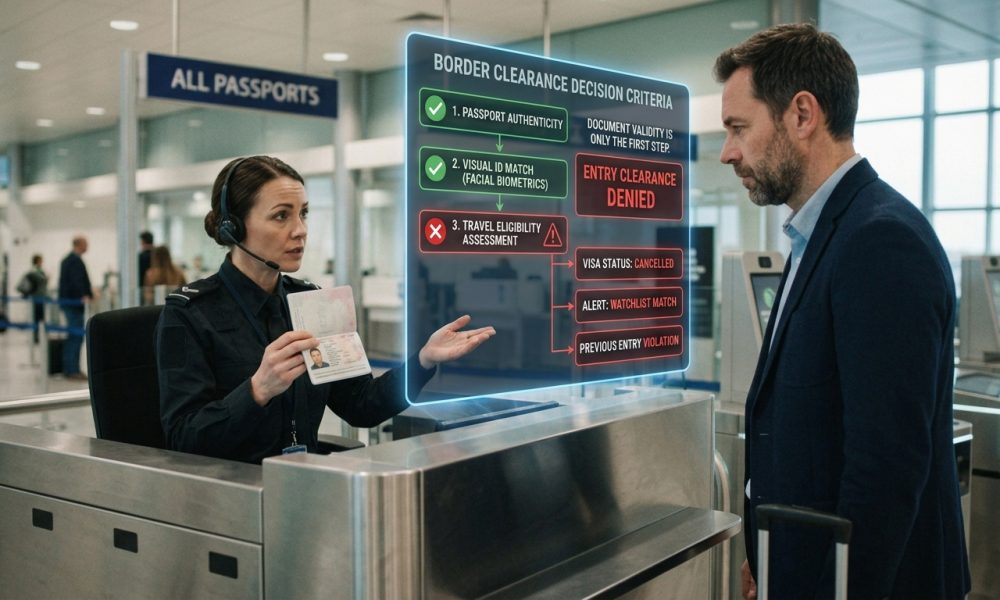
A valid document establishes only part of the Information authorities need to assess a traveler’s eligibility to enter or depart.
WASHINGTON, DC, October 10, 2026 — An authentic passport with a functioning electronic chip, verified digital signatures, and a facial photograph that matches its holder may meet key identity-verification requirements. Still, these characteristics do not automatically guarantee permission to cross an international border.
Across major international airports, immigration authorities increasingly distinguish between the Authenticity of a travel document and the legal eligibility of the individual presenting it, using electronic records, biometric verification, immigration databases, and applicable national legislation to make that determination.
The distinction is becoming increasingly important as countries introduce automated border control gates, electronic travel authorizations, digital immigration permissions, and biometric entry and exit systems that examine Information extending far beyond the passport’s physical and electronic security features.
For international travelers, understanding the difference between document Authenticity and border clearance can help prevent misunderstandings when a genuine passport receives successful electronic Authentication. Still, the traveler nevertheless encounters additional questioning, an immigration referral, or a refusal of entry.
Passport Authenticity and Immigration Eligibility Are Different Questions
A passport serves as an internationally recognized travel document that an issuing government uses to identify its holder and confirm nationality or another recognized status. At the same time, the receiving country independently determines the conditions governing admission.
When authorities inspect a passport, they may first evaluate its physical security features, electronically stored Information, digital signatures, and biometric characteristics to establish confidence that the document is genuine and belongs to the individual presenting it.
However, confirming the Authenticity of a passport does not establish whether the traveler possesses the required visa, satisfies admission conditions, complies with previous immigration decisions, or faces restrictions imposed under applicable national laws.
This separation explains why a traveler may complete electronic document verification and facial recognition yet still be directed to a border officer who must resolve questions about immigration status or entry requirements.
What Electronic Passport Authentication Actually Establishes
Modern electronic passports contain contactless chips that store biographical Information and digitally encoded facial photographs, along with cryptographic security structures that let compatible inspection systems assess whether protected electronic Information remains authentic and unchanged.
Through a procedure known as Passive Authentication, inspection equipment can evaluate the digital signature associated with the passport’s electronic records and determine whether the protected Information corresponds to credentials issued by a trusted government signing authority.
This verification provides important evidence that electronically stored identity Information originated through an authorized document issuance process. However, it does not independently establish whether the issuing government still recognizes the passport as valid for travel.
A passport may therefore have authentic electronic signatures and a legitimate biometric photograph while having subsequently expired, been canceled, or become subject to an administrative restriction requiring examination by the responsible authorities.
These distinctions show why a successful NFC chip read or smartphone passport verification cannot replace official immigration clearance, since electronic Authentication addresses only selected security characteristics of the document rather than the traveler’s full legal circumstances.
A Valid Visa Does Not Guarantee Admission
One of the clearest examples of the distinction between travel documents and immigration permission appears in the United States, where holding a valid visa generally authorizes a foreign traveler to request admission rather than guaranteeing entry.
The U.S. Department of State’s official visa guidance explains that immigration officers at ports of entry determine whether arriving foreign nationals may enter and how long they may remain under the applicable admission rules.
Consequently, an individual may hold a genuine passport with a properly issued, unexpired visa yet still face questions about the intended purpose of travel, past immigration compliance, or other legally relevant admission requirements.
The immigration officer’s assessment may consider whether the proposed activities correspond to the visa classification, whether the traveler remains eligible under immigration law, and whether additional circumstances require further examination before admission.
This distinction matters because the expiration date printed on a visa does not necessarily reflect the authorized length of stay, which may instead depend on the admission decision and related immigration records.
Electronic Travel Authorizations Are Not Border Clearance Decisions
Countries increasingly require certain visa-exempt foreign nationals to obtain electronic travel authorization before boarding transportation to their destination, creating another preliminary screening layer that operates separately from the final decision at the border.
Programs such as the United States Electronic System for Travel Authorization and the United Kingdom Electronic Travel Authorization allow authorities to assess qualifying travelers before departure, subject to each national system’s requirements and limitations.
Although an approved authorization may satisfy a program’s travel requirement, it generally does not remove the destination country’s authority to determine whether the individual meets applicable admission conditions upon arrival.
Travelers should therefore distinguish between receiving permission to travel toward a border, satisfying an airline’s document verification requirements, and obtaining legal authorization to enter the destination country following the applicable immigration inspection.
The growing reliance on digital travel permissions also makes accurate passport Information important, because an authorization tied to a previous document number may not automatically satisfy requirements when an individual later travels with a replacement passport.
Immigration Records Can Affect an Otherwise Valid Passport
Border authorities may consult immigration records concerning previous admissions, authorized periods of stay, visa applications, residence permissions, removal decisions, and other administrative matters relevant to an individual’s eligibility to enter a particular country.
These records exist separately from the cryptographic Information in an electronic passport, so successful document Authentication does not mean the traveler’s immigration history meets every applicable admission requirement.
For example, a traveler previously admitted for a limited period may face additional examination if electronic records suggest the authorized stay was exceeded or relevant immigration conditions were not met.
Likewise, individuals holding residence permissions may face difficulties when their digital immigration accounts contain outdated document details, particularly where the destination country requires electronic records to match the passport used for travel.
Such complications do not necessarily indicate fraud or deliberate noncompliance, since administrative errors and incomplete Information can also require human examination before border officials determine the appropriate course of action.
Europe’s Entry/Exit System Adds Digital Travel History Checks
European border management illustrates how passport Authentication increasingly operates alongside immigration databases that record travel movements and help authorities assess compliance with the conditions governing temporary admission.
The European Union’s Entry/Exit System, launched progressively on October 12, 2025, became fully operational on April 10, 2026, replacing routine passport stamping for covered short-stay travelers with electronically recorded entries and departures.
According to the European Commission’s official Entry/Exit System Information, the system records relevant travel document Information, biometric identifiers, and border crossing events for qualifying non-EU nationals entering or leaving participating European countries.
These records assist authorities in determining whether travelers have complied with permitted periods of stay and provide additional identity verification Information that can be considered during subsequent crossings of the participating countries’ external borders.
A genuine electronic passport may therefore pass its document integrity checks. At the same time, associated immigration records identify a matter requiring examination, demonstrating the practical separation between the Authenticity of a document and compliance with entry conditions.
The system does not mean every international traveler undergoes identical processing, because exemptions and different legal requirements apply to various categories of citizens, residents, long-stay visa holders, and other qualifying individuals.
Automated Border Gates Evaluate More Than Facial Similarity
Automated passport control gates commonly use cameras to compare a passenger’s live facial Image with a trusted reference photograph, helping establish whether the individual presenting the document matches the recorded identity.
However, facial comparison is only one component of a broader inspection process that may include document Authentication, immigration permission checks, eligibility rules, and relevant national security screening arrangements.
A passenger can closely resemble the photograph in an authentic passport yet lack the immigration authorization needed for admission, creating situations where biometric identity verification succeeds but automated clearance cannot proceed.
Conversely, legitimate travelers may be referred for manual inspection because Camera conditions, document reading problems, or administrative discrepancies prevent the equipment from completing its normal verification sequence, even when no immigration violation exists.
These outcomes show why the physical opening of an automated gate should not be interpreted as a facial recognition decision, since operational clearance may depend on multiple checks across connected border management systems.
The United Kingdom Demonstrates the Difference
The United Kingdom operates automated passport gates that allow eligible travelers to complete immigration processing without presenting themselves directly to an officer during every routine arrival, subject to the country’s established eligibility and border control requirements.
According to official UK Border Force guidance on eGate difficulties, passengers may be referred for further examination when authorities need to verify documents, establish identity, assess immigration eligibility, or resolve problems involving required digital permission.
These referrals may occur even when a traveler has a genuine biometric passport, because successful document Authentication alone does not satisfy every legal requirement for entry.
British authorities also identify equipment faults and problems with digital immigration records as possible reasons automated processing may fail, showing that an unsuccessful passage through an eGate does not automatically establish fraudulent identity or unlawful travel.
The distinction remains relevant as the United Kingdom introduces contactless border processing for eligible travelers, since removing the immediate requirement to place a passport on a reader does not eliminate the underlying immigration and security checks.
Security Screening Operates Separately From Passport Authentication
Border agencies may also consult law enforcement records, immigration alerts, and relevant national security Information when determining whether individuals require additional examination before crossing an international border.
These checks involve a different assessment from digital passport Authentication, because the existence of a valid government-issued identity document does not independently resolve questions arising from applicable legal restrictions or authorized security records.
A passenger’s electronic passport may contain legitimate signatures, consistent biographical Information, and an authenticated photograph. At the same time, a separate government system may flag an alert for an immigration or law enforcement officer to review.
Such an alert does not automatically establish wrongdoing, since authorities may need to verify the underlying record, resolve Identification discrepancies, and determine the legal significance of the Information obtained.
Not every country maintains identical database connections or screening arrangements, and travelers should not assume that all automated border systems conduct the same searches or share Information through one universal international platform.
An Authentic Passport May Have Been Revoked or Canceled
Document Authenticity and current validity can also diverge when an issuing authority changes a passport’s administrative status after its original production, without altering the physical booklet or its embedded electronic Information.
A passport reported lost or stolen may retain all its original security features, including a functioning NFC chip and valid cryptographic signatures, even though the issuing government no longer accepts it as an authorized travel document.
Other administrative circumstances may similarly affect document status, depending on the issuing country’s laws and the particular conditions under which the government may cancel, revoke, or otherwise invalidate travel documentation.
This distinction explains why inspection authorities may consult relevant document-status records in addition to examining physical security features and electronically signed data during an international border inspection. An authentic passport therefore provides evidence of government issuance and identity. Still, it does not eliminate the need to determine whether the document remains valid under the relevant administrative and legal framework.
Departure Controls Can Present Separate Legal Requirements
International travelers often focus on the requirements for entering their destination country, overlooking the possibility that leaving the country they are leaving may involve separate legal or administrative controls.
Some jurisdictions conduct systematic exit immigration inspections, while others rely primarily on airline Information, electronic departure records, or selective enforcement procedures rather than requiring every passenger to undergo an identical physical exit examination.
Depending on the applicable national legislation, departure restrictions may arise from judicial orders, immigration enforcement measures, child Protection requirements, or other legally authorized circumstances unrelated to whether the individual possesses a genuine passport.
These restrictions differ considerably between countries, and a legal impediment in one jurisdiction does not necessarily correspond to an identical restriction or enforcement mechanism in another country’s border management system.
Consequently, the Authenticity of a passport cannot independently establish a universal right to depart through every international checkpoint, even though recognized rights of movement and departure are protected under relevant domestic and international legal frameworks.
Citizens and Foreign Nationals Have Different Legal Positions
Another complication is the distinction between citizens returning to their own country and foreign nationals seeking admission, because nationality-based rights can substantially change the immigration assessment.
Under international human rights principles, individuals have recognized protections regarding entry into their own country, although specific constitutional provisions, statutory procedures, and identity-verification requirements vary across jurisdictions.
Foreign visitors ordinarily face a different legal framework, where admission may depend on visas, electronic permissions, permitted travel purposes, admissibility rules, and the receiving government’s authority to regulate noncitizen entry.
Permanent residents and others with established immigration status may fall into additional legal categories, with rights and obligations that cannot be assessed solely by examining the nationality printed in their passports.
These distinctions show why two travelers with equally valid documents may face different processing requirements, because border agencies must apply the legal conditions relevant to each person’s nationality and immigration circumstances.
Airline Boarding Approval Is Not Immigration Admission
Before international departure, airlines normally examine travel documents and relevant destination entry requirements, sometimes using electronic systems that obtain or verify Information concerning passenger eligibility to travel on a particular route.
These checks can include passport validity, visa or authorization requirements, and document Information supplied through applicable passenger processing systems. Still, approval to board an aircraft should not be confused with permission to enter the destination.
Carriers perform their own compliance responsibilities under transportation and immigration requirements. At the same time, government border authorities retain the powers established by national law to inspect arriving passengers and determine their admission status.
A traveler may therefore satisfy an airline’s boarding procedures and arrive with an authentic passport, yet still be required to answer immigration questions or provide additional evidence concerning the proposed visit.
Similarly, an airline may decline boarding because it cannot confirm a required authorization, even when the passenger has a legitimate passport and believes the remaining immigration conditions are met.
Manual Inspection Remains an Essential Safeguard
Although automated systems can evaluate identity data and administrative records efficiently, immigration officers remain important when available Information is incomplete, inconsistent, or insufficient to support a routine automated border clearance decision.
Manual examination may allow authorities to review supporting documents, clarify travel circumstances, correct administrative misunderstandings, or assess identity Information that an automated system cannot reliably reconcile with available records.
A referral to an officer does not necessarily indicate that authorities suspect fraudulent conduct, because routine technical failures and unresolved immigration Information can produce the same operational result as more substantive concerns.
However, a passport’s successful biometric verification does not prevent an authorized officer from examining additional evidence or applying legal requirements outside the scope of the automated document inspection process.
These procedures show why technology supports, rather than replaces, the legal responsibilities of immigration authorities, especially when a decision requires interpreting national legislation or examining circumstances not fully captured in electronic records.
The Importance of Accurate Digital Immigration Records
As more governments adopt electronic visas and digital residence permissions, travelers increasingly depend on accurate links between their passport Information and government systems that store their immigration status or authorization to travel.
A replacement passport, changed name, updated nationality record, or administrative correction can create complications if the relevant immigration platform does not reflect the document Information currently being presented at the border.
These circumstances matter especially for individuals holding long-term residence permissions, because the entitlement may remain legally valid while the electronic records used for automated verification require updating.
Travelers should therefore ensure that relevant government immigration records are current and match the travel documents they intend to use, following each destination country’s official procedures.
Accurate records cannot guarantee border clearance, but they can reduce avoidable discrepancies that might otherwise interrupt automated processing or require additional investigation before immigration authorities can complete an assessment.
Successful Passport Verification Is Only One Layer of Border Security
Modern border management increasingly combines electronic document Authentication, biometric comparison, immigration records, and authorized screening resources, allowing governments to assess different aspects of international travel through complementary verification processes.
Each component addresses a distinct question, including whether the passport data originated from a trusted issuing authority, whether the person presenting it matches the recorded identity, and whether applicable travel conditions have been satisfied.
No single result can reliably answer all of these questions, which is why governments continue to maintain separate document Authentication systems, immigration databases, border inspection procedures, and mechanisms for human review.
The growing use of automated technology may speed up routine crossings for eligible travelers. Still, the underlying legal distinction between possessing a genuine identity document and receiving permission to cross a border remains unchanged.
Authenticity Establishes Identity, Not Automatic Permission
A genuine passport remains an essential foundation of lawful international travel, providing evidence of identity and nationality while allowing authorities to examine recognized security features and electronically authenticated Information during border inspection.
Nevertheless, the right to enter or depart a country depends on additional legal considerations, including citizenship, immigration status, administrative document validity, applicable restrictions, and other requirements established under national law.
For travelers, the key takeaway is that successful NFC verification, valid digital signatures, and a matching passport photograph confirm only specific aspects of document and identity Authenticity, not admission.
As international borders become increasingly automated and connected to digital immigration infrastructures, distinguishing between passport Authentication and border clearance will become even more important for understanding how governments evaluate international travel.
Ultimately, an authentic passport establishes important evidence about the travel document and its holder. Still, border clearance remains a separate legal and administrative determination made under the laws governing the individual crossing.




