
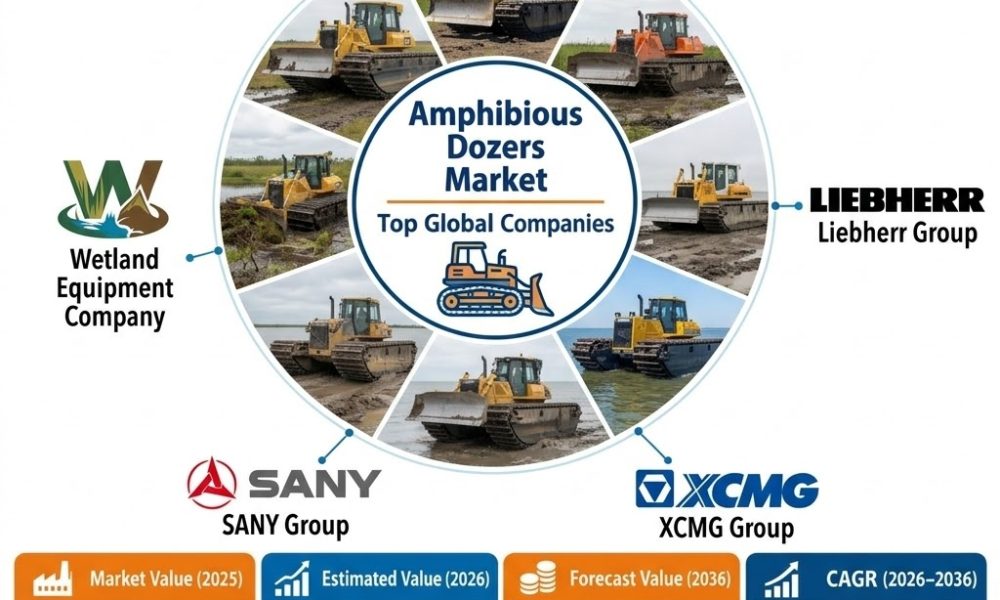
. The global amphibious dozers market is projected to reach USD 2.1 billion by 2036, up from USD 1.2 billion in 2026, expanding at a compound annual growth rate (CAGR) of 5.7%, according to the supplied Fact.MR market analysis. The market was valued at USD 1.1 billion in 2025. The forecast implies an absolute opportunity of USD 0.9 billion between 2026 and 2036.
Demand is being supported by construction and environmental restoration projects that require earthmoving on saturated soil, marshland and floodplains. Unlike conventional dozers, amphibious configurations are designed to maintain mobility on weak ground through specialized flotation and low-ground-pressure systems.
Get detailed market forecasts, competitive benchmarking, and pricing trends: https://www.factmr.com/connectus/sample?flag=S&rep_id=10756
Wetland restoration and flood protection shape demand
Construction on waterlogged terrain presents a practical challenge for contractors. Conventional crawler equipment can lose traction, become immobilized or leave deep ruts when operating on weak soil. Amphibious dozers address these conditions by distributing machine weight over a wider footprint and supporting material movement close to waterways.
Wetland restoration is one source of demand. Projects involving channel reconnection, floodplain reshaping and riverbank stabilization require equipment that can work on saturated ground while limiting the need for extensive temporary access preparation.
Flood-control and drainage projects create another application. Channel improvement, embankment work and infrastructure construction in flood-prone areas can require specialized machines capable of operating where ordinary earthmoving equipment faces mobility constraints.
However, demand remains closely linked to project schedules. Contractors must weigh the benefits of specialized equipment against transport, mobilization, maintenance and utilization costs. Rental arrangements and project-specific equipment packages may offer an alternative for businesses that undertake wetland work only occasionally.
Where growth is fastest
The supplied country forecasts identify Germany and Brazil as the fastest-growing markets among the five countries profiled.
- Germany: 6.6% CAGR, 2026–2036. River restoration, floodplain rehabilitation and wetland rewetting projects create opportunities for specialized equipment used on saturated ground.
- Brazil: 6.0% CAGR, 2026–2036. Drainage infrastructure, flood-risk reduction and Pantanal conservation and restoration initiatives support potential demand.
- United States: 5.4% CAGR, 2026–2036. Wetland restoration, channel improvement and bank-stabilization projects provide applications for low-ground-pressure earthmoving equipment.
- United Kingdom: 4.9% CAGR, 2026–2036. Flood-defence infrastructure, riverbank work and natural flood-management projects create requirements for equipment that can operate on soft ground.
- Japan: 4.3% CAGR, 2026–2036. River improvement, levee reinforcement, drainage work and flood-resilience projects support demand for specialized machinery near waterways.
These growth rates are forecasts from the supplied market extract. They should be reconciled with the currently accessible Fact.MR report page before publication.
What leads the market
The 2026 segment forecasts identify standard amphibious dozers, wetland construction and pontoon-based undercarriages as leading categories.
- Standard amphibious dozers: 38.9% of product demand. These machines balance pushing capacity with transport requirements for wetland and canal projects.
- Wetland construction: 34.2% of application demand. Canal work, riverbank stabilization and material handling on saturated ground underpin this segment.
- Construction companies: 36.7% of end use. Contractors select equipment for infrastructure projects involving marshes, floodplains and areas with limited ground-bearing capacity.
- Pontoon-based systems: 44.5% of undercarriage systems. Their wider footprint supports flotation and helps distribute machine weight across weak soil.
- Medium-power dozers: 41.3% of power output. This category balances pushing force against the weight and mobility constraints of soft terrain.
- Direct sales: 52.6% of distribution. Site-specific configuration, technical guidance and field support make direct supplier engagement relevant to equipment procurement.
The hurdle: utilization and operating costs
The principal commercial challenge is the difficulty of keeping specialized equipment productive between projects. Contractors whose work is concentrated on dry land may struggle to justify purchasing an amphibious dozer for occasional wetland assignments.
Transport and field assembly can add to mobilization costs. Depending on the project, environmental permits and restricted work windows may also affect deployment schedules. Undercarriage wear, sealing requirements and corrosion maintenance can further influence total operating costs.
These considerations make project planning central to equipment selection. Buyers need to assess soil conditions, water depth, pushing requirements, access constraints and expected machine utilization before deciding whether to purchase, rent or subcontract specialized dozing work.
Industry investment and competitive priorities
The supplied analysis identifies infrastructure construction, wetland restoration and flood-control programs as important sources of potential demand. It also points to opportunities for modular pontoon systems, faster field assembly, project-based rentals and remote jobsite support.
The country examples in the source include Germany’s floodplain-restoration initiatives, Brazil’s urban drainage and Pantanal conservation programs, US ecosystem-restoration projects, UK flood-risk management schemes and Japan’s river-improvement measures. Their relevance to individual equipment orders depends on project specifications, procurement decisions and site conditions.
The source lists the following companies as key participants in the market:
- Caterpillar Inc.
- Komatsu Ltd.
- Hitachi Construction Machinery
- Liebherr Group
- XCMG Group
- SANY Group
- Wetland Equipment Company
Competition involves more than blade power. Buyers also evaluate flotation, ground pressure, transport dimensions, assembly time, undercarriage durability and access to service technicians and spare parts. Manufacturers and specialized suppliers that can configure machines for site conditions and support deployment may be better positioned to compete for project-based requirements.
Analyst perspective
Shambhu Nath Jha, Principal Consultant, Fact.MR, states:
“Amphibious dozer demand is governed less by routine fleet replacement than by whether a contractor can place productive pushing power on ground that ordinary equipment cannot support. Buyers are therefore comparing flotation, ground pressure, transportability, field assembly, service response and the amount of site preparation a machine can eliminate. Suppliers that solve those operating constraints can capture demand across wetland restoration, flood-control and infrastructure work.”
What this means for construction buyers
- Match the machine to the site. Evaluate ground strength, water depth, material type and required pushing force before choosing an amphibious configuration. A larger machine is not automatically the best choice if its weight creates transport or mobility constraints.
- Compare ownership with project-based access. Contractors with intermittent wetland assignments should compare purchase costs with rental, mobilization and subcontracting options. The decision should account for the expected number of operating days and the cost of preparing temporary access routes.
- Include service support in procurement. Assess undercarriage durability, corrosion protection, spare-parts availability and field-service response alongside the initial equipment price. Delays caused by unavailable parts or difficult repairs can affect productivity during restricted construction windows.
Report coverage
The Amphibious Dozers Market analysis covers product type, application, end use, undercarriage system, power output and distribution channel, with country-level forecasts and competitive analysis.
Top Trending Reports:
Emergency Warning Lights Market https://www.openpr.com/news/4510481/emergency-warning-lights-industry-moves-toward-smart
Hydrocyclone Market https://www.openpr.com/news/4510493/hydrocyclone-market-gains-momentum-as-water-recovery
About Fact.MR
Fact.MR is a market research and consulting firm providing market intelligence, industry analysis and strategic insights across multiple sectors. Its research covers market sizing, growth forecasts, competitive developments and industry trends.



