
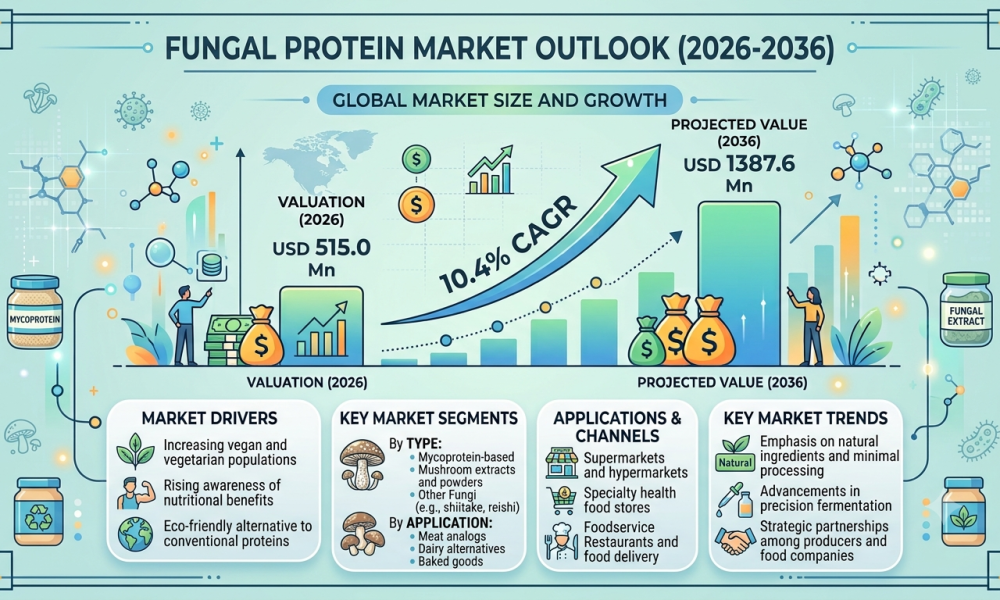
The global fungal protein market is projected to grow from USD 515.0 million in 2026 to USD 1,387.6 million by 2036, registering a CAGR of 10.4% during the forecast period. Demand is supported by food manufacturers’ efforts to diversify protein sourcing beyond conventional animal and plant ingredients, alongside advances in fermentation technology and expanding commercial production capacity. Fungal protein is gaining attention for its protein content, fibrous texture, and potential applications across beverages, prepared foods, bakery products, meat alternatives, and animal nutrition.
Commercial opportunities are expanding as ingredient manufacturers develop fungal and yeast proteins for specific food and feed applications. Yeast remains an important source because of established fermentation processes and familiarity among food manufacturers, while the food and beverage segment benefits from opportunities to incorporate fungal protein into existing formulations. However, commercial adoption depends on production economics, sensory performance, processing stability, and regulatory clearance for individual ingredients and manufacturing processes.
Get detailed market forecasts, competitive benchmarking, and pricing trends: https://www.futuremarketinsights.com/reports/sample/rep-gb-14432
Global Segment Leaders
- Source – Yeast: 37.8% in 2026. The segment benefits from established fermentation infrastructure, familiar production methods, and existing applications for yeast-derived ingredients in food and nutrition products.
- End-Use Application – Food & Beverage: 37.4% in 2026. Demand is supported by opportunities to incorporate fungal protein into beverages, bakery products, prepared foods, and meat alternatives, subject to formulation requirements.
- Commercial Application – Food Formulation: Manufacturers are evaluating fungal protein for protein fortification, fibrous texture, and ingredient diversification. Successful adoption depends on product-specific sensory testing and processing compatibility.
Country-Level Performance
The United States is projected to grow at a CAGR of 12.7% through 2036, the highest rate among the countries profiled. Growth is supported by protein reformulation initiatives, food-ingredient innovation, and regulatory developments for defined fungal biomass ingredients. In November 2025, the U.S. Food and Drug Administration closed GRN 1255 with no questions for Fusarium compactum fungal protein intended for multiple food categories.
Japan is forecast to record a CAGR of 12.3%, supported by food technology development, fermentation expertise, and opportunities to incorporate fungal protein into convenient, high-protein food formats. The country’s focus on food technology provides a potential route for new production approaches, although consumer preferences and ingredient-specific evaluation remain important.
The United Kingdom is projected to expand at a CAGR of 11.1%. Existing familiarity with mycoprotein products provides a foundation for evaluating newer fungal protein ingredients. Food manufacturers can explore applications in familiar savory foods and packaged products, while individual ingredients must still meet relevant regulatory requirements and demonstrate acceptable taste and processing performance.
Germany is expected to register a CAGR of 10.3%, supported by its established food manufacturing base, technical formulation capabilities, and access to the European Union market. Food manufacturers may evaluate fungal proteins for bakery products, sports nutrition, and other protein-fortified applications, provided ingredients satisfy applicable safety and processing specifications.
South Korea is forecast to grow at a CAGR of 8.9%. Food technology initiatives and established branded-food manufacturers create opportunities for new protein ingredients in convenience foods and high-protein products. Commercial progress will depend on ingredient qualification, regulatory requirements, and partnerships with local food manufacturers.
Regional Context
The United States and Japan represent the fastest-growing markets among the five countries profiled, with projected CAGRs of 12.7% and 12.3%, respectively. Both markets offer opportunities for ingredient developers to work with food manufacturers on protein reformulation, product development, and application-specific testing. Regulatory review and consumer acceptance will influence the pace at which new ingredients progress from trials to recurring commercial orders.
The United Kingdom and Germany are also expected to record double-digit growth, at 11.1% and 10.3%, respectively. Familiarity with mycoprotein in the UK and Germany’s food manufacturing capabilities provide potential routes for product qualification. South Korea, with a projected CAGR of 8.9%, offers opportunities through food technology development and partnerships with established food companies.
The full report covers North America, Latin America, Western Europe, Eastern Europe, East Asia, South Asia and Pacific, and the Middle East and Africa, with country-level forecasts for key markets.
Access full Report in PDF Format@ https://www.futuremarketinsights.com/reports/brochure/rep-gb-14432
Competitive Landscape
The competitive landscape includes Angel Yeast Co., Ltd., The Protein Brewery, Enifer, Revyve, MycoTechnology, Inc., Lallemand Bio-Ingredients, Onego Bio, and The EVERY Company. Competition is shaped by fermentation efficiency, production scale, ingredient functionality, regulatory readiness, application support, and the ability to meet food manufacturers’ cost and quality requirements. Direct fungal and yeast protein producers compete alongside fermentation-based ingredient platforms that develop specialized proteins for food applications.
Recent developments reflect growing investment in production capacity and commercialization. In September 2025, Enifer secured self-affirmed generally recognized as safe (GRAS) status for PEKILO mycoprotein for food applications in the United States. In November 2025, Angel Yeast began operating an annual 11,000-ton yeast protein production line at Baiyang Biotechnology Park in Yichang, China. In June 2026, The Protein Brewery reported European Union authorization for Fermotein following positive voting by all 27 member states for its novel mycelium ingredient. These developments highlight the importance of production scale, regulatory progress, and customer qualification in advancing fungal protein commercialization.
About Future Market Insights (FMI)
Future Market Insights, Inc. (ESOMAR certified, recipient of the Stevie Award, and a member of the Greater New York Chamber of Commerce) offers profound insights into the driving factors that are boosting demand in the market. FMI stands as the leading global provider of market intelligence, advisory services, consulting, and events for the Packaging, Food and Beverage, Consumer Technology, Healthcare, Industrial, and Chemicals markets. With a vast team of over 400 analysts worldwide, FMI provides global, regional, and local expertise on diverse domains and industry trends across more than 110 countries.



