
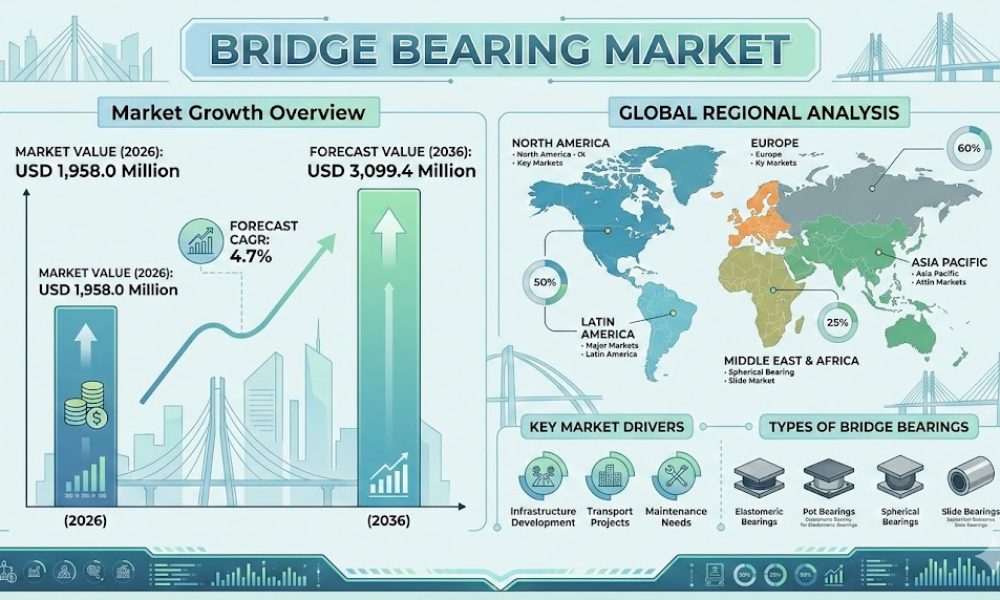
The Bridge Bearing Market is projected to reach USD 3.1 billion by 2036, up from USD 1.9 billion in 2026, expanding at a 5.1% CAGR during the forecast period. Demand is being supported by new bridge construction and rehabilitation programs, where engineered bearing systems provide defined load-transfer points between bridge structures and their supports.
Get detailed market forecasts, competitive benchmarking, and pricing trends: https://www.futuremarketinsights.com/reports/sample/rep-gb-4955
Global Segment Leaders
The market’s leading segments in 2026 highlight the importance of bearing configuration, material selection, and bridge application:
- Spherical bearings account for 28.0% of bearing type demand.
- Steel represents 59.0% of material type demand.
- Highway bridges account for 46.0% of bridge type demand.
These segments reflect the importance of reliable load-transfer solutions for bridge structures where bearing selection must correspond with design loads, structural requirements, and project specifications.
Market Growth Drivers
Bridge bearings are essential at engineered support locations where structural loads must be transferred while accommodating movement and other design requirements. Both new bridge construction and rehabilitation projects require appropriately specified bearing systems.
The continued development and maintenance of road infrastructure therefore creates demand for both new bearing installations and replacement packages. Project qualification and engineering specifications play an important role because bearing systems must match the requirements established for individual bridge structures.
Bridge Construction and Rehabilitation Support Demand
New bridge construction creates demand for bearing systems during the initial structural installation, while rehabilitation programs generate replacement requirements for existing infrastructure.
In June 2025, the U.S. Department of Transportation made nearly USD 4.9 billion available for major bridge projects. While this funding does not directly determine the Bridge Bearing Market forecast, it supports bridge project activity and can sustain schedules for new bearing installations and replacement packages.
Bridge-bearing demand therefore remains closely connected to the broader investment cycle in road and highway infrastructure.
Spherical Bearings Lead Bearing Types
Spherical bearings are estimated to account for 28.0% of bearing type demand in 2026, making them the leading bearing category.
Bearing selection depends on the structural requirements of each project, including design loads and the need for an appropriate load-transfer mechanism. Engineering teams evaluate bearing configurations based on bridge design, expected loading, movement requirements, and project specifications.
Steel Dominates Material Demand
Steel represents 59.0% of material type demand in 2026, highlighting the importance of steel-based bearing solutions in bridge infrastructure.
Material selection is influenced by structural requirements, durability expectations, design specifications, and the operating environment. Because bearings form part of an engineered bridge support system, material choices are generally tied to project qualification and approved specifications.
Highway Bridges Represent the Largest Bridge Type Segment
Highway bridges account for 46.0% of bridge type demand in 2026, making them the leading application segment.
Highway infrastructure requires ongoing investment not only for new construction but also for rehabilitation and maintenance of existing structures. Bearing systems are incorporated into these projects as engineered load-transfer components, creating demand across both new-build and replacement applications.
Design Qualification Influences Purchasing Decisions
Bridge bearing procurement is highly specification-driven. Buyers must ensure that the selected bearing is appropriate for the structural loads and design requirements of a particular bridge.
Qualification requirements can limit substitution because alternative bearing designs or materials may require engineering review and project approval. This creates a more structured purchasing process than simple component replacement.
Restricted Access Can Complicate Replacement
Replacement work can become more challenging when bearings are located in areas with restricted access. Bridge rehabilitation teams must account for site conditions, accessibility, lifting requirements, and the practical constraints associated with removing and installing bearing systems.
These considerations can influence project scheduling and replacement strategies, particularly where existing bridge structures limit access to bearing locations.
Competitive Landscape
Competition in the Bridge Bearing Market centers on bearing configuration, material selection, structural compatibility, project qualification, and installation requirements.
Manufacturers and buyers are likely to evaluate:
- Bearing type and load-transfer configuration
- Steel and alternative material options
- Design-load compatibility
- Bridge type and structural application
- Project qualification requirements
- Replacement and rehabilitation needs
- Site accessibility
- Installation and maintenance requirements
Suppliers that can meet project-specific engineering specifications while supporting installation and replacement requirements remain important to infrastructure contractors and bridge project stakeholders.
Get the Complete Story—Read More About Our Latest Report
The Bridge Bearing Market report provides analysis of market growth, bearing types, materials, bridge types, and other factors shaping demand through 2036.
Explore the full Bridge Bearing Market report: https://www.futuremarketinsights.com/reports/bridge-bearings-market
Analyst Perspective
“Bridge bearing demand remains closely tied to infrastructure construction and rehabilitation because every engineered support point requires a bearing solution matched to structural loads and project specifications. Steel accounting for 59.0% of material demand and highway bridges representing 46.0% of bridge type demand highlight the importance of established structural applications. At the same time, qualification requirements and restricted site access can make bearing replacement a technically demanding process,” says Nikhil Kaitwade, Future Market Insights.
About Future Market Insights (FMI)
Future Market Insights, Inc. (FMI) is an ESOMAR-certified, ISO 9001:2015 market research and consulting organization, trusted by Fortune 500 clients and global enterprises. With operations in the U.S., UK, India, and Dubai, FMI provides data-backed insights and strategic intelligence across 30+ industries and 1200 markets worldwide.
For Press & Corporate Inquiries
Rahul Singh
AVP – Marketing and Growth Strategy
Future Market Insights, Inc.
+91 8600020075



