
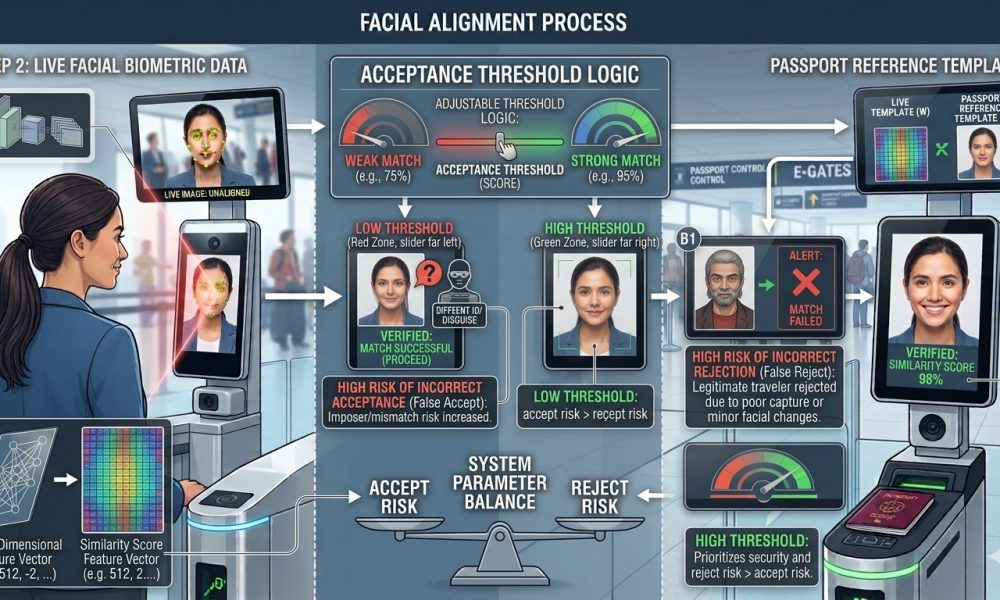
System settings balance the risk of accepting an incorrect facial match against the competing risk of rejecting a legitimate traveler, making threshold selection one of the most important operational decisions within automated biometric border processing.
WASHINGTON, DC, October 6, 2026 — When an automated border gate compares a traveler’s live facial Image with the reference portrait associated with a passport, the recognition algorithm usually produces a similarity score rather than an absolute declaration that the two photographs unquestionably belong to the same person.
Before the system can decide whether to continue processing automatically, it must evaluate that similarity score against an acceptance threshold, which sets the minimum level of biometric correspondence considered sufficient for the border-control workflow configured by the responsible authority.
The threshold therefore acts as a decision boundary between comparisons that satisfy the automated system’s requirements and comparisons that require another outcome, such as a new photograph, additional document examination, or referral to a border officer for further assessment.
Although travelers rarely see this calculation, threshold selection can directly affect how often genuine passengers move through an automated gate successfully and how aggressively the system guards against accepting facial comparisons between two different individuals.
A Similarity Score Requires a Decision Rule
Modern facial recognition software typically converts the live traveler Image and the reference photograph into mathematical representations before calculating how closely those representations correspond according to the recognition algorithm’s internal comparison method.
That calculation produces a similarity score, but the score alone does not tell the border system what action to take because authorities must first establish what level of similarity is sufficient for automated processing under their specific security requirements.
The acceptance threshold provides that operational rule by separating scores strong enough for the intended verification task from scores below the level required for an automatic biometric match.
If a traveler’s comparison exceeds the configured threshold and other required checks are satisfied, the automated system may permit processing to continue. In contrast, a comparison below the threshold can result in recapture or additional examination.
Thresholds Convert Mathematics Into Operational Decisions
A facial recognition algorithm can generate a continuous range of similarity values, meaning the system could potentially describe two faces as more or less similar without immediately reducing that complex mathematical relationship to a simple yes-or-no outcome.
Border operations, however, eventually require an actionable decision, so authorities must define a point at which biometric similarity becomes strong enough for the automated process to treat the facial comparison as successful.
That transition from numerical measurement to operational result is where the acceptance threshold becomes essential, because the setting determines which similarity scores will pass automatically and which results will require another form of processing.
The threshold therefore does not change the photographs or mathematical representations themselves, but it changes how the border system interprets the similarity produced when it compares those representations.
A Higher Threshold Demands Stronger Facial Similarity
Raising the acceptance threshold requires a facial comparison to produce stronger mathematical correspondence before the automated system treats the traveler and reference portrait as sufficiently similar for the intended verification process.
This stricter setting can reduce the likelihood that photographs of two different individuals happen to generate enough similarity to satisfy the system, which is particularly important when authorities prioritize minimizing incorrect acceptance.
However, raising the threshold can also cause more legitimate travelers to fall below the required level when differences involving aging, lighting, expression, Camera quality, or head position weaken otherwise genuine comparisons.
This tradeoff means authorities cannot raise the threshold indefinitely without affecting legitimate passenger processing, because increasingly strict requirements can create more situations where genuine travelers need additional examination.
Lower Thresholds Produce the Opposite Effect
Lowering the acceptance threshold allows facial comparisons with less mathematical similarity to pass, potentially helping legitimate travelers whose current appearance differs substantially from the portrait stored with their travel document.
Such a setting can reduce unnecessary rejection when ordinary photographic differences affect the comparison, allowing more genuine passengers to complete automated processing without intervention from a border officer.
The competing consequence is that lowering the threshold may also increase the possibility that two different individuals produce sufficient similarity to satisfy the automated decision rule, depending upon the performance characteristics of the particular recognition algorithm.
Threshold selection therefore requires authorities to balance competing risks rather than searching for one universal setting that can eliminate every incorrect acceptance and every incorrect rejection simultaneously.
False Matches Represent One Side of the Tradeoff
A false match occurs when facial images belonging to different individuals generate similarity sufficient to cross the system’s acceptance threshold, causing the biometric process to treat a non-genuine comparison as though the images corresponded adequately.
Reducing false matches is particularly important in identity-verification environments because an incorrect acceptance could undermine the purpose of comparing the person physically present with the reference identity associated with the travel document.
A stricter threshold can generally make such events less likely by requiring stronger similarity before the system accepts the comparison. However, the exact relationship depends upon the algorithm, Image conditions, and implementation involved.
The National Institute of Standards and Technology’s facial recognition evaluations assess algorithm performance using measures that include false-match and false-non-match behavior, helping organizations understand the consequences of different operating points.
False Non-Matches Affect Legitimate Travelers
A false non-match occurs when two facial images that genuinely belong to the same person do not produce enough similarity to meet the selected acceptance threshold, causing the automated process to reject a legitimate comparison.
These outcomes can result from image-quality problems, significant aging, unusual expressions, temporary changes in appearance, or other differences between the reference photograph and the live capture obtained by the border Camera.
Raising the threshold can increase the frequency of these unsuccessful genuine comparisons because even legitimate facial pairs must produce progressively stronger similarity before the system treats them as automatically acceptable.
For travelers, the practical consequence may involve another photograph or officer review. Still, high false-non-match rates can reduce passenger throughput and increase the operational burden placed on border personnel.
No Threshold Eliminates Both Errors
Threshold selection is difficult because false matches and false non-matches generally move in opposite directions as authorities adjust the point required for automated acceptance within a given recognition system.
Increasing the threshold can reduce incorrect acceptances but may increase legitimate rejections, whereas lowering it can let more genuine passengers pass while potentially allowing more non-genuine comparisons to satisfy the system.
This relationship means biometric performance cannot be summarized meaningfully by claiming one threshold is universally safer or more accurate without identifying which error type takes priority in the Application.
A carefully configured border system therefore considers both error types alongside operational consequences, passenger volume, available officer resources and the wider security mechanisms surrounding the facial recognition process.
Border Authorities Choose an Operating Point
An operating point describes how a biometric system performs at a specific threshold, linking the recognition algorithm’s underlying capabilities to the practical security requirements set by the organization using it.
Authorities can examine large numbers of genuine and non-genuine comparisons during evaluation to determine how frequently different threshold settings produce false matches and false non-matches under conditions intended to represent actual operational use.
That evidence allows system designers to select an operating point appropriate for the consequences associated with the border environment rather than choosing a threshold simply because a particular numerical value appears intuitively strict.
The final setting can therefore represent a policy and risk-management choice informed by technical performance, making threshold configuration both an engineering decision and an operational security decision.
Different Applications Can Require Different Thresholds
A facial recognition system used to unlock a personal device does not necessarily require the same operating characteristics as technology that controls access to a secure facility or supports automated processing at an international border checkpoint.
Each environment has different consequences when the system makes an incorrect decision, so organizations can reasonably select different thresholds even when using recognition technology based on broadly similar mathematical principles.
A border authority processing large passenger volumes may need to maintain very low false-match rates while also ensuring that unnecessary false non-matches do not overwhelm officers responsible for handling exceptions.
The selected threshold therefore reflects the deployment environment rather than a universal mathematical definition of the facial similarity required to establish identity in every possible situation.
The Same Algorithm Can Operate Differently Under Different Settings
Two organizations could theoretically deploy the same facial recognition algorithm and produce different operational outcomes because each authority might choose different thresholds based on its risk tolerance and processing requirements.
One deployment could emphasize extremely strict automated acceptance and send more travelers to manual review. At the same time, another could select a different operating point because additional security controls elsewhere in the process affect the overall risk calculation.
This distinction explains why knowing the name of a recognition algorithm does not necessarily reveal how an airport or government agency has configured its biometric decision process in practice.
Understanding operational facial recognition requires examining both the technology’s underlying performance and the threshold rules used to convert similarity scores into automated decisions.
A Threshold Is Not a Universal Percentage
Because facial recognition algorithms use different scoring scales, a threshold expressed as a specific number in one system cannot automatically be compared with the same number in another recognition platform.
A system using an acceptance threshold of 80, for example, should not be interpreted automatically as requiring 80 percent certainty, because the number may represent an internal similarity scale rather than a probability of identity.
Another recognition system could produce mathematically equivalent performance using decimal values, distances, or entirely different numerical conventions, demonstrating why raw thresholds have little meaning without information about the algorithm that generated the scores.
The operationally important question is therefore how well the threshold separates genuine comparisons from non-genuine comparisons within the relevant system, rather than whether thethreshold’ss numerical value appears high or low.
Reference and Live Images Influence the Result
Thresholds determine how similarity scores are interpreted, but the score itself depends heavily upon the quality of the facial images supplied to the recognition algorithm during the comparison process.
A clear passport portrait and a high-quality live airport photograph can provide far more reliable information than photos affected by blur, extreme pose, heavy shadow, or obstruction, allowing the algorithm to generate stronger mathematical representations.
When Image quality deteriorates, genuine comparisons may produce lower similarity and become more likely to fall below a strict threshold, even when the traveler unquestionably corresponds with the identity represented by the document.
This relationship explains why airport biometric systems combine threshold settings with camera-quality controls and image-assessment procedures instead of relying exclusively on the final similarity number.
Recapturing the Image Can Change the Outcome
A traveler whose first photograph falls below the acceptance threshold may produce a successful comparison seconds later if another capture improves lighting, facial orientation, focus, or other conditions affecting the Image.
The person’s identity and passport have not changed between those attempts. Still, the mathematical representation produced from the second photograph may contain better biometric information and consequently generate stronger similarity with the reference Image.
Automated systems can use recapture procedures precisely because a single weak comparison does not necessarily demonstrate that the two images belong to different people or that the travel document presents an identity problem.
Allowing another capture can therefore reduce unnecessary manual referrals while preserving the configured security threshold, improving biometric evidence quality rather than weakening the acceptance standard.
Aging Can Push Genuine Scores Downward
Passport validity periods can span many years, creating situations where a traveler’s current appearance differs significantly from the photograph captured during enrollment, even though both images unquestionably represent the same individual.
Normal changes in skin texture, hairlines, facial weight, and other visible characteristics can affect the similarity score generated by recognition software, making age differences an important consideration when evaluating genuine comparison performance.
Modern algorithms are designed to accommodate reasonable aging. Still, resilience varies across systems and can interact with the selected threshold when determining whether an older reference photograph remains suitable for automated verification.
A system using an especially strict threshold may therefore refer some legitimate travelers for additional review when long intervals between photographs reduce similarity below the configured acceptance point.
Lighting Can Affect Whether a Genuine Comparison Passes
Lighting conditions alter shadows, contrast, and visible facial detail, meaning the same person can generate noticeably different recognition scores when photographed under bright frontal illumination compared with uneven or poorly controlled lighting.
Airport designers therefore try to create capture environments with reasonably consistent illumination, reducing the chance that avoidable lighting differences weaken legitimate facial comparisons enough to fall below the operational threshold.
The threshold remains unchanged, but better Image acquisition helps genuine comparisons meet it more consistently because the recognition model receives clearer information to build the live facial representation.
This distinction shows why effective biometric deployment depends on the entire capture and comparison pipeline, not just choosing a sophisticated recognition algorithm and setting a numerical acceptance point.
Head Position Can Influence Threshold Outcomes
A traveler looking directly at the Camera generally provides more usable facial information than someone turning significantly to one side, because rotation can distort apparent geometry and hide parts of the face from the Camera.
Alignment software can compensate for manageable differences, but extreme pose can still reduce similarity and potentially push a genuine comparison below the threshold selected for automated acceptance.
Visual instructions at eGates frequently encourage travelers to look directly toward the Camera because standardized positioning improves the quality of the information entering the recognition process before the similarity calculation occurs.
Good capture practices therefore help authorities maintain strict thresholds without creating unnecessary rejection simply because travelers were photographed under preventable conditions that weakened otherwise valid comparisons.
The Passport Portrait Provides the Trusted Reference
In a typical one-to-one automated border verification process, the system compares the traveler’s live facial Image with an authorized reference portrait linked to the identity presented during inspection.
The International Civil Aviation Organization’s border control guidance discusses biometric verification as an important component of automated border processing, where a live traveler sample can be compared with biometric information associated with an electronic travel document.
The acceptance threshold determines how closely those representations must match for the biometric component to consider the comparison successful. However, the broader border system can still conduct separate checks involving the document and traveler.
Facial acceptance should therefore be understood as one completed stage within a layered border process rather than a comprehensive decision resolving every question about document Authenticity, immigration status, or travel eligibility.
One-to-One Verification Differs From Database Identification
Threshold behavior must also be interpreted differently depending upon whether the system performs one-to-one verification or one-to-many Identification, because those biometric tasks involve different numbers of comparisons and different operational risks.
One-to-one verification asks whether a live traveler corresponds with one expected reference identity. At the same time, one-to-many Identification compares a facial representation against numerous enrolled candidates to determine whether any candidate appears sufficiently similar.
Searching larger galleries introduces different statistical considerations because every additional comparison creates another opportunity for an unrelated face to produce an unusually strong similarity score by chance.
Thresholds used for direct passport verification therefore should not automatically match thresholds used for large-scale biometric Identification, even when both applications rely on facial recognition technology.
Thresholds Work Alongside Document Authentication
A successful facial comparison does not independently prove that a passport is authentic because biometric similarity addresses whether the traveler resembles an authorized reference rather than whether the physical and electronic document has legitimate security characteristics.
Modern electronic passports contain cryptographically protected information that supports separate Authentication processes intended to assess whether digital data has the expected relationship with the issuing authority and remains consistent with protected document information.
Likewise, physical passport examination can assess printing, materials, and security features that facial recognition does not evaluate, giving border systems several independent methods for detecting different categories of identity or document problems.
Amicus International Consulting has examined these distinctions in its overview of modern passport security and biometric verification, explaining why physical, electronic, and biometric checks provide separate but complementary layers of Protection.
Passing the Facial Threshold Does Not Guarantee Border Clearance
A traveler can exceed the facial recognition threshold. At the same time, another part of the border inspection process may identify an issue requiring examination, because biometric correspondence is only one component of the overall decision environment.
Authorities may separately evaluate travel-document validity, immigration requirements, and authorized security information, none of which becomes irrelevant simply because the live facial representation resembles the reference portrait strongly enough for automated biometric acceptance.
The reverse can also occur when a traveler holds a valid document and satisfies other entry requirements but receives additional processing because the automated facial comparison falls below the configured threshold.
Separating these functions helps explain why the result displayed by an eGate should not be interpreted as though facial recognition alone determines every aspect of a traveler’s border status.
Failing the Threshold Does Not Establish Impersonation
When a comparison falls below the acceptance threshold, the system has determined only that the available biometric evidence did not satisfy the level required for automated acceptance under the current configuration.
That outcome does not independently establish that the traveler is an impostor, because false non-matches are a recognized characteristic of biometric systems and can arise from legitimate variation or inadequate Image quality.
A border officer can examine the document, visually compare the traveler, and review other authorized information, providing a broader assessment than the facial recognition algorithm can through similarity calculation alone.
This layered process allows authorities to preserve demanding automated thresholds without treating every technically unsuccessful comparison as evidence of deliberate identity fraud.
Thresholds Influence Passenger Flow
Even small changes to acceptance thresholds can have meaningful operational consequences when an international airport processes thousands of passengers through biometric checkpoints during busy travel periods.
A configuration that produces slightly more false non-matches can generate substantial additional referrals when applied across a large passenger population, increasing queues and requiring more officer time for cases automation could not resolve.
Conversely, reducing referrals by lowering the threshold must be evaluated against the effect on false-match risk, particularly when the purpose of the biometric process is to provide reliable identity confirmation.
Airport biometric design therefore involves both security engineering and capacity planning, because the chosen operating point affects not only statistical performance but also passengers’ physical movement through the border environment.
Authorities Need Representative Testing
Thresholds should be selected using performance evidence that reflects realistic operating conditions rather than relying solely on ideal laboratory photographs, because airports introduce variations in lighting, movement, cameras, age differences, and traveler behavior.
Testing across representative Image conditions can reveal how often genuine travelers fall below different thresholds and how often non-genuine comparisons exceed them, helping authorities understand the practical consequences of alternative settings.
Demographic performance must also be evaluated carefully because recognition accuracy can vary across populations and algorithms, making broad testing important when systems are deployed to process diverse international passenger groups.
A threshold that works well in a narrow test population may perform differently when exposed to the wider range of faces, ages, and capture conditions encountered during international travel.
Threshold Settings Are Only as Good as the Underlying Algorithm
An acceptance threshold cannot transform a weak recognition algorithm into a highly accurate system because threshold selection merely determines how the software interprets the similarity scores produced by its existing mathematical model.
If genuine and non-genuine score distributions overlap substantially, authorities face a difficult tradeoff because many threshold settings will produce either excessive false matches, excessive false non-matches, or an undesirable combination of both errors.
A stronger algorithm creates greater separation between genuine and non-genuine comparisons, allowing operators to select thresholds that keep incorrect acceptance very low while preserving high successful verification among legitimate travelers.
Threshold configuration therefore complements algorithm performance rather than replacing it, making independent evaluation and ongoing testing essential when selecting technology for consequential identity-verification environments.
Consumer Applications May Use Different Thresholds
Facial comparison applications on smartphones can display similarity percentages or match indicators, but those results should not be interpreted as automatically revealing the thresholds used by government border authorities.
Consumer applications may rely on different algorithms, reference images, scoring conventions, and acceptance settings, so a result on a personal device does not necessarily predict how an airport eGate will evaluate the same traveler.
Even two commercial applications can disagree because each system may preprocess images differently and convert its internal similarity measurement into a user-facing value according to unrelated rules.
Official border thresholds therefore cannot be inferred reliably from consumer software unless the responsible authority specifically documents that it uses the same algorithm, configuration, and decision criteria.
Operational Thresholds Can Change Over Time
Border authorities can reevaluate biometric thresholds as recognition technology improves, new performance evidence becomes available, or operational requirements change, so a configuration should not be treated as permanent.
Upgraded algorithms may provide stronger separation between genuine and non-genuine comparisons, potentially allowing authorities to reduce false non-matches while maintaining stringent Protection against incorrect acceptance.
Changes in Camera systems, passenger demographics, or processing procedures can also affect performance, creating reasons to revisit settings rather than assuming that a threshold selected during initial deployment will remain optimal indefinitely.
Continuous evaluation helps ensure that biometric systems continue operating according to the intended security and passenger-processing objectives as technology and operating conditions evolve.
The Best Threshold Depends on the Intended Risk Balance
No universal acceptance threshold applies to every airport, government agency, or facial recognition system because the right operating point depends on algorithm performance and the consequences of different mistakes.
The most security-sensitive Application may tolerate more legitimate referrals to achieve an exceptionally low incorrect-acceptance rate. At the same time, another environment could choose a different balance because complementary safeguards reduce the consequences of an isolated biometric error.
What matters is that the threshold remains grounded in measured performance and a clearly defined operational objective, rather than being selected because a particular numerical value sounds reassuring or sufficiently strict.
This risk-based approach provides a more accurate understanding of facial recognition than treating the technology as though every comparison can be divided perfectly into obvious matches and obvious non-matches.
Automated Border Decisions Depend on Multiple Layers
The traveler standing before an eGate may see only a Camera, passport reader, and opening barrier. At the same time, behind that interaction, several systems can assess document data, electronic Authenticity, facial similarity, and other authorized information.
The facial recognition threshold determines whether the biometric component produces an acceptable comparison. Still, separate security mechanisms remain responsible for determining whether the travel document itself appears legitimate and whether other processing requirements have been satisfied.
This layered architecture limits dependence upon any single algorithmic decision and provides mechanisms for handling legitimate travelers whose facial comparisons fall outside the range suitable for straightforward automated acceptance.
Thresholds therefore operate as one carefully configured element inside a broader identity-verification framework rather than as an independent mechanism capable of determining every aspect of border security.
Acceptance Thresholds Define Where Automation Stops
Ultimately, the acceptance threshold sets the point at which a facial recognition system has achieved enough mathematical similarity for the automated workflow to treat a comparison as successful under the authority’s chosen operating conditions.
Above that boundary, the biometric process may proceed automatically when other requirements are met, while below it the system can seek additional information rather than assume why the comparison failed.
That design lets governments balance the competing risks inherent in biometric verification while maintaining procedures for legitimate travelers whose photographs do not produce sufficient similarity on the first automated attempt.
For passengers, the calculation remains largely invisible. Yet, the threshold quietly determines where algorithmic confidence ends and additional border processing begins, making it one of the most consequential settings within modern automated facial recognition.




