
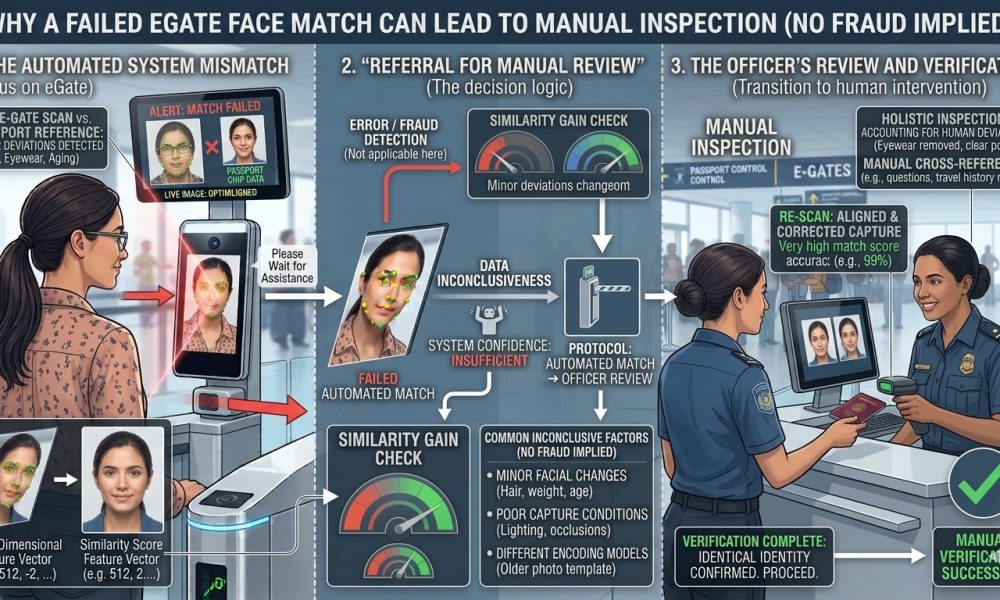
An unsuccessful automated comparison may require an officer’s review without establishing fraud or wrongdoing, because Image quality, aging, expression, Camera conditions, and other ordinary factors can prevent a legitimate traveler from satisfying an automated facial recognition threshold.
WASHINGTON, DC, October 6, 2026 — When an automated airport border gate fails to confirm that a traveler’s live facial Image sufficiently resembles the reference portrait associated with a passport, the result does not automatically mean the system has detected fraud, impersonation, or any other form of wrongdoing.
Instead, a failed comparison generally means the biometric system did not achieve enough similarity, Image quality, or confidence under its configured operating rules to complete facial verification automatically, making additional human review an appropriate next step rather than an immediate accusation.
That distinction is important because facial recognition systems operate through mathematical comparison and predefined thresholds, meaning a legitimate traveler can fall below the required acceptance level when ordinary differences between the live Image and the passport portrait affect the resulting similarity score.
Manual inspection therefore functions as a safeguard within the broader border process, allowing trained officers to review the traveler, physical passport and other authorized information when automation cannot resolve the identity question confidently enough on its own.
Automated Facial Recognition Uses Thresholds Rather Than Absolute Certainty
An eGate facial recognition system typically converts the traveler’s live photograph and the passport reference Image into mathematical representations before calculating a similarity score that measures how closely those biometric representations correspond within the particular recognition algorithm.
The system then compares that score against an acceptance threshold set for the border-control environment, allowing sufficiently strong matches to proceed automatically while routing weaker or uncertain results to another capture or a different inspection procedure.
A comparison falling below the threshold means only that the algorithm did not find enough similarity to satisfy that automated decision rule, not that the live traveler and passport portrait necessarily represent different people.
This design reflects an essential limitation of biometric technology because facial recognition systems must make decisions from photographs captured under imperfect real-world conditions, where legitimate images can sometimes produce weaker correspondence than expected.
False Non-Matches Are a Recognized Biometric Outcome
A false non-match occurs when two facial images that genuinely belong to the same person fail to produce enough similarity to meet the configured acceptance threshold, resulting in an unsuccessful automated decision despite the traveler presenting the correct identity.
Such errors can occur because facial recognition depends on the quality and characteristics of the images supplied to the algorithm. At the same time, changes in lighting, pose, aging, expression, or Camera performance can reduce similarity without changing the underlying identity.
The National Institute of Standards and Technology’s facial recognition evaluations examine false-match and false-non-match performance across recognition systems, illustrating why biometric verification should be understood through measured error rates rather than assumptions of perfect automation.
An unsuccessful eGate comparison therefore belongs within a known category of biometric uncertainty, making additional examination a normal operational response rather than evidence that the traveler necessarily attempted to deceive authorities.
A Poor Live Image Can Trigger the Referral
One of the simplest reasons for an unsuccessful automated comparison is that the airport Camera did not capture a sufficiently clear Image of the traveler’s face, even when the passport portrait and traveler unquestionably correspond.
Motion blur can reduce facial detail when a passenger moves during capture. At the same time, poor focus, uneven lighting, or an unusual Camera angle can interfere with the visual information the recognition algorithm needs.
A heavily shadowed face may produce weaker mathematical features than a clearly illuminated frontal Image, just as a Camera positioned at an awkward angle can introduce geometric differences that complicate comparison.
When the system cannot generate a sufficiently reliable facial representation from the first photograph, requesting another Image or referring the traveler for manual inspection can provide a more dependable way to complete identity verification.
Head Position Can Influence the Comparison
Automated border cameras generally work best when travelers look directly toward the lens with their face reasonably centered, because excessive head rotation can hide facial information and alter the apparent relationship among visible features.
Alignment software can compensate for manageable differences in position, scale, and head angle. Still, those corrections cannot restore facial regions that were never clearly visible in the original live photograph.
A traveler turning significantly toward one side, looking downward, or moving while the Image is captured may therefore generate a weaker similarity score, even though an officer examining the person directly might recognize the correspondence immediately.
The referral that follows can therefore reflect a technical response to poor Image geometry rather than an indication that authorities have identified suspicious conduct or deliberate identity manipulation.
Aging Can Reduce Automated Similarity
Passports frequently remain valid for many years, meaning the reference portrait presented at an airport may have been captured long before the traveler arrives at an eGate for a current border inspection.
During that interval, natural changes in skin texture, facial weight, hairlines, facial hair, and other visible characteristics can alter appearance enough to influence the mathematical representation produced by facial recognition software.
Modern algorithms are designed to tolerate reasonable aging, but no recognition system is completely unaffected by substantial differences between an older enrollment photograph and a newly captured live Image.
When the resulting similarity falls below the configured threshold, an officer can examine the traveler and document in context rather than assuming that the appearance difference automatically indicates impersonation.
Expressions Can Also Affect Automated Recognition
Passport photographs are normally captured under standardized conditions with relatively neutral expressions, while travelers approaching an airport Camera may smile, speak, squint, or move facial muscles in ways that alter several visible regions simultaneously.
Changes around the mouth, cheeks and eyes can influence how the recognition model represents the face, potentially reducing similarity when the live expression differs noticeably from the controlled reference portrait.
Sophisticated systems are designed to tolerate ordinary expression differences. However, substantial variation can still lead to an uncertain result when combined with other factors such as lighting, aging, or Image quality.
An officer reviewing the traveler directly can consider these obvious contextual differences, which is one reason human inspection remains an important fallback when automation cannot complete the comparison confidently.
Glasses and Other Temporary Appearance Changes Can Matter
Travelers may wear glasses during one photograph and not another, change hairstyles significantly, grow or remove facial hair, or undergo other ordinary appearance changes between passport enrollment and later border inspection.
Modern recognition systems try to focus on persistent identity-related patterns rather than superficial appearance alone. However, temporary changes can still affect Image quality and the amount of facial information available to the algorithm.
Reflections on eyeglasses, for example, can obscure parts of the eye region under certain lighting conditions, while heavy facial hair can change visible texture across portions of the lower face.
These circumstances can reduce automated similarity without implying any improper conduct, making manual review an appropriate mechanism for resolving a comparison that technology could not complete conclusively.
The Passport Portrait May Also Limit Performance
The live airport photograph is not always the source of the problem because the passport reference Image itself may contain characteristics that make automated comparison more difficult many years after enrollment.
Older reference photographs can have lower resolution, different compression characteristics, or appearance differences that become more significant as the holder ages during the document’s validity period.
Recognition software can work effectively across many such variations, but Image quality matters because a comparison cannot recover biometric detail that neither photograph captured adequately.
When one side of the comparison provides limited information, automated verification may become less reliable, and human inspection can provide additional context unavailable to the similarity algorithm alone.
Manual Inspection Adds Context the Algorithm Does Not Have
A border officer can evaluate information beyond the numerical relationship between two facial representations, including the physical passport, the traveler’s current appearance, and other authorized records available during the inspection process.
The officer can also recognize obvious explanations for differences, such as substantial aging, hairstyle changes, or unusual lighting, without relying exclusively upon the mathematical similarity score generated by the eGate.
This broader perspective allows human inspection to address ambiguous situations that biometric software treats conservatively, creating a layered process in which automation handles routine cases while officers resolve exceptions.
Manual review should therefore be understood as an additional verification step rather than a punitive response, particularly when the only issue is an unsuccessful automated facial comparison.
The Officer May Compare the Traveler With the Passport
In many cases, manual inspection begins with the traditional identity task that border officers performed long before automated facial recognition became widespread, involving direct visual comparison between the traveler and the portrait displayed on the travel document.
Human observers can intuitively account for changes in hairstyle, aging, expression, and other appearance differences, while also checking the document for consistency and asking routine questions when appropriate.
That visual Judgment does not make human inspection infallible. Still, it provides a different form of evidence from the algorithmic similarity calculation and can help resolve situations where Image capture conditions reduce automated performance.
Combining machine and human assessment creates redundancy, which is valuable in border environments where both security and fair treatment of legitimate travelers depend on avoiding excessive reliance on any single verification method.
Another Photograph May Resolve the Problem Immediately
Some automated systems or inspection procedures can attempt another facial capture before escalating to a more detailed manual review, particularly when the initial Image fails quality requirements rather than producing a clearly inconsistent comparison.
A second photograph taken with better positioning, lighting, or focus can produce a stronger mathematical representation and yield similarity above the threshold, even though the traveler’s identity remained unchanged throughout both attempts.
This outcome illustrates why an unsuccessful first comparison should not be interpreted as proof of deception, because improving only the Image can transform the biometric result without changing the passport or the person presenting it.
Recapture procedures therefore provide an efficient intermediate step between automatic acceptance and extended inspection, allowing systems to correct ordinary Camera or positioning problems while preserving the configured security threshold.
An eGate Failure Does Not Automatically Mean the Passport Failed.
Facial recognition represents only one component of automated border processing, and an unsuccessful face comparison should not be confused with a finding that the passport itself is counterfeit, altered,d or electronically invalid.
An electronic passport can pass document and chip Authentication checks while the facial comparison remains inconclusive, because document Authenticity and traveler-to-document correspondence answer different security questions.
The International Civil Aviation Organization’s border control guidance describes automated border control as a process that combines travel-document examination with biometric verification, showing why separate components can produce different outcomes during the same inspection.
A referral can therefore occur even when other aspects of the document appear completely normal, simply because the live facial comparison failed to meet the automated system’s acceptance criteria.
Chip Authentication and Face Matching Serve Different Purposes
Electronic passport Authentication is designed to help determine whether protected digital information possesses the expected cryptographic characteristics associated with legitimate issuance and whether relevant data remains consistent with the document’s security architecture.
Facial recognition, by contrast, evaluates whether the person standing before the Camera matches the authorized reference portrait associated with the identity being presented.
A passport can therefore contain correctly authenticated electronic information. At the same time, the holder still requires manual facial verification, just as a strong facial match does not independently establish that every physical and electronic security feature in the booklet is legitimate.
These separate mechanisms are intentionally complementary, allowing border systems to evaluate document integrity and traveler identity through different methods rather than forcing one technological check to answer every security question.
Physical Document Inspection Can Occur During the Referral
When an eGate cannot complete automated processing, an officer may also inspect the physical passport more closely, examining materials, printing, and other visible security characteristics alongside thetraveler’ss identity.
This additional examination does not necessarily mean the gate detected a document problem because referral procedures can provide officers with an opportunity to complete multiple checks once automated processing has stopped.
The broader review can still help confirm that the traveler, portrait, and document remain consistent, particularly when the biometric comparison produced an ambiguous result rather than a clear automated acceptance.
Amicus International Consulting has examined these layered safeguards in its guide to modern passport security and biometric verification, which explains how physical, electronic and biometric checks address different components of travel-document security.
A Failed Face Match Does Not Reveal Why the Comparison Failed
The automated system may know that a similarity score fell below the required threshold. Still, that numerical outcome does not necessarily provide a simple human-readable explanation identifying exactly why the images failed to correspond strongly enough.
Several factors can contribute simultaneously, including Image quality, pose, aging, and temporary appearance changes, making it difficult to attribute the result to one specific characteristic without additional examination.
This limitation explains why officers should not treat the score itself as a complete narrative about the traveler, because the algorithm reports the strength of comparison rather than establishing motive or determining whether any suspicious behavior occurred.
Manual inspection lets officers review the broader circumstances and decide whether the unsuccessful biometric result has an ordinary explanation or needs further attention.
A Referral Is Not the Same as an Accusation
Travelers sometimes interpret redirection from an automated gate as an indication that something is wrong with their passport or that authorities suspect misconduct. Still, biometric referrals can occur for routine technical reasons.
An automated gate is designed to complete only cases that satisfy all required conditions, so any unresolved issue can move the traveler into a staffed process where an officer has greater flexibility to assess the situation.
The referral therefore represents a change in processing method rather than an automatic legal conclusion, allowing the border authority to continue verification using tools and Judgment unavailable to the automated system.
That distinction remains essential for accurately describing biometric border technology because an algorithmic non-match carries substantially less meaning than a formal determination of fraud, impersonation or document misuse.
Different Airports Can Handle Non-Matches Differently
Operational procedures vary among countries and border authorities, meaning one airport may automatically attempt another photograph while another installation can direct unsuccessful facial comparisons more quickly toward staffed inspection.
The number of permitted recaptures, threshold settings, and officer-review procedures can also differ according to local regulations, technology providers, and the overall architecture of the automated border system.
Travelers should therefore avoid assuming that an eGate referral in one jurisdiction carries the same operational meaning or sequence of steps as a referral encountered elsewhere.
The common principle remains that automation can refer cases it cannot resolve confidently, leaving authorized personnel to complete the identity and document assessment using the procedures established for that location.
One-to-One Verification Still Produces Occasional Errors
When an eGate performs one-to-one verification, the live Image is compared with one expected reference identity rather than searched against an unlimited collection of possible travelers. Still, even this focused task can produce occasional false non-matches.
The presence of one known reference simplifies the comparison, yet Image variation and algorithm limitations can still reduce the measured similarity below the operating threshold.
A legitimate holder can therefore fail one-to-one automated verification without implying that the system found another identity or determined that the traveler corresponds with someone else.
The automated process has merely concluded that the available pair of images did not provide enough similarity to satisfy the configured rule, making human review an appropriate next stage.
Manual Inspection Can Protect Legitimate Travelers
Human review is frequently discussed as though it exists only to strengthen security. Still, the fallback process also protects legitimate travelers by preventing an imperfect automated result from becoming the final decision.
If facial recognition alone controlled the entire process, a false non-match could create an unjustified outcome simply because the Camera produced a poor Image or the traveler’s appearance changed substantially since passport enrollment.
Officer review provides a mechanism to correct that uncertainty, allowing additional evidence to establish that the traveler matches the identity even when the automated score remains insufficient.
This redundancy is an important component of responsible biometric deployment because consequential decisions should account for the recognized limitations and error characteristics of automated recognition technology.
Manual Inspection Also Protects Border Security
The fallback process also supports security objectives because authorities do not need to lower biometric thresholds to ensure travelers with difficult comparisons can continue through the border.
Instead, systems can maintain demanding automated acceptance criteria while directing uncertain cases to officers with additional tools and information to complete the verification process.
This arrangement balances passenger convenience with identity assurance, allowing routine strong comparisons to move quickly while preserving more careful examination for situations technology cannot resolve conclusively.
Manual inspection therefore supports both legitimate passengers and security objectives, rather than representing a failure of the overall border system whenever an automated gate requests human intervention.
Thresholds Determine How Often Referrals Occur
The acceptance threshold a border authority selects directly influences how many facial comparisons proceed automatically, because stricter thresholds require greater similarity before travelers can complete the biometric stage without assistance.
A higher threshold can reduce false matches while increasing false non-matches, meaning more legitimate travelers may require manual inspection even when the recognition algorithm itself has not changed.
A lower threshold can reduce referrals but may increase the probability that two different faces satisfy the automated decision rule, illustrating why border authorities must consider both security and passenger-flow consequences when selecting operating settings.
The number of referrals observed at an airport can therefore reflect deliberate risk-management choices rather than evidence that the underlying recognition technology is malfunctioning.
Passenger Volume Makes Exception Handling Important
Large international airports process substantial numbers of travelers, meaning even a facial recognition system with a very low false-non-match rate can generate many manual referrals when applied across millions of passenger encounters.
Border authorities consequently design exception-handling procedures as a normal part of biometric deployment, because statistically uncommon unsuccessful comparisons become operationally significant when technology operates at very large scale.
Efficient manual review helps prevent these inevitable exceptions from causing excessive delays while preserving the security benefits of appropriately demanding automated thresholds.
Staffed inspection alongside eGates should therefore be understood as part of the system’s intended architecture rather than an emergency measure used only when technology breaks down.
Environmental Conditions Can Influence Referral Rates
Changes in terminal lighting, Camera placement, or passenger flow can affect the quality of live images and, in turn, influence how often genuine comparisons fall below the system’s threshold.
A Camera that becomes misaligned or a capture area affected by unusually difficult lighting can potentially increase unsuccessful comparisons even though travelers and passports remain no different from those processed previously.
Operational monitoring can identify such changes and allow technicians or administrators to determine whether Image acquisition rather than identity inconsistency is contributing to elevated referral rates.
This dependence on environmental conditions illustrates why facial recognition performance should be evaluated as part of an entire system involving cameras, software, and physical infrastructure rather than judging the algorithm alone.
Children and Significant Appearance Changes Can Present Challenges
Facial appearance can change more rapidly during childhood than during many periods of adulthood, creating additional complexity when older reference photographs are compared with substantially changed current appearances.
Adults can also experience significant changes from weight variation, medical procedures, or other lawful circumstances that alter visible facial characteristics without changing the individual’s legal identity.
Recognition systems may continue performing successfully across many such changes, but unusual differences can reduce similarity enough to require human review rather than automatic processing.
An officer can consider those changes in context, making manual inspection particularly valuable when a numerical comparison cannot adequately explain why two legitimate photographs appear different.
Human Review Does Not Eliminate the Need for Technology
The fact that officers remain necessary for uncertain cases does not undermine the usefulness of automated facial recognition, because biometric systems can still process large numbers of routine travelers quickly and consistently.
Automation allows border personnel to concentrate attention on exceptions rather than manually performing every identity comparison, potentially improving passenger flow while maintaining structured verification requirements.
The appropriate objective is therefore not to eliminate human inspection, but to use automation where confidence is sufficient while preserving human Judgment for situations that fall outside the system’s reliable operating range.
This division of responsibilities reflects a broader principle in identity security, where technology and trained personnel can complement one another rather than competing for exclusive control over every decision.
The eGate Result Is Only One Part of Border Processing.
An unsuccessful face match can occur while every other aspect of a traveler’s border examination remains routine, because immigration status, passport validity, and security inquiries operate through systems distinct from the facial comparison algorithm.
Similarly, a successful face match does not guarantee border clearance when another authorized check identifies an issue requiring examination, showing that biometric verification is only one component of the overall border-control framework.
This separation prevents travelers and observers from assigning excessive meaning to the eGate’s facial result, whether successful or unsuccessful, because neither outcome independently determines every aspect of admissibility or document legitimacy.
The automated gate performs a defined verification task, while the broader border system integrates that result with other information required under the rules governing the traveler’s journey.
A Manual Referral Can Be Entirely Routine
In practical terms, a traveler whose facial comparison fails may present the passport to an officer, answer routine questions, and continue once the officer confirms the person and document match.
Other cases may require another photograph or additional document checks, while a much smaller number could involve circumstances that genuinely require further investigation.
The critical point is that the initial biometric referral does not reveal which outcome will follow, so it is inappropriate to equate an automated non-match with evidence of fraud before further examination occurs.
Manual inspection exists precisely because the border system recognizes that unsuccessful automated results can arise from both innocent technical conditions and circumstances requiring greater scrutiny.
The Safest Interpretation Is That Automation Could Not Finish the Job
When an eGate rejects a facial comparison, the most accurate immediate interpretation is that the automated process did not obtain sufficient biometric correspondence to complete verification according to its configured rules.
That conclusion remains narrower and more technically accurate than assuming the system has detected a counterfeit passport, identified an impostor, or determined that criminal conduct occurred.
Theofficer’ss role is to continue the examination using additional information and human Judgment, allowing the border process to distinguish routine biometric uncertainty from situations that genuinely merit greater attention.
For legitimate travelers, this layered arrangement provides an important safeguard because one imperfect photograph or borderline similarity score does not need to become the final determination concerning their identity.
Manual Inspection Is Part of the Design, Not Evidence of Failure
Automated border systems are most effective when they are designed with realistic expectations about biometric performance, including the recognition that some genuine travelers will occasionally produce comparisons that cannot satisfy automated acceptance criteria.
By routing those cases toward officers, the system preserves strict biometric standards without forcing technology to make decisions beyond the evidence available from the captured photographs.
This structure combines the speed of automated facial recognition with the contextual Judgment of trained border personnel, creating a more resilient identity-verification process than either method could provide independently.
A failed eGate face match should therefore be understood primarily as a request for additional verification, not as a conclusion of fraud, because manual inspection aims to resolve the uncertainty automation could not answer confidently.




