
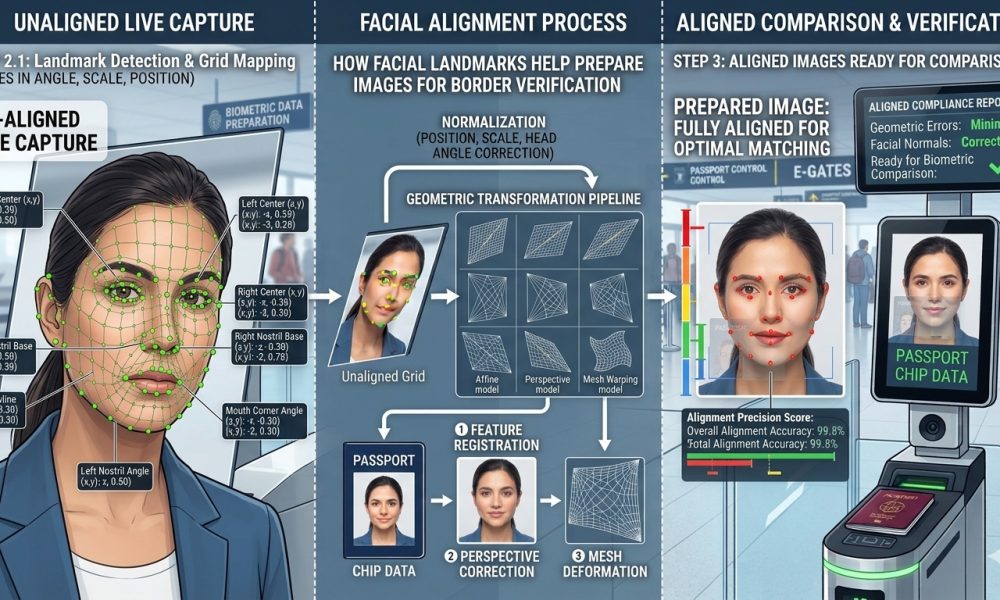
Features around the eyes, nose, and mouth can guide photo alignment before automated comparison, helping border systems reduce common differences in position, scale, and head orientation between a live traveler Image and the reference portrait associated with a passport.
WASHINGTON, DC, October 6, 2026 — When an automated border system captures a traveler’s face, the resulting photograph rarely matches the exact position, scale, and orientation of the portrait associated with the traveler’s passport, even when both images clearly depict the same individual under normal conditions.
To reduce those differences before performing a biometric comparison, facial recognition systems can identify structural reference points commonly described as facial landmarks, which provide mathematical guidance for repositioning and normalizing images before more advanced recognition algorithms evaluate whether the two facial representations correspond.
These landmarks may include locations associated with the eyes, nose, mouth, and surrounding facial geometry. However,h the exact number of points and the mathematical methods used to identify them vary considerably among commercial systems, government implementations, and evolving recognition technologies.
Facial Landmarks Provide a Geometric Reference
A facial landmark is a measurable location tied to a recognizable part of the face, allowing computer vision software to determine how facial structures are positioned relative to one another in a camera-captured photograph.
Rather than treating every pixel in an Image as equally important during initial preparation, software can use these structural reference points to estimate where the face begins, how it is oriented, and which mathematical adjustments may improve consistency before extracting biometric features.
Points around the eyes are particularly useful because the relative location of the eye regions can indicate whether a face is tilted, shifted, or captured at an angle compared with the standardized portrait in an identity document.
Landmarks around the nose and mouth can provide additional geometric information, helping the system estimate facial orientation while confirming that multiple detected points follow a plausible structural arrangement rather than representing unrelated patterns elsewhere within the photograph.
The Eyes Can Help Establish Orientation
The approximate relationship between the two eye regions provides a useful geometric reference because a line connecting those regions can indicate whether a traveler’s face appears tilted sideways relative to the orientation expected by the recognition system.
If one eye appears substantially higher than the other because the traveler tilted the head, alignment software can estimate that rotation and mathematically reposition the facial Image so that the eye regions occupy a more standardized orientation before later processing occurs.
This adjustment does not alter the person’s biological characteristics because the software mathematically corrects how the photograph is presented, rather than modifying the underlying facial information that recognition algorithms use when comparing biometric representations.
The same principle applies when a traveler stands slightly off-center, because landmark positions can help software determine where the face is in the Camera frame and shift the relevant facial region into a more consistent coordinate system.
The Nose Helps Describe the Center of the Face
The nose sits near the center of the human face, making information around the bridge, tip, and surrounding regions useful when software estimates orientation and distinguishes straight-on positioning from moderate sideways rotation.
When a person turns their head, the visible relationship between the nose and other facial regions changes, allowing recognition software to estimate pose and determine whether normalization can compensate sufficiently before automated comparison continues.
A small rotation may require only modest geometric adjustment. At the same time, a significantly turned face can reduce the useful information available from the more distant side, making another photograph preferable to extensive mathematical correction.
This limitation illustrates an important principle of biometric processing: facial landmarks can guide alignment effectively when usable information exists, but they cannot recreate anatomical detail that a Camera never captured because of extreme pose, obstruction, or poor Image quality.
Mouth Regions Add Additional Structural Information
Features around the mouth can provide another set of reference points that help software estimate how the lower portion of the face is positioned relative to the eyes and nose during the initial stages of Image preparation.
Although expressions can change the mouth’s appearance considerably, broader positional relationships can still provide useful information when combined with other landmarks, particularly when software evaluates the overall geometry of a detected face rather than relying on any single point.
Modern systems generally avoid depending exclusively on one facial feature because temporary expressions, glasses, shadows, facial hair and other ordinary conditions can affect individual regions differently, making combinations of structural information more useful than isolated measurements.
The purpose of landmark detection is therefore not to declare that a particular eye, nose or mouth belongs to a specific traveler, but to provide the geometric framework needed to prepare the entire facial Image for a later recognition calculation.
Alignment Comes Before Identity Comparison
Facial landmark detection should be understood as part of Image preparation rather than the final identity decision because identifying structural points does not, by itself, establish whether the traveler at a border checkpoint is the legitimate holder of the passport.
Once landmarks have been identified, software can use their relative positions to translate, rotate and rescale the face into a normalized representation, reducing differences caused primarily by Camera placement, traveler height, head angle and distance from the lens.
Only after this preparation can later recognition stages generate mathematical representations of facial characteristics and compare those representations with a reference Image, such as the portrait associated with an electronic passport or another authorized government identity record.
This sequencing matters because a strong recognition system should distinguish between correcting photographic geometry and evaluating identity, rather than treating ordinary differences in Image framing as meaningful biological differences between two people.
Position, Scale and Rotation Can Be Normalized
Translation addresses situations in which the traveler’s face appears too far left, right, high, or low within the captured frame, allowing software to reposition the detected facial region into coordinates better suited for subsequent recognition processing.
Scaling addresses differences created when one photograph was captured from a closer distance than another, which can make the face appear substantially larger even though the underlying proportions and biometric characteristics remain associated with the same individual.
Rotation correction addresses minor head tilt or camera-orientation differences, allowing the software to present corresponding facial regions more consistently before generating the numerical representations used for automated similarity calculations.
Together, these adjustments help remove sources of photographic variation that have little relationship to identity, allowing recognition algorithms to focus more effectively on facial information that remains after easily correctable geometric differences have been reduced.
Passport Photographs Provide a Standardized Reference
Passport photographs are produced under relatively controlled requirements because consistent Image quality supports both human document inspection and automated facial comparison across countries that increasingly rely on biometric systems at airports and land borders.
The International Civil Aviation Organization’s travel document specifications establish internationally recognized principles governing machine-readable travel documents and facial images, helping issuing authorities create reference portraits that remain suitable for automated processing across different border environments.
A standardized passport portrait gives recognition software an important advantage because one side of the comparison begins with an Image designed to present the face clearly, reducing uncertainty that would increase if both photographs were captured under uncontrolled conditions.
The live border Image still introduces natural variation because travelers approach cameras at different angles, distances, and heights, making landmark-guided alignment particularly useful when reconciling that spontaneous photograph with the more carefully produced reference Image.
Image Quality Determines What Landmarks Can Be Found
Facial landmark software depends on sufficient Image quality because poorly illuminated, heavily blurred, or substantially obstructed photographs may prevent the system from locating key facial structures reliably enough to support accurate alignment.
A Camera cannot provide software with detailed information that was never recorded, meaning severe motion blur, excessive shadow, or extreme head rotation can undermine both landmark detection and later recognition, regardless of the algorithm’s sophistication.
Research through the National Institute of Standards and Technology’s facial recognition evaluations has repeatedly examined the relationship between image quality and recognition performance, reinforcing the importance of factors including pose, illumination and usable resolution within biometric workflows.
Airport systems therefore combine recognition software with carefully designed capture environments, screen prompts, and camera placement intended to increase the likelihood that travelers naturally provide facial images suitable for automated detection, alignment, and comparison.
Landmarks Do Not Need to Match Pixel for Pixel
Two photographs of the same person may position corresponding features at very different pixel coordinates because camera resolution, cropping, subject distance and image dimensions can vary substantially between the passport enrollment process and a later airport capture.
Landmark-guided normalization lets the software map those features into a common geometric arrangement, so the system can evaluate corresponding facial structures without requiring the original and live photographs to share identical dimensions, framing, or pixel locations.
This capability is essential for practical border processing because passengers cannot reasonably be expected to reproduce the precise posture, camera distance and framing conditions present when their original passport photograph was captured months or years earlier.
Instead, automated systems try to make the images mathematically comparable, creating a normalized starting point from which biometric recognition algorithms can evaluate similarity despite the ordinary variations introduced by different cameras, environments, and capture dates.
Head Pose Creates a More Difficult Alignment Problem
Small sideways tilts are relatively easy to address because the entire face remains visible. At the same time, larger rotations can create asymmetry and hide parts of one side, reducing the corresponding information available for comparison.
Engineers often describe facial orientation using concepts comparable to roll, pitch and yaw, which respectively characterize sideways tilt, upward or downward movement and rotation toward the left or right relative to the camera.
Landmark positions can help estimate these movements because the apparent relationships among the eyes, nose and mouth change predictably as the head moves, allowing software to assess whether normalization can produce a useful representation.
When the pose becomes too extreme, however, another live photograph may provide a better solution because mathematical alignment should not be confused with reconstructing anatomical information that remains invisible in the original captured Image.
Expressions Can Change Landmark Positions Slightly
Smiling, speaking, or opening the mouth can change the position and shape of facial regions, particularly around the lips and cheeks, which explains why standardized identity photographs generally favor neutral expressions and unobstructed views.
Recognition systems must therefore tolerate some natural variation rather than assuming that every landmark maintains an absolutely fixed relationship across all photographs of the same person captured at different times.
By considering multiple reference points and broader structural patterns, modern processing pipelines can reduce their dependence on any single region that may be temporarily affected by expression, illumination,n or ordinary changes in appearance.
This approach reflects the broader design philosophy behind biometric systems, where reliable performance usually comes from combining several sources of information rather than making an identity decision based upon one isolated visual characteristic.
Landmarks Are Not the Same as a Biometric Template
The coordinates produced during facial landmark detection should not automatically be confused with the more sophisticated biometric representation generated later by a recognition algorithm because the two processing stages serve different technical purposes.
Landmarks primarily help software understand facial geometry and orientation. At the same time, the subsequent feature extraction can generate a higher-dimensional mathematical representation intended to preserve information useful for distinguishing one individual from another during automated comparison.
A system can therefore use landmarks to straighten and normalize an Image before another algorithm converts that prepared face into numerical information that can be compared with a corresponding representation derived from the passport portrait.
Keeping these functions separate helps explain why facial recognition involves an entire processing pipeline rather than a single algorithm that looks at two photographs and immediately produces a definitive conclusion about identity.
Electronic Passport Authentication Is a Separate Process
Facial landmark detection should not be confused with electronic passport authentication because these technologies answer fundamentally different questions within the broader border verification process.
Electronic passport Authentication examines protected digital information and cryptographic relationships intended to help determine whether data originated from an authorized issuing authority and whether protected information has remained consistent with the document’s security mechanisms.
Facial comparison instead asks whether the person physically appearing before the Camera corresponds sufficiently with an authorized reference portrait, making landmark-guided alignment one preparatory component within that separate biometric verification process.
This distinction matters because a passport can contain valid electronic data. However, the border system must still determine whether the presenter is the rightful holder, just as a visually similar face cannot prove that a travel document is authentic.
A Border Check Combines Several Independent Layers
Modern border processing can combine passport inspection, electronic chip validation, facial recognition, immigration inquiries and database screening because each mechanism addresses a different component of identity, document integrity or travel eligibility.
Facial landmarks contribute primarily to the image-comparison layer by helping prepare photographs for recognition. At the same time, they provide no independent information about whether a document has been reported stolen, canceled, or associated with another security concern.
Similarly, successful facial alignment does not mean successful identity verification because the system must still perform the comparison and determine whether the resulting similarity meets the operational requirements set by the relevant authority.
Amicus International Consulting has previously examined these distinctions in its overview of modern passport security and identity verification, which explains why contemporary travel documents depend upon multiple physical, digital and biometric safeguards working together.
Airport Cameras Are Designed to Help the Process
Automated border gates often include positioning guides, visible Camera indicators, and on-screen instructions that encourage travelers to face forward and remain reasonably still, reducing the corrections needed before recognition can begin.
These design features complement facial landmark technology because obtaining a strong live Image at the beginning is generally preferable to asking software to compensate for unnecessary geometric differences or poor capture conditions afterward.
The system may still tolerate ordinary variation because travelers differ dramatically in height, posture, and behavior. Still, a frontal Image with clear illumination gives both landmark detection and subsequent recognition algorithms a stronger informational foundation.
When a system cannot confidently locate sufficient landmarks, the appropriate response may be to capture another photograph or refer the traveler for additional processing, rather than automatically assuming the passport holder failed an identity check.
Landmarks Help Separate Geometry From Identity
The practical value of facial landmarks becomes clearest when you consider the difference between how a person is photographed and who that person actually is, because those are related but fundamentally different questions in automated recognition.
Moving several inches to one side, standing closer to the Camera, or tilting the head does not change an individual’s identity. Yet, each action can substantially change the arrangement of facial information within a two-dimensional Image.
Landmark-guided alignment reduces some of that irrelevant variation by establishing where key facial regions appear and transforming the Image into a more consistent orientation before algorithms evaluate biometric similarity.
The result is not perfect uniformity, but rather a controlled representation intended to reduce avoidable differences so that later comparison stages can focus more effectively on information that may distinguish the passport holder from another person.
Changes in Appearance Still Require Robust Recognition
People naturally age, change hairstyles, grow facial hair, wear different glasses, and experience other changes during the years that a passport remains valid, creating additional differences that simple geometric alignment cannot eliminate.
Facial landmarks can help position images consistently, but they do not eliminate the need for recognition algorithms that can handle realistic changes in appearance between an enrollment photograph and a later live border capture.
This explains why alignment is only one stage in a larger biometric system: correcting head position cannot independently resolve differences caused by aging, Image quality, facial expression, occlusion, or long-term changes in appearance.
Successful border verification therefore depends upon the interaction between standardized reference images, reliable capture equipment, effective preprocessing, robust recognition algorithms, and operational procedures designed to handle cases that automated systems cannot resolve confidently.
Human Review Remains Part of the Security Framework
Automated systems can process large passenger volumes rapidly. Still, legitimate travelers occasionally produce images that fail quality requirements or produce uncertain comparison results because biometric technology operates in real-world conditions rather than laboratory environments.
Border officers can examine the physical document, review authorized records, and consider other information unavailable to a facial landmark detector, making human intervention fundamentally broader than simply repeating the mathematical Image comparison performed by an automated gate.
A traveler who receives additional inspection therefore should not automatically be interpreted as having failed an identity test because many technical, administrative, or procedural conditions can trigger further examination without indicating fraud or impersonation.
This layered architecture lets automated facial comparison improve efficiency while preserving mechanisms to resolve ambiguous cases, balancing the advantages of biometric technology with the practical need for Judgment when Image processing alone cannot provide sufficient confidence.
Facial Landmarks Work Quietly Behind the Border Camera
For most travelers, face detection and alignment remain invisible because software can perform these calculations rapidly between the moment a Camera captures an Image and the point when the broader border system determines how processing should continue.
Behind that brief interaction, however, the system may identify structural facial regions, estimate orientation, normalize the Image, assess quality, generate a biometric representation, and compare that representation with an authorized reference before applying the relevant operational decision rules.
Facial landmarks therefore occupy an important but limited role within automated border verification, providing the geometric framework that helps transform photographs captured under different conditions into images suitable for meaningful biometric comparison.
Their importance lies not in identifying travelers independently, but in preparing photographs so differences in framing, scale, and ordinary head position do not unnecessarily interfere with the much more complex task of determining whether two facial representations correspond.
As airports increasingly incorporate biometric processing into passenger journeys, understanding this distinction helps explain why automated facial recognition is not simply camera-matching photographs, but a sequence of carefully separated technical stages designed to make identity comparison more consistent, repeatable,e and reliable.




