
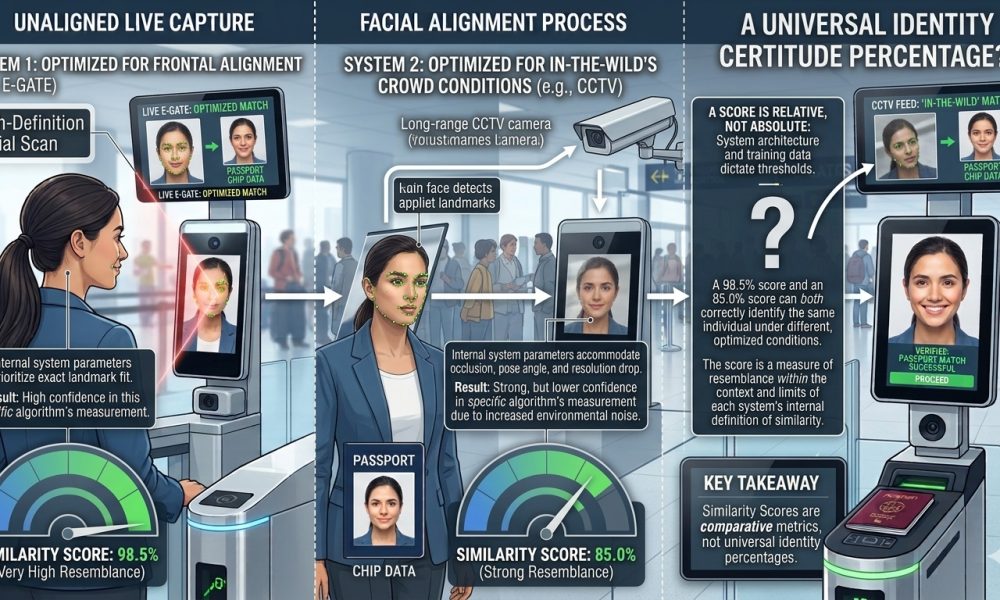
The score measures resemblance within a particular recognition system rather than providing a universal percentage of identity certainty. Hence, thresholds, algorithm design, and operating conditions matter when interpreting automated facial comparisons at airports and other identity checkpoints.
WASHINGTON, DC, October 6, 2026 — When an airport facial recognition system compares a traveler with the reference photograph associated with a passport, the resulting number may appear precise, but it should not be interpreted automatically as a percentage expressing how certain the system is about the traveler’s identity.
Instead, the score represents the degree of similarity calculated between two mathematical facial representations according to the rules, architecture, and internal scale of the particular recognition algorithm performing the comparison, meaning the same numerical value can carry very different significance across unrelated systems.
A score of 85 produced by one recognition platform, for example, should not automatically be interpreted as 85 percent confidence, an 85 percent probability, or the same level of similarity that another manufacturer’s system might associate with an identical numerical result.
Understanding this distinction matters because facial recognition systems ultimately make operational decisions by comparing similarity scores against configured thresholds, rather than converting those scores into universal statements about the absolute certainty of a person’s identity.
The Score Comes After the Images Have Been Processed
Before a facial recognition system can calculate similarity, it generally must capture or obtain the two photographs, detect the faces, evaluate Image quality, and prepare the facial regions so ordinary differences in scale, position, and orientation do not unnecessarily distort the eventual comparison.
The system can then convert each prepared facial Image into a numerical representation containing characteristics that the recognition algorithm has learned or otherwise determined are useful for distinguishing one identity from another across photographs captured under different circumstances.
Those mathematical representations, often described as templates, embeddings, or feature vectors, become the objects the recognition engine compares, allowing complex visual information to be evaluated through mathematical calculations rather than direct pixel-by-pixel inspection.
The resulting similarity score therefore appears near the end of a substantial processing sequence, meaning the number reflects not only the two original photographs but also the algorithm responsible for preparing, representing, and comparing the facial information within them.
Similarity Measures Resemblance Within One Mathematical System
A recognition algorithm assigns a score based on its own mathematical comparison procedure, which may examine distance, correspondence, or other relationships between the numerical representations generated from the live traveler Image and the available reference photograph.
In many facial recognition systems, stronger similarity generally produces a higher comparison score. However, different implementations can use different scales, mathematical conventions, and output formats, so users cannot assume every vendor expresses similarity identically.
The National Institute of Standards and Technology explains in its discussion of biometric similarity scores and decision thresholds that a new biometric sample can be compared with an enrolled template to generate a similarity score, which is then evaluated against a selected threshold.
That relationship between score and threshold matters far more than the score in isolation, because the threshold sets the point at which a particular implementation treats the available similarity as sufficient for its configured verification process.
A Score Is Not an Identity Probability
One of the most common misunderstandings arises when a numerical result is presented on a scale that resembles a percentage, encouraging users to interpret a high value as though the system were reporting a statistical probability that two photographs depict the same person.
A recognition algorithm producing a score of 92 does not necessarily mean there is a 92 percent probability that the traveler is the passport holder, because the value generally represents similarity according to the model’s internal scoring system rather than a universally calibrated probability statement.
Likewise, a score of 99 should not automatically be described as providing 99 percent certainty, since the operational meaning of that value depends upon the algorithm, the distributions of genuine and non-genuine comparisons and the threshold selected for the specific Application.
For this reason, responsible explanations of facial recognition should describe similarity scores as comparison measurements rather than identity-certainty percentages, unless a particular system explicitly provides a separately calibrated probability supported by validated statistical methodology.
The Threshold Turns a Score Into an Operational Result
A facial recognition system generally requires a decision threshold that separates comparison scores considered sufficient for automated acceptance from those requiring another outcome, such as recapture, manual inspection, or additional identity verification.
If the calculated similarity exceeds the configured threshold, the system may treat the facial comparison as successful for that particular workflow. In contrast,e a score below the threshold may prevent automatic continuation even when both photographs genuinely belong to the same person.
The threshold therefore converts a continuous mathematical measurement into an operational decision, making its selection one of the most consequential configuration choices within a biometric verification system used for border control or another high-volume identity process.
Importantly, moving the threshold changes the balance between different types of recognition errors, meaning authorities cannot simply make the system universally more accurate by continuously raising or lowering the required score without creating consequences elsewhere.
Higher Thresholds Can Reduce False Matches
When a system raises the similarity threshold required for acceptance, photographs of different people are less likely to accidentally exceed that higher standard, potentially reducing the frequency of false matches in that operating environment.
However, a stricter threshold can also make it harder for legitimate comparisons to succeed when aging, lighting, pose differences, Image quality, or other factors reduce similarity between two genuine photographs of the same traveler.
This tradeoff means that raising the threshold to improve one security characteristic can simultaneously increase inconvenience for legitimate users, creating more false non-matches and potentially sending additional travelers toward secondary or manual processing.
Threshold configuration must therefore reflect the consequences of both errors rather than focus exclusively on one number, because a biometric system operates in a practical environment where security, passenger flow, and the availability of human review all matter.
Lower Thresholds Create the Opposite Tradeoff
Lowering the acceptance threshold allows more genuine comparisons to succeed despite modest photographic differences, potentially reducing unnecessary rejection of legitimate travelers whose live images do not resemble their passport portraits as strongly as expected.
At the same time, reducing the required similarity can increase the chance that photographs of two different people produce scores high enough to cross the threshold, particularly when their facial features happen to resemble one another within the algorithm’s mathematical representation.
The appropriate operating point therefore depends upon the risks associated with the particular Application, because unlocking a consumer device, processing an airport passenger, and searching a law enforcement database can require substantially different error tolerances.
Consequently, no single threshold represents the universally correct setting for every facial recognition system, even when the underlying software can operate across several different environments.
False Matches and False Non-Matches Describe Different Errors
A false match occurs when facial images from different people show enough similarity to meet the system’s configured decision threshold, leading to the erroneous conclusion that the two biometric samples match strongly enough for the intended operation.
A false non-match occurs when photographs of the same person fail to reach the required threshold, potentially because Image quality, aging, expression, pose, or algorithmic limitations reduce the measured similarity below the system’s acceptance level.
These errors are related because changing the threshold can often reduce one while increasing the other, creating the fundamental biometric performance tradeoff that system designers and operators must evaluate when determining appropriate settings.
The most useful description of a system’s accuracy therefore requires more information than a single impressive similarity score, because operational performance depends upon how genuine and non-genuine comparisons behave across large numbers of tested images.
NIST Evaluations Examine Performance Across Thresholds
Independent evaluation provides a more reliable understanding of facial recognition than isolated score examples because large testing programs can measure how frequently algorithms produce errors under different Image conditions and decision thresholds.
The current NIST Face Recognition Technology Evaluation examines facial recognition algorithms through standardized testing, allowing performance characteristics to be compared systematically rather than relying exclusively upon claims made by individual technology vendors.
Such evaluations can examine genuine comparisons involving photographs of the same individual alongside non-genuine comparisons involving different people, producing distributions that reveal how effectively an algorithm separates those two categories under tested conditions.
A high-performing system generally produces enough separation between genuine and non-genuine scores that an operational threshold can achieve a low false-match rate while retaining a useful level of successful verification among legitimate users.
The Same Person Does Not Always Produce the Same Score
Two photographs of the same traveler can produce different similarity scores depending on lighting, expression, age, Camera characteristics, head angle, resolution, and other conditions that affect how clearly facial information appears in each Image.
A traveler could therefore receive one similarity score during an airport encounter and another score minutes later after the system captures a better photograph, even though the person, passport and claimed identity remain completely unchanged.
This variation is one reason biometric systems commonly include quality controls and recapture procedures, because a weak initial Image can produce a lower comparison score that improves substantially when the Camera obtains a clearer and more frontal photograph.
The score should consequently be understood as the result of a specific comparison between particular samples, rather than a permanent biometric rating assigned to an individual that remains unchanged across every Camera, environment, and recognition system.
Different Algorithms Can Score the Same Images Differently
Recognition systems from different developers can use different model architectures, training procedures, and mathematical representations, meaning the same pair of photographs can produce substantially different raw similarity values when processed by unrelated algorithms.
One system might express strong similarity with values approaching 100, while another could use a decimal scale or produce scores whose useful range bears little resemblance to traditional percentage notation.
Comparing raw numbers across vendors without understanding their scoring conventions can therefore lead to misleading conclusions, particularly when observers assume a larger numerical value always represents stronger real-world performance than a smaller value produced by another platform.
Meaningful comparisons require standardized performance testing, error-rate analysis, and knowledge of relevant thresholds, rather than simply placing twomanufacturers’’ raw similarity scores side by side and assuming their scales are equivalent.
One-to-One Verification Provides a Specific Context
At an automated passport gate, facial recognition commonly performs a verification task in which the live traveler Image is compared against a specific reference portrait associated with the claimed identity presented during the transaction.
The system therefore asks whether these two facial representations resemble one another sufficiently under the configured algorithm and threshold, rather than asking which person in a large population most closely resembles the traveler.
This one-to-one structure matters for interpreting similarity because the score reflects the relationship between one probe Image and one expected reference, creating a different operational problem than searching an unknown face across a large biometric gallery.
A strong score in that context supports the proposition that the live traveler corresponds with the reference Image. Still, it remains one technological component within the wider identity and border-processing framework.
One-to-Many Searches Use Similarity Differently
A one-to-many facial Identification search compares a probe Image against numerous enrolled references, allowing the system to rank potential candidates according to the similarity produced against each member of the searchable collection.
In that environment, a high score can help identify promising candidates. Still, the meaning of the result depends upon database size, algorithm performance, threshold settings, and procedures governing whether human reviewers evaluate the returned candidates.
A candidate appearing at the top of a similarity ranking does not automatically establish identity, because someone must still consider whether the score and available evidence meet the requirements for that particular investigative or operational purpose.
Confusing one-to-one verification with one-to-many Identification can therefore produce inaccurate descriptions of airport facial recognition, since different systems and checkpoints may use biometrics for distinct functions even when the underlying technology appears similar to travelers.
Image Quality Can Influence the Similarity Score
A high-quality reference photograph and clear live capture generally give recognition software more useful facial information, while blurred, poorly lit, or substantially rotated images can weaken the mathematical representations used during comparison.
If motion blur or obstruction obscures important facial detail, the recognition algorithm cannot reliably infer every missing characteristic, so the resulting score may drop even when the person genuinely matches the reference identity.
Airport systems therefore try to control Camera placement, lighting, and traveler positioning so they can consistently capture usable images before the recognition algorithm calculates similarity.
This relationship between capture quality and comparison performance demonstrates why the score should not be interpreted independently from the photographs and technical conditions that produced it.
Aging Can Reduce Similarity Without Changing Identity
Passport photographs can remain in circulation for years, allowing natural aging to create visible differences between the enrollment Image and the traveler who later presents the document at an automated checkpoint.
Changes in skin texture, hair, facial weight, and other appearance characteristics can affect recognition scores. However, modern algorithms are designed to maintain useful performance despite many ordinary changes during a passport’s validity period.
Tolerance varies by algorithm and Image quality, so comparisons across long time gaps may yield lower similarity than two photos taken under closely matched conditions.
A reduced score caused partly by aging does not itself indicate impersonation, which is why operational systems require thresholds and review procedures that can distinguish uncertain automated outcomes from confirmed evidence of identity fraud.
Expression Can Also Change the Result
A passport photograph generally uses a controlled expression. At the same time, a traveler at an airport Camera might smile, speak, squint, or move facial muscles in ways that alter the visual appearance of the eyes, cheeks, and mouth.
Modern algorithms try to tolerate reasonable expression differences, but substantial variation can still affect the mathematical representation and, therefore, the resulting similarity score generated during a particular comparison.
This effect reinforces the importance of clear capture instructions, since asking travelers to face the Camera normally and remain still can reduce avoidable variation before recognition software begins its mathematical analysis.
When an unusual expression contributes to a poor result, taking another photo may resolve the problem more effectively than treating the original low similarity score as definitive evidence of identity.
A Strong Score Does Not Authenticate the Passport
Facial recognition primarily answers whether two facial images resemble one another sufficiently within a biometric system, meaning a high similarity result does not independently prove that the passport booklet itself was legitimately issued or remains unaltered.
Physical document examination and electronic chip Authentication address different security questions, while database checks can determine whether authorities have recorded concerns involving the document, traveler, or travel authorization.
A person could theoretically resemble the portrait on a document. In contrast, another document feature still requires examination, which is why modern border controls combine facial comparison with separate document-security procedures.
Amicus International Consulting has examined these independent layers in its guide to modern passport security and biometric verification, which describes why physical, electronic, and biometric checks should be understood as complementary rather than interchangeable safeguards.
Passport Chip Authentication Answers a Different Question
An electronic passport contains digitally protected information that authorities can examine using cryptographic methods intended to help assess whether relevant chip data possesses characteristics associated with legitimate issuance and whether protected information appears unchanged.
The facial recognition score, by contrast, measures the resemblance between biometric representations derived from facial photographs, meaning chip Authentication and face matching operate through entirely different mathematical and security mechanisms.
A successful chip check therefore does not automatically establish that the traveler presenting the passport is its rightful holder, just as a strong facial similarity score does not independently prove the electronic document is authentic.
Combining these mechanisms gives border authorities multiple independent sources of information, reducing dependence upon any single technological test when determining whether the document and traveler satisfy the requirements for automated processing.
The Threshold Reflects Operational Risk
Choosing a recognition threshold ultimately involves deciding how much similarity the system requires before accepting a comparison, making threshold selection a practical security decision rather than merely an abstract mathematical exercise.
An organization operating a high-security environment may prioritize an extremely low false-match rate, even if that approach requires additional genuine users to undergo manual review. At the same time,e another Application may choose a different balance appropriate to its consequences.
Airports and border authorities must consider passenger volume, available staffing, Camera quality, algorithm performance, and the consequences of incorrect decisions when designing how biometric similarity contributes to the overall inspection process.
The resulting configuration can therefore differ among systems even when both organizations use capable facial recognition technology, because operational objectives help determine how mathematical scores become practical decisions.
There Is No Universal Passing Score
Because algorithms, scales, and thresholds differ, treat statements claiming that every airport requires a particular facial recognition score to pass with caution unless they identify the specific authority, system, and operating configuration that supports the claim.
A numerical threshold used by one implementation cannot automatically be transferred to another system, particularly when vendors generate scores using different mathematical representations and comparison functions.
Even software from the same technology family could operate under different thresholds when deployed for different purposes, allowing one organization to emphasize extremely low false matches. At the same time,e another accepts more automated approvals and relies upon additional safeguards elsewhere.
Travelers should therefore avoid interpreting isolated score values found in applications, online demonstrations or commercial scanning tools as though those numbers necessarily predict how an official border system will evaluate the same photographs.
Consumer Applications Can Use Different Scales
Smartphone applications that compare facial photographs may display percentages, ratings, or similarity values designed to make results understandable for ordinary users. Still, those outputs should not automatically be equated with official airport recognition scores.
A consumer Application may use a different algorithm, different preprocessing methods, and a different decision threshold than the technology deployed by a government border authority.
The resulting numerical values can therefore provide information within that Application while offering little basis for predicting whether another system would generate the same score or reach the same operational result.
This limitation mirrors the broader principle that similarity numbers acquire meaning within the context of the algorithm and threshold that produced them, rather than functioning as universal biometric measurements transferable between unrelated systems.
The Score Does Not Describe Physical Resemblance in Ordinary Language
A recognition system can determine that two mathematical representations are highly similar without providing a human-readable explanation of which facial characteristics contributed most to the score.
Contemporary machine-learning models often distribute recognition information across many mathematical dimensions, making their internal representations considerably more complex than familiar measurements such as eye spacing, nose width, or overall face shape.
For this reason, a similarity score should not be interpreted as a simple count of matching facial features, because the underlying model may combine many learned visual patterns when calculating correspondence.
The numerical output summarizes that complex relationship for computational purposes, allowing software to make systematic comparisons without requiring every internal feature to correspond with an easily named anatomical characteristic.
A Low Score Does Not Automatically Indicate Fraud
When two genuine photographs produce similarity below the configured threshold, the event represents an unsuccessful automated comparison rather than automatic proof that the traveler attempted impersonation or presented a fraudulent travel document.
Poor Image quality, natural aging, substantial changes in appearance, Camera problems, or algorithmic limitations can all reduce similarity without any misconduct by the person undergoing inspection.
Responsible border systems therefore provide procedures for handling uncertain results, which can include capturing another photograph, examining the passport manually, or conducting additional authorized checks before reaching a broader identity determination.
This distinction remains particularly important because technological systems necessarily produce occasional errors, and treating every false non-match as evidence of criminal behavior would fundamentally misunderstand how biometric verification operates.
Human Review Provides Additional Context
An officer reviewing an unsuccessful automated comparison can examine information that the similarity score alone cannot provide, including the physical passport, travel circumstances, and other authorized records available within the relevant inspection environment.
Human review can also identify obvious explanations for Image differences, such as substantial aging, hairstyle changes, or unusual capture conditions, and decide whether another photograph or additional document examination is a reasonable next step.
This process demonstrates why facial recognition should function as part of a layered identity system rather than as an unquestionable numerical authority whose output overrides every other available source of information.
Automation can process routine cases rapidly, while human intervention remains valuable when biometric similarity falls into an uncertain range or when separate document and immigration considerations require further assessment.
Similarity Scores Are Evidence, Not Absolute Truth
The most accurate way to understand a facial recognition similarity score is as a mathematical measurement of how strongly two biometric representations correspond under a particular algorithm and set of conditions.
The score can provide strong evidence for automated identity verification, particularly when the algorithm has demonstrated strong performance, and both photographs meet appropriate quality requirements. Still, the number does not make biometric comparison absolute certainty.
Its operational significance emerges only after the system applies a threshold chosen based on performance testing, risk tolerance, and the requirements of the environment in which recognition technology is used.
Two systems can therefore examine identical photographs, generate different numerical values and still reach reasonable verification decisions because their scoring scales and calibrated thresholds need not resemble one another.
Understanding the Score Prevents Misleading Claims
Facial recognition becomes easier to understand once the similarity score is separated from the intuitive idea of percentage certainty, because the number represents mathematical resemblance inside a particular system rather than a universal statement concerning personal identity.
The critical questions are therefore which algorithm produced the score, how that system was evaluated, what threshold applies, what Image conditions existed, and what consequences follow when the comparison falls above or below the selected decision point.
Those details provide far more meaningful information than an isolated number on a screen, particularly when comparing official border systems with consumer applications or interpreting facial recognition results from different technology providers.
For travelers passing through an automated airport gate, the visible process may last only several seconds, but behind the Camera lies a calibrated decision system in which facial similarity becomes useful only when the score is interpreted within the mathematical and operational framework that produced it.




