
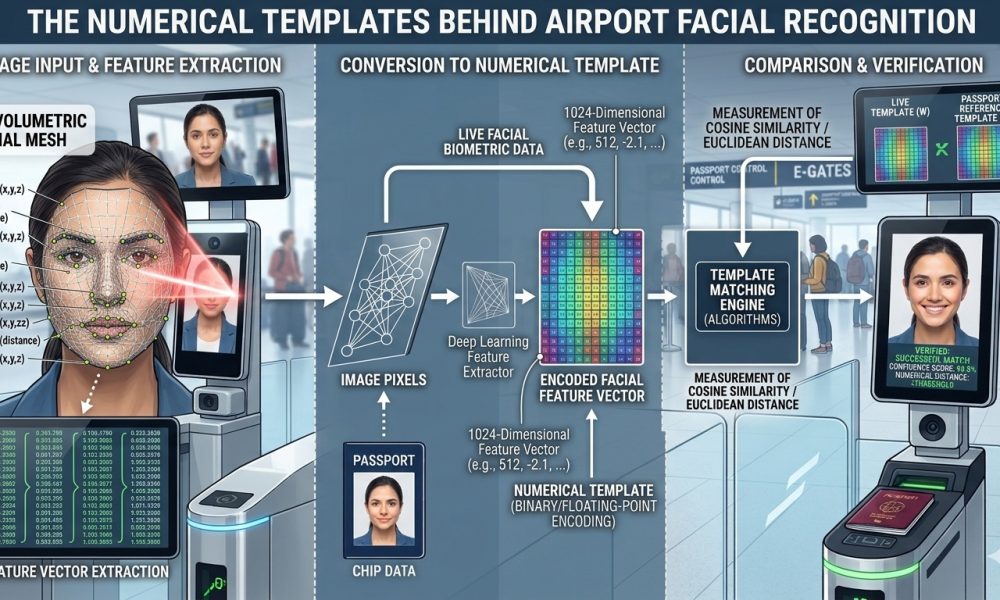
Adjustments for position, scale, and head angle help facial recognition systems compare a live airport Image with the portrait associated with a traveler’s passport, reducing differences caused by Camera placement, distance, posture, and other common capture conditions.
WASHINGTON, DC, October 6, 2026 — When a traveler pauses in front of an airport eGate or biometric inspection Camera, the facial Image captured at that moment may differ noticeably from the carefully controlled portrait stored with the traveler’s passport, so software must account for ordinary variations before making a meaningful comparison.
Facial alignment is an important processing stage that helps address these differences, because recognition software can locate key facial regions and mathematically normalize the Image so position, apparent size, and orientation become more comparable to the reference portrait used during identity verification.
The process does not change a traveler’s identity or alter the underlying passport photograph, because alignment generally prepares images for comparison by reducing irrelevant geometric differences that could otherwise interfere with an algorithm’s ability to evaluate corresponding facial characteristics accurately.
Two Images Rarely Arrive in the Same Position
Passport portraits are normally created under controlled conditions intended to produce a clear, standardized representation of the holder. At the same time, live airport photographs often capture travelers of different heights approaching cameras at different speeds, distances, and positions.
A traveler may stand slightly to the left of the Camera, lean forward, tilt their head several degrees, or stand farther from the lens than another passenger, meaning the resulting face can occupy a different location and proportion within the captured Image.
Those variations may seem minor to a human observer. Still, automated recognition systems measure Image characteristics mathematically, making consistent positioning valuable when software compares corresponding facial information across two photographs taken under very different circumstances.
For this reason, facial comparison technology generally includes preprocessing stages that prepare images before the primary recognition calculation, helping ensure that differences caused mainly by Camera geometry or traveler positioning do not dominate the eventual similarity assessment.
Facial Alignment Creates a More Consistent Starting Point
A facial alignment process typically begins after software detects the presence and approximate location of a face, allowing the system to identify landmarks or other structural information that helps determine how the face is positioned within the captured frame.
Those landmarks may provide information about locations around the eyes, nose, mouth, and broader facial geometry. However, the precise points, models, and processing techniques differ considerably among recognition systems and should not be assumed to operate identically across every airport installation.
Once the relevant geometry has been estimated, software can mathematically reposition or normalize the Image into a more standardized representation, reducing differences in translation, scale, and orientation before later recognition stages attempt to determine whether the live traveler corresponds with the available reference Image.
This normalization is particularly useful because two photographs of the same person can otherwise show substantially different pixel arrangements simply because one Image was captured from farther away, slightly off-center, or with the subject’s head rotated relative to the Camera.
Position Is One of the Simplest Differences to Correct
A traveler does not need to stand in precisely the same place where the original passport portrait was captured, meaning the live face may appear higher, lower, farther left, or farther right within the electronic Image generated at an inspection point.
Alignment software can compensate for much of that positional difference by determining where the face appears within the live frame and repositioning the relevant facial region into the coordinate arrangement expected by subsequent recognition processing.
This adjustment can prevent the comparison algorithm from treating simple Image placement as though it represented a biological difference between two people, because the meaningful question concerns whether the facial structures correspond rather than whether both photographs occupy identical pixel coordinates.
This adjustment also helps explain why airport cameras can accommodate ordinary differences in traveler positioning without requiring every person to reproduce the exact posture, distance, and framing used when the original passport photograph was taken.
Scale Helps Account for Distance From the Camera
Distance also affects facial appearance because a traveler standing closer to a Camera normally occupies a larger proportion of the captured Image. At the same time, someone positioned farther away may produce a smaller facial region even when both photographs represent the same individual.
Normalization can rescale the detected facial region so that relevant structures occupy a more comparable mathematical size before recognition begins, reducing a geometric difference that has little relationship to the underlying identity of the person being examined.
This does not mean Image resolution becomes irrelevant, because a very small, blurred, or poorly captured face may still contain insufficient useful information even after scaling, particularly when the original Camera never recorded important facial detail clearly.
Instead, scaling works within the information already available by presenting facial data in a more consistent form, allowing later stages of a recognition system to concentrate more effectively on characteristics that may help distinguish one individual from another.
Head Angle Can Change How Facial Features Appear
Head orientation presents another challenge because a face viewed directly from the front does not produce precisely the same two-dimensional Image as the same face photographed while slightly tilted, turned, or raised relative to the Camera.
Even small orientation changes can alter the apparent distances and relationships among visible features. At the same time, larger rotations may partially hide one side of the face and substantially change the information available for automated comparison.
Recognition pipelines can therefore estimate facial pose and apply alignment procedures to reduce manageable rotational differences. However, software cannot perfectly reconstruct information that was never captured when a face turns too far away from the Camera.
This distinction is important because alignment improves comparability rather than creating missing biometric information, meaning an excessively rotated or obscured face may require another photograph instead of relying on software to compensate indefinitely for unsuitable capture conditions.
Roll, Pitch and Yaw Describe Different Movements
Engineers commonly describe head orientation using concepts comparable to roll, pitch and yaw, with roll referring broadly to sideways tilt, pitch describing upward or downward movement and yaw describing rotation toward the left or right.
Each movement can affect how facial landmarks appear in a two-dimensional Camera Image. Still, the effects differ because sideways rotation may conceal parts of the face that remain visible when the traveler tilts the head only a few degrees.
A recognition system may therefore tolerate some variations better than others. At the same time, airport interfaces often encourage travelers to look directly toward the Camera because a stronger frontal Image reduces the normalization required and preserves more useful facial information.
The objective is not to force travelers into perfectly identical poses, but to obtain an Image sufficiently consistent with the reference portrait that the automated system receives enough reliable information to perform its intended comparison.
International Standards Encourage Consistent Passport Portraits
The importance of standardized facial imagery extends beyond airport cameras because international passport specifications are designed partly to ensure that travel document portraits remain suitable for both human examination and automated biometric comparison across different countries and border environments.
The International Civil Aviation Organization’s travel document specifications require displayed facial images in machine-readable travel documents to provide a true likeness of the document holder while supporting compatibility with recognized specifications governing facial Image capture and quality.
A standardized reference Image gives border technology a stronger foundation because the airport system can compare a live photograph against a portrait originally acquired under more controlled conditions than are normally available in a crowded passenger-processing environment.
The passport photograph therefore does more than serve a decorative Identification function, because its standardized characteristics support both traditional visual inspection by officers and increasingly sophisticated automated processes designed to confirm that the person presenting the document matches its authorized holder.
Image Quality Remains Critical Even With Good Alignment
Alignment cannot turn a fundamentally poor photograph into a high-quality biometric reference because recognition software still needs sufficient Image detail, suitable illumination, usable resolution, and an adequately visible face before meaningful comparison is possible.
A photograph affected by severe motion blur, extreme underexposure, heavy obstruction, or substantial pose variation may still produce weak recognition information after normalization because geometric correction cannot recover facial details the Camera never captured clearly.
Research through the National Institute of Standards and Technology’s facial Image quality evaluations examines how factors including pose, illumination, and resolution relate to recognition performance, reflecting the continuing importance of capture quality in operational biometric systems.
Those findings reinforce a broader principle in biometric engineering: the sophistication of an algorithm cannot fully eliminate problems created by unsuitable input data, making strong Image acquisition and effective normalization complementary rather than interchangeable components of reliable facial comparison.
Airport Cameras Are Designed Around the Capture Problem
Modern airport biometric installations often use Camera positioning, visual prompts, and automated adjustments intended to increase the likelihood that travelers naturally present their faces in a suitable orientation without requiring complicated instructions or lengthy manual positioning.
Some systems can accommodate travelers of different heights through multiple cameras or automated Camera selection. At the same time, screen prompts may ask passengers to look toward a particular point so the system can capture a frontal photograph of sufficient quality for comparison.
These interface choices matter because biometric performance depends partly on the interaction between people and equipment, meaning an otherwise capable recognition algorithm may perform less consistently when passengers cannot tell where to stand or where to look.
A well-designed inspection environment therefore tries to solve image-quality problems before they reach the recognition algorithm. At the same time, facial alignment adds another layer of processing for the normal variations that remain after the Camera captures the traveler.
The Passport Portrait and Live Image Serve Different Roles
The reference portrait associated with a passport ordinarily represents an enrolled identity Image created before travel. In contrast, the airport photograph represents a fresh observation intended to determine whether the person physically present corresponds sufficiently with that previously established identity.
Because those photographs originate at different times and under different conditions, differences involving hairstyle, aging, lighting, expression, Camera equipment, and Image framing may appear even when both images unquestionably depict the same person.
Facial recognition technology is therefore designed to evaluate identity despite ordinary appearance variations. At the same time, alignment specifically addresses geometric differences that can be reduced before the more complex representation and similarity calculations occur.
This separation helps explain why alignment should not be confused with recognition itself, because preparing two faces for comparison is conceptually different from determining the degree of similarity between the biometric representations derived from those prepared images.
Alignment Comes Before the Main Similarity Calculation
After preprocessing creates a suitably normalized facial representation, modern recognition software can extract numerical information describing the Image characteristics, converting visible facial patterns into mathematical forms that can be compared more efficiently than raw photographs alone.
The resulting representation lets the system calculate a similarity measure between the live capture and an available reference. However, implementation details, mathematical architectures, and decision thresholds vary considerably across products, agencies, and operational environments.
Alignment improves this later stage by reducing unnecessary variation before generating those representations, helping ensure comparable facial regions appear in reasonably consistent geometric relationships rather than forcing the recognition model to account for every avoidable positional difference.
The final result therefore comes from a processing chain rather than a single visual Judgment, with acquisition, quality assessment, face detection, alignment, feature representation, and similarity calculation each contributing a different function to the overall biometric comparison.
A Similarity Score Is Not a Percentage of Identity
Automated systems generally produce mathematical comparison results that indicate how strongly two facial representations correspond. Still, those values should not be casually interpreted as a literal percentage describing how certain the system is about a person’s identity.
Thresholds and operational rules determine how a particular system responds to comparison scores, and those settings may differ by Application, desired security level, Image quality, and the consequences of incorrect acceptance or rejection.
An airport environment may also include additional checks involving passport data, travel records, document Authentication, or officer review, meaning facial comparison ordinarily operates as one component within a larger identity and border-processing framework rather than functioning as an isolated verdict.
Understanding that distinction helps prevent exaggerated claims about facial recognition technology because neither alignment nor similarity scoring independently proves identity with absolute certainty, even though both can contribute valuable evidence within a properly designed verification process.
Facial Alignment Does Not Alter the Passport Chip
The normalization performed during facial recognition occurs within image-processing software. It should not be confused with modifying the digitally stored portrait, the electronic passport chip, or the underlying travel-document information presented by the traveler.
An electronic passport can contain a facial Image stored as protected data. At the same time, airport systems may obtain reference photographs from authorized government holdings or travel-document information depending on the specific jurisdiction, system architecture, and border-processing procedure involved.
Alignment works on Image representations used during comparison, allowing software to prepare those photographs mathematically without rewriting the original biometric data stored within the passport or changing the identity information established by the issuing authority.
That distinction matters when travelers use consumer passport-reading applications because accessing an electronic chip and performing facial comparison involve different technical processes, even when both ultimately contribute information about the same travel document holder.
Chip Authentication and Facial Alignment Solve Different Problems
Electronic passport Authentication primarily determines whether protected digital information was legitimately created and whether relevant data remains consistent with cryptographic protections established by the issuing authority. At the same time, facial recognition addresses whether a person matches an identity Image.
A genuine electronic chip does not automatically establish that the individual presenting the passport is the rightful holder, just as a strong facial similarity result does not independently establish that the physical booklet and its electronic components are authentic.
Border systems can therefore combine document examination, cryptographic validation, facial comparison and database checks because each mechanism addresses a different question and contributes a separate layer to the overall assessment of a traveler and travel document.
Amicus International Consulting has previously explained these layered protections in its overview of modern passport security and counterfeit detection, which examines how physical and electronic safeguards work together rather than relying upon any single feature.
A Perfectly Centered Face Is Not the Objective
Facial alignment can sometimes create the misleading impression that travelers must position themselves with laboratory precision. However, modern operational systems are generally intended to accommodate reasonable human variation while still encouraging good-quality frontal captures whenever possible.
Normalization aims to manage manageable differences, allowing passengers to use automated systems without reproducing an identical photographic pose every time they encounter an airport Camera or border inspection terminal.
Travelers can still improve capture conditions by facing the Camera normally, following on-screen positioning instructions, and avoiding unnecessary movement. At the same time, the system takes the photograph because these simple behaviors give it more consistent information from the start.
When the captured Image falls outside acceptable quality parameters, the appropriate response may be another photograph or additional inspection rather than assuming a traveler failed identity verification or that the passport itself has a problem.
Human Review Still Matters in Border Processing
Automated facial comparison can speed up routine passenger processing by helping systems quickly identify strong biometric matches. However, border authorities still have procedures for situations where technology cannot capture an adequate Image or produce a useful comparison result.
A failed automated attempt can arise from several causes unrelated to fraud, including poor lighting, movement, unusual positioning, temporary obstruction, aging differences, technical limitations, or other conditions affecting either the live Image or the available reference photograph.
Human officers can consider information beyond the mathematical face comparison, including the physical document, traveler responses, immigration records, and other authorized information, making secondary inspection fundamentally different from simply repeating the automated similarity calculation.
This layered approach matters in high-volume environments because biometric systems must balance efficiency with the reality that legitimate travelers will occasionally produce photographs that fall outside the conditions under which an automated process performs best.
Alignment Helps Reduce Differences That Do Not Define Identity
The central purpose of facial alignment is to remove photographic variation that has little relation to who the traveler actually is, allowing the recognition process to focus more effectively on information relevant to biometric correspondence.
Moving a face several centimeters within a Camera frame does not create a different identity, and standing closer to a lens or tilting the head slightly should not be the primary reason two otherwise corresponding photographs appear mathematically dissimilar.
By compensating for those geometric differences before recognition, alignment creates a more standardized starting point from which algorithms can examine the characteristics that remain after simple variations in position, scale, and orientation have been reduced.
The technique shows how modern biometric systems break a difficult identity problem into multiple processing stages, each addressing a different source of uncertainty before the system reaches its final comparison result.
Modern Border Verification Depends on Multiple Layers
Facial alignment demonstrates why an automated airport passport check should not be understood as a Camera simply deciding whether two photographs look alike, because substantial Image preparation and quality control can occur before a similarity assessment becomes meaningful.
The live capture must first contain a usable face; the software must determine where that face appears; geometric differences may require normalization; biometric information must then be represented mathematically; and the resulting comparison must be interpreted according to the system’s operational rules.
Meanwhile, the travel document itself may undergo separate physical and electronic checks. At the same time, immigration and security systems can perform additional inquiries that have no direct relationship to the facial alignment process used to prepare images for recognition.
For travelers, the visible experience may last only several seconds at an automated gate. Still, the underlying technology reflects decades of development in travel-document standards, digital imaging, biometric measurement, and border-processing systems designed to make identity verification faster without eliminating essential security controls.
Facial alignment occupies a relatively quiet position in the process. Yet, it remains important because reliably comparing photographs captured years apart and under different conditions begins with ensuring that ordinary differences in framing and pose do not overwhelm the biometric information that matters.




