
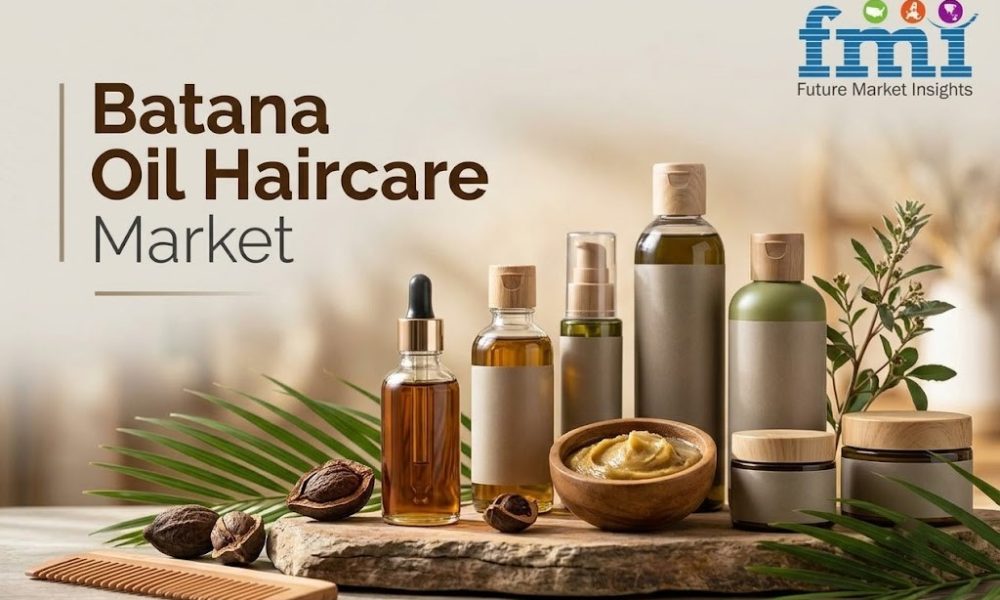
The global batana oil haircare market is projected to grow from USD 322.5 million in 2026 to USD 510.5 million by 2036, expanding at a 4.7% CAGR, according to a new report by Future Market Insights (FMI). The market was valued at USD 308.0 million in 2025.
Batana oil is moving beyond standalone oil products into familiar haircare categories, including shampoos, conditioners, treatments and scalp-care products. This integration into established routines is helping brands introduce the ingredient to consumers without requiring a separate product format.
Familiar Haircare Formats Support Market Growth
Core/classic lines are estimated to account for 33.0% of product type revenue in 2026, making them the leading product category. Oils, shampoos and conditioners already form part of regular haircare routines, allowing batana oil to be incorporated into products that consumers understand and use regularly.
The market is also seeing greater interest in products designed around conditioning, manageability and scalp care. Adoption of batana oil in shampoos and treatment products is expected to create additional opportunities for volume sales through 2036.
Conventional products are projected to hold a 52.0% share of the nature segment in 2026. Conventional formulations allow manufacturers to combine batana oil with other ingredients to improve texture, scent and rinse feel. This approach can address some of the challenges associated with using pure oils, including heaviness and strong odor.
Get detailed market forecasts, competitive benchmarking, and pricing trends: https://www.futuremarketinsights.com/reports/sample/rep-gb-35617
Liquid and Serum Formats Gain Ground
Liquid and serum formats are expected to account for 27.0% of the market in 2026. These formats are suited to direct application on the scalp or hair and can support controlled dosing through applicators.
The segment is also benefiting from increased availability of pure batana oil. In July 2026, Moe’s Group launched 100% pure Batana Oil under the INCI name Elaeis Oleifera Kernel Oil, offering the product for direct sale as well as private-label and custom formulation applications.
Mass-priced products lead price positioning with a 37.0% share in 2026, reflecting the importance of accessible entry points as consumers become more familiar with batana oil.
E-commerce Creates a Key Route to Consumers
E-commerce & DTC is forecast to lead sales channels with a 34.0% share in 2026. Online channels provide brands with additional space to explain ingredient use, product positioning and application instructions. They also allow smaller brands to reach consumers without relying entirely on physical retail distribution.
The U.S. market illustrates the importance of this channel. E-commerce accounted for 17.1% of total U.S. retail sales in the second quarter of 2026, according to the data cited in the FMI analysis. The U.S. Census Bureau reported USD 340.2 billion in retail e-commerce sales during the same quarter.
Retail availability is also expanding. In September 2025, Hollywood Beauty introduced a batana oil blend through Walmart, Target, CVS, Walgreens and e-commerce channels. Earlier, in August 2025, Taliah Waajid Brand launched Love My Natural Hair with Batana Oil Gro Drops across a textured-hair range.
Claims and Ingredient Consistency Remain Important
Market expansion comes with regulatory and quality challenges. Brands need to clearly identify product ingredients and ensure that performance claims can be supported.
Hair-growth and hair-loss claims can trigger stricter regulatory requirements in several markets. In the United States, claims implying drug action can move products beyond the cosmetic category. South Korea has specific rules for functional cosmetics associated with hair-loss symptoms, while Japan can classify hair-growth products as quasi-drugs.
Ingredient consistency is another consideration. Retailers and buyers need confidence that batana oil is genuine, consistently formulated and suitable for the intended application. This creates opportunities for suppliers and brands that can provide clear ingredient information and maintain consistent quality.
Country-Level Growth Outlook
The UAE is projected to record the highest CAGR at 6.0% from 2026 to 2036, followed by Saudi Arabia at 5.7% and South Korea at 5.4%. The USA is expected to grow at 5.1%, while the UK is projected at 4.7%.
France is forecast to expand at 4.4%, Germany at 4.1% and Japan at 3.8%. These figures represent expected growth rates rather than market-size rankings.
In the UAE and Saudi Arabia, registration and product notification requirements will remain important for market entry. In South Korea and Japan, product positioning and claims can determine the applicable regulatory route. European markets similarly require compliance with cosmetic requirements and supporting evidence for product claims.
Analyst Perspective
“Batana oil is easier to sell when it stays within a clear haircare use, such as conditioning or scalp care. The risk starts when brands move into hair-growth claims without enough evidence. Suppliers that can prove ingredient identity and keep the formula consistent will have a better chance of repeat sales.”
— Rahul Pandita, Principal Consultant, Future Market Insights
Access the Complete Report in PDF Format: https://www.futuremarketinsights.com/reports/brochure/rep-gb-35617
Competitive Landscape
The batana oil haircare market includes established consumer and professional haircare companies with capabilities across oils, serums, scalp care, treatment products and omnichannel distribution.
Companies profiled in the FMI report include Unilever, Church & Dwight, Olaplex, Shiseido, Wella Company, Kao Corporation, L’Oréal, Amorepacific, Henkel and Procter & Gamble.
The competitive environment includes large consumer haircare platforms, professional and treatment-focused specialists, and companies with targeted hair and scalp-care portfolios. The report notes that a batana-specific product was not verified for every profiled company by the publication cutoff.
Report Scope
The Batana Oil Haircare Market report covers Product Type, Nature, Format, Price Positioning and Sales Channel. The study provides market estimates in USD million for 2026–2036 and covers North America, Latin America, Western Europe, Eastern Europe, East Asia, South Asia and Pacific, and the Middle East and Africa.
The report includes country analysis for the USA, Germany, France, UK, Saudi Arabia, UAE, Japan and South Korea. The market definition includes manufacturer- or brand-level revenue from products sold as batana oil haircare, including pure batana hair oils and formulations where batana is a named haircare ingredient.
Business Impact
FMI helps organizations transform market complexity into strategic clarity, enabling leadership teams to identify growth opportunities faster, optimize resource allocation, strengthen competitive positioning, and make high-stakes business decisions with confidence.
To explore how FMI Custom Research can support your strategic priorities, please connect with our team at – [email protected]
About Future Market Insights (FMI)
Future Market Insights, Inc. (FMI) is an ESOMAR-certified, ISO 9001:2015 market research and consulting organization, trusted by Fortune 500 clients and global enterprises. With operations in the U.S., UK, India, and Dubai, FMI provides data-backed insights and strategic intelligence across 30+ industries and 1200 markets worldwide.



