
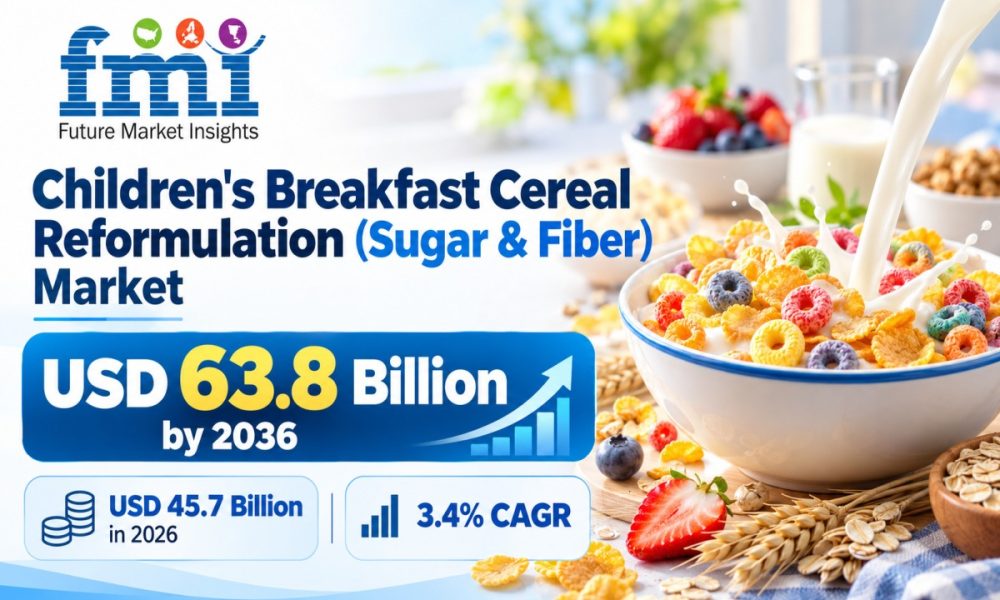
The global Children’s Breakfast Cereal Reformulation (Sugar & Fiber) Market is projected to reach USD 63.8 billion by 2036, up from approximately USD 45.7 billion in 2026, expanding at a 3.4% CAGR during the forecast period, according to the latest analysis by Future Market Insights (FMI).
Market expansion is being driven by manufacturers reformulating familiar children’s cereals to meet increasingly explicit nutrition requirements while maintaining taste, texture and scalable production performance. Sugar reduction and fiber enrichment are becoming important formulation priorities as school nutrition programs, nutrition-labeling systems and retail expectations place greater emphasis on nutrient composition.
Get Detailed Market Forecasts, Competitive Benchmarking, and Pricing Trends:
https://www.futuremarketinsights.com/reports/sample/rep-gb-34574
Sugar Reduction Leads Reformulation Focus
Sugar reduction is projected to account for 41.3% of focus demand in 2026, making it the leading reformulation priority.
School food rules and nutrition labels increasingly translate sugar limits into measurable formulation requirements for child-facing cereals. USDA guidance updated in April 2025 capped added sugars at 6 grams per dry ounce for breakfast cereals in the relevant child nutrition program context, providing manufacturers with a direct target for reformulation.
Cereal Continues to Lead Product Demand
Cereal is expected to account for 51.6% of product demand in 2026.
Established ready-to-eat cereal formats provide manufacturers with a familiar platform for staged sugar reduction, fiber enrichment, fortification and whole-grain improvements without creating a completely new eating occasion.
Post Consumer Brands launched two Mom’s Best cereals in February 2025, with Fruity Rings positioned as a whole-grain product. Such launches demonstrate how nutrition improvements can be integrated into familiar cereal formats while retaining established breakfast habits.
Whole Grain and Fiber Enrichment Create Reformulation Opportunities
Fiber and whole-grain improvements provide manufacturers with an opportunity to increase nutrient density without changing the basic breakfast occasion.
A reusable formulation platform can combine lower sugar with increased fiber or whole grain, reducing the need to develop separate nutrition-focused products. CEEREAL reported in October 2025 that Nesquik cereal fiber increased by 288% between 2003 and 2025, alongside lower sugar and higher whole-grain content.
School Nutrition Rules Increase Reformulation Pressure
School nutrition policies are turning nutrient thresholds into commercial specifications for child-facing cereal products.
Mexico’s education ministry reported in March 2025 that healthy-food guidelines entered operation across 262,547 schools, making compliance an important consideration for manufacturers supplying education channels. Manufacturers that can reformulate established family recipes to meet school requirements may avoid developing entirely separate cereal platforms for institutional use.
Sensory and Processing Trade-Offs Can Raise Costs
Lowering sugar or increasing whole-grain and fiber content can affect sweetness, texture, mouthfeel and cereal structure. These changes may require additional pilot testing and adjustments to food additives or production-line settings.
CEEREAL reported in October 2025 that Brüggen’s 2024 retail cereal portfolio averaged 45% whole-grain content following gradual recipe changes built around consumer acceptance. Reformulation therefore requires manufacturers to balance nutritional improvement with sensory performance and factory economics.
Mexico Shows the Fastest Growth Among Highlighted Markets
Among the profiled countries, Mexico is projected to record a 4.6% CAGR through 2036, followed by the United Kingdom at 4.2%, the USA at 3.8%, France at 3.4% and Germany at 3.0%.
Mexico leads the country comparison as school nutrition rules create direct formulation requirements for child-facing products. The UK follows as nutrient-related promotion restrictions influence cereal formulation and commercial planning.
The USA benefits from school and WIC nutrition specifications, while France’s Nutri-Score changes make nutrition reformulation more visible to consumers.
Competitive Landscape
The Children’s Breakfast Cereal Reformulation (Sugar & Fiber) Market includes major global cereal companies and European specialists with established whole-grain and family-focused cereal portfolios.
Key companies profiled by FMI include Kellanova (Mars), Cereal Partners Worldwide, General Mills, H. & J. Brüggen KG, Lantmännen Cerealia, Weetabix Food Company, Associated British Foods (Jordans) and Post Consumer Brands.
Competitive positioning depends on the ability to deliver lower sugar and improved fiber or whole-grain credentials while maintaining familiar taste, texture and production economics. Large international cereal platforms benefit from established brand reach, while European manufacturers bring strong grain-processing capabilities and whole-grain expertise.
Key Industry Developments
In March 2026, General Mills completed its K-12 color transition by reformulating Lucky Charms 25% Less Sugar Cereal within its institutional portfolio.
In February 2026, Lantmännen renamed AXA Natural Oat Rings as Bamse’s Oat Rings and stated that the family cereal carries Sweden’s Keyhole nutrition label.
In December 2025, Kellanova became part of Mars following required approvals, placing Kellogg’s international cereal brands within the Mars Snacking portfolio.
Analyst Perspective
“For children’s cereal reformulation, evaluation starts with the nutrient rule controlling channel access beyond unit price. A viable recipe preserves sweetness and crunch at production scale across school and retail packs.” — Nandini Roy Choudhury, Principal Consultant, Future Market Insights
Exclusive Discounts on Full Report :
Report Scope
The FMI study covers the Children’s Breakfast Cereal Reformulation (Sugar & Fiber) Market by focus, product and region. Focus categories include sugar reduction, fiber enrichment, fortification and whole grain. Product coverage includes cereal, bars and snacks for child and family eating occasions.
The study covers North America, Latin America, Europe, East Asia, South Asia and Pacific, and the Middle East and Africa, with the USA, UK, Germany, France, Mexico and more than 20 countries included in the full report.
Key Executive Benefits
- Decision-Ready Insights
- Reduced Strategic Risk
- Market Entry Confidence
- Competitive Advantage
- Faster Growth Decisions
- Primary Market Validation
To explore how FMI Custom Research can support your strategic priorities, connect with our team at [email protected].
About Future Market Insights (FMI)
Future Market Insights, Inc. is an ESOMAR-certified, ISO 9001:2015 market research and consulting organization trusted by Fortune 500 companies. With a global presence across the U.S., UK, India and Dubai, FMI delivers data-driven insights across 30+ industries and 1,200 markets worldwide.



