
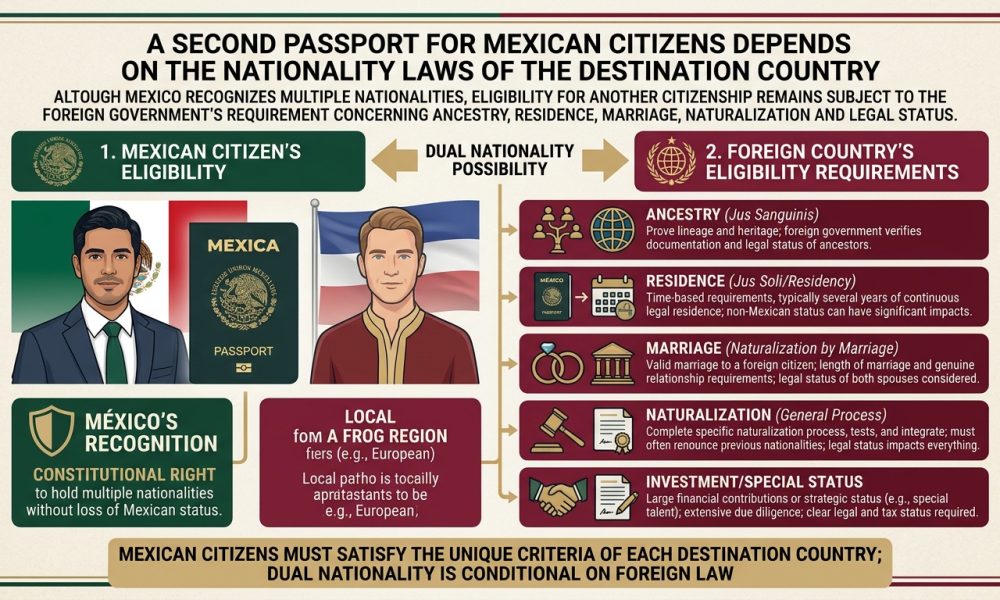
Although Mexico recognizes multiple nationalities, eligibility for another citizenship still depends on the foreign government’s requirements for ancestry, residence, marriage, naturalization, and legal status,s o Mexicans seeking additional passports must carefully evaluate international nationality laws.
WASHINGTON, DC, November 19, 2026 — Mexican citizens exploring second citizenship must understand that their country’s constitutional recognition of multiple nationalities does not automatically establish eligibility for a foreign passport, because every destination government applies its own citizenship legislation, documentation standards and naturalization requirements.
Although Mexico generally protects the nationality of Mexicans by birth who voluntarily acquire additional citizenship, prospective applicants must separately establish that they qualify under the foreign country’s legal framework, whether through family ancestry, marriage, lawful residence, or an authorized investment-based program.
The distinction has become increasingly important as Mexican professionals, retirees, internationally mobile families, and business owners explore additional citizenship opportunities in Europe, North America, the Caribbean, and other regions offering different immigration and nationality arrangements.
Mexico’s Recognition of Dual Nationality Does Not Guarantee Foreign Citizenship
Mexico’s constitutional framework recognizes nationality acquired by birth and naturalization, with Article 37(A) protecting Mexicans by birth against deprivation of their Mexican nationality when they subsequently establish citizenship relationships with other countries.
However, that constitutional Protection governs the individual’s relationship with Mexico rather than the eligibility criteria imposed by Spain, Italy, Ireland, Canada, the United States or another government considering a citizenship application.
A Mexican citizen who wishes to acquire another passport must therefore satisfy the destination country’s independent legal requirements, including any applicable rules concerning ancestry, residence periods, criminal background checks, language proficiency and recognition of existing nationalities.
Mexican Citizens by Birth Have Important Constitutional Protections
Mexicans by birth generally retain their original nationality after acquiring foreign citizenship, giving individuals substantial flexibility to pursue international residence rights while preserving enduring personal and legal connections with Mexico.
This constitutional Protection applies to qualifying individuals born in Mexico and certain people born abroad to Mexican parents. However, citizenship classification must be established under the relevant constitutional provisions and supported by authentic civil documentation.
The situation differs for naturalized Mexican citizens because Article 37(B) identifies circumstances that can result in nationality loss, including voluntary acquisition of another nationality, making independent Mexican legal advice particularly important before pursuing a foreign passport.
Foreign Governments Determine Their Own Citizenship Eligibility
Every sovereign government can set nationality rules within the limits of applicable law, meaning Mexican citizenship alone cannot compel another country to approve naturalization or recognize a claim through distant ancestry.
A foreign government may require applicants to show a specific family relationship, establish continuous lawful residence, pass language examinations, or meet additional character requirements before approving citizenship and the associated passport.
These conditions can change through legislation, administrative policy, or judicial interpretation, making current verification especially important when applicants rely upon historical eligibility information published before significant reforms affecting foreign citizenship acquisition.
Citizenship Through Ancestry Depends on Documented Family Relationships
Citizenship by descent can offer valuable opportunities for Mexicans whose parents, grandparents, or earlier relatives held another nationality. Still, eligibility depends upon the particular country’s rules concerning citizenship transmission between generations.
Some governments recognize citizenship automatically under qualifying circumstances. In contrast, others require formal registration, administrative recognition, or an application establishing that the relevant family members retained their nationality when the next generation was born.
Applicants commonly need birth certificates, marriage certificates, death records, naturalization histories, and official civil registry documents demonstrating an uninterrupted qualifying family connection, with additional translations and authentication required when documents originate from different jurisdictions.
Italian Citizenship Reform Demonstrates Why Foreign Laws Matter
Italy’s 2025 citizenship reforms substantially restricted certain ancestry-based claims, demonstrating that a Mexican citizen with historical Italian family connections cannot assume that rules allowing recognition through distant generations remain unchanged.
In April 2026, The Associated Press reported on American families challenging Italy’s restrictions on citizenship by descent, highlighting continuing legal disputes over reforms that narrowed opportunities for descendants born abroad who already possess another nationality.
For Mexican applicants with Italian ancestry, eligibility now requires careful examination of the amended legislation, relevant parental or grandparental connections, possible residence-related exceptions, and transitional provisions affecting applications or proceedings initiated before specified deadlines.
Irish Citizenship Provides a Different Ancestry-Based Framework
Ireland maintains nationality rules that may allow qualifying descendants of Irish citizens to obtain citizenship through family relationships. However, the procedures differ depending on whether the relevant parent or grandparent was born in Ireland.
A Mexican citizen with an Irish-born grandparent may qualify to apply through the Foreign Births Register, provided the family relationship and supporting nationality records satisfy the requirements established by the responsible Irish authorities.
More distant ancestry can add conditions, such as whether an earlier generation completed citizenship registration before the next generation’s birth, showing why a family tree alone cannot establish eligibility for an Irish passport.
Polish Ancestry Claims Require Historical Nationality Research
Mexicans whose ancestors emigrated from Poland may investigate citizenship confirmation. Still, these cases often require substantial historical research into earlier nationality laws, emigration records, military service, and potentially significant changes in citizenship status.
An applicant may need to establish that a Polish ancestor held citizenship under the legislation in force at the relevant time and that subsequent events did not interrupt lawful transmission through later generations.
For families whose records span several countries, historical border changes and different civil registration systems can complicate verification, making accurate documentary research essential before concluding that Polish citizenship can be recognized.
Spain Offers a Distinct Residence-Based Opportunity for Mexicans
Spain’s Civil Code sets a reduced nationality residence period for nationals of Ibero-American origin, including Mexico, providing an important alternative for individuals without qualifying European ancestry.
Under Article 22, eligible Mexican nationals by origin may ordinarily apply for Spanish nationality after two years of legal, continuous residence immediately before their application, rather than the general ten-year residence period that applies to many other foreign applicants.
However, completing two years of qualifying residence does not automatically produce Spanish citizenship, because applicants must still establish good civic conduct, demonstrate the required degree of integration and satisfy applicable documentation and administrative requirements.
Spanish Residence Authorization Must Come Before Naturalization
A Mexican citizen seeking Spanish citizenship through residence must first obtain an appropriate immigration status allowing lawful residence, since visiting Spain as a tourist does not ordinarily establish the qualifying residence required under nationality legislation.
Potential residence pathways include qualifying employment, family relationships, non-lucrative residence and other authorized arrangements. However, each has separate eligibility conditions regarding financial resources, permitted activities, health insurance, and continuing residence obligations.
An applicant relying upon Spain’s reduced nationality period should therefore distinguish the date lawful residence begins from the date of arrival, because immigration classification and continuity can determine whether the statutory requirement has been fulfilled.
Spanish Citizenship Approval Remains a Separate Government Decision
Once the required residence period is complete, the applicant must submit a nationality application through the appropriate Spanish procedures, including supporting records on identity, residence history, nationality, and criminal background.
Applicants may also need to satisfy integration requirements involving constitutional and sociocultural knowledge. At the same time, exemptions from Spanish-language testing can apply to qualifying nationals of countries where Spanish is an official language.
Government processing, review, nd registration can extend beyond the minimum residence period, so it is inaccurate to advertise a Spanish passport as automatically available exactly two years after a Mexican citizen relocates to Spain.
Mexican Nationality by Origin Matters Under Spanish Law
Spain’s accelerated two-year residence provision applies to nationals by origin of qualifying countries, creating an important legal distinction between someone who has Mexican nationality from birth and someone who later acquired Mexican citizenship through naturalization.
A naturalized Mexican citizen should not assume that holding a Mexican passport alone establishes entitlement to Spain’s reduced residence period, because Spanish authorities must assess nationality under their own legislation.
The proper assessment should examine the applicant’s complete citizenship history, original nationality, and supporting documentation before determining whether the individual qualifies for the preferential residence period or another naturalization pathway.
Marriage to a Foreign Citizen Does Not Automatically Grant a Passport
Marriage can create opportunities for foreign residence and eventual citizenship, but most countries require additional legal conditions before a Mexican spouse becomes eligible to receive nationality through a marital relationship.
Depending on the jurisdiction, applicants may need to establish the marriage’s authenticity, maintain lawful residence, complete a prescribed marital period, or meet language and integration requirements before naturalization can be approved.
For example, marriage to a Spanish citizen can provide access to a shorter nationality residence period under specified circumstances. However, the applicant must still satisfy qualifying residence and other statutory conditions rather than receive citizenship automatically.
United States Citizenship Through Marriage Requires Naturalization Eligibility
A Mexican citizen married to an American citizen may qualify for immigration benefits through the marriage, but obtaining lawful permanent residence differs from obtaining United States citizenship or a passport.
Certain spouses of American citizens may apply for naturalization after three years of qualifying permanent residence, provided they meet additional requirements related to the marital relationship, physical presence, continuous residence, and other eligibility conditions.
The U.S. Department of State’s official guidance on dual nationality explains that American law generally permits acquisition of another citizenship without automatically requiring relinquishment of American nationality. At the same time, continuing obligations remain applicable to dual citizens.
American Citizenship Creates Rights and Continuing Responsibilities
Mexicans born in Mexico who successfully naturalize as American citizens generally retain Mexican nationality under Mexico’s constitutional protections, allowing them to maintain citizenship ties with both countries and preserve significant international residence opportunities.
However, American citizens ordinarily must use United States passports to enter and leave the country, subject to limited authorized exceptions, even when they hold valid Mexican passports or other foreign nationality documents.
American federal tax obligations can also continue after overseas relocation, so United States citizenship is a decision to evaluate through permanent nationality rights and legal responsibilities rather than passport convenience alone.
Canada Establishes Different Naturalization Conditions
Mexican citizens considering Canadian citizenship generally must first qualify for permanent residence before becoming eligible for ordinary naturalization, creating a multistage process distinct from ancestry recognition or immediate citizenship through an investment contribution.
Under the general Canadian citizenship framework, qualifying applicants ordinarily must accumulate at least 1,095 days of physical presence within the applicable five-year period and satisfy any other requirements relevant to their circumstances.
Additional conditions can include language proficiency, citizenship knowledge, required tax filings, and restrictions related to certain legal circumstances, showing that holding Canadian permanent residence does not automatically entitle a Mexican national to citizenship.
Residence-Based Citizenship Requires Long-Term Commitment
Countries offering citizenship through residence commonly distinguish between temporary permission to stay, permanent residence, and eligibility for naturalization, with each stage governed by different legal standards and administrative requirements.
A Mexican professional relocating abroad for employment may initially obtain a temporary residence authorization, later qualify for permanent residence, and eventually become eligible for citizenship only after meeting the relevant statutory conditions.
The process can require several years of continuous compliance, so applicants who intend to maintain employment, family responsibilities, or financial connections in Mexico during their foreign residence period should plan long term.
Investment Residence Is Not the Same as Investment Citizenship
International investment immigration programs may offer lawful residence through qualifying property investments and financial contributions. Still, applicants should distinguish these arrangements from programs that provide a pathway to citizenship.
A residence-by-investment authorization may allow you to live in the destination country without granting immediate nationality. At the same time, subsequent naturalization may depend on language skills, physical presence, integration, or other requirements.
Citizenship-by-investment programs operate under different statutory arrangements and may grant nationality following qualifying government approval. However, their availability, screening procedures, financial commitments and treatment of family members can vary considerably.
Investment Programs Must Be Verified With Competent Authorities
Mexican investors considering additional citizenship should verify whether an advertised program is legally authorized, whether applications must pass through licensed agents, and whether the government has established independent due diligence procedures.
Background screening may involve identity verification, criminal history checks, source-of-funds documentation, nd review of applicable restrictions, meaning an applicant’s ability to finance the required contribution does not guarantee acceptance.
Applicants should also investigate whether a program grants permanent citizenship, whether dependents qualify, and whether the resulting passport provides the residence and travel rights claimed in promotional materials.
Citizenship Approval and Passport Issuance Are Separate Steps
A foreign government’s approval of citizenship does not always lead to immediate possession of a passport, because nationality registration, oaths, civil documentation,, and passport applications maybee distinct administrative requirements.
For ancestry applicants, recognition may first require the government to update its civil registry. At the same time, naturalized citizens may need to complete a formal declaration or ceremony before receiving their citizenship certificates.
Travel arrangements should therefore account for the difference between establishing legal nationality and obtaining the physical passport needed for international travel, particularly when the new document is required for employment or relocation.
Foreign Language and Integration Requirements Can Affect Eligibility
Some countries require naturalization applicants to demonstrate language proficiency or knowledge of national history and civic institutions, creating additional obligations that do not necessarily apply to individuals recognized as citizens through qualifying ancestry.
These requirements may be modified for particular applicants based upon age, disability, educational background, or nationality. Still, exemptions must be confirmed under the current rules established by the responsible foreign government.
Mexicans comparing citizenship destinations should therefore consider the practical demands of preparing for examinations and maintaining qualifying residence, rather than evaluating opportunities exclusively through advertised passport strength or minimum processing periods.
Criminal Background Screening Is Common in Naturalization Programs
Foreign governments often review criminal history, immigration compliance, and other matters relevant to good character or public security when considering citizenship applications, although standards differ by jurisdiction.
An individual who meets an ancestry, marriage, or residence requirement may still face additional review if the government identifies unresolved criminal proceedings, inaccurate application information, or conduct relevant to statutory eligibility restrictions.
Applicants should provide complete and truthful information through official procedures, recognizing that a second passport cannot properly be obtained by concealing material facts or bypassing lawful government eligibility reviews.
Document Authentication Can Become a Major Application Requirement
Mexican birth certificates, marriage records, and other civil documents may need apostilles, certified translations, or additional government authentication before foreign nationality authorities will accept them as evidence of identity or qualifying family relationships.
Applicants pursuing citizenship through several ancestral generations may encounter additional difficulties when historical names differ, records contain transcription errors, or different administrative systems issued family documents.
Resolving those discrepancies through appropriate civil registry procedures can prevent unnecessary application delays, while preserving a reliable documentary connection between earlier generations and the person requesting citizenship recognition.
Second Citizenship Can Create Important Family Opportunities
A qualifying foreign citizenship may provide residence, education, or employment opportunities for spouses and children. Still, family benefits are not necessarily automatic and may depend on age, marital status, and the issuing country’s nationality transmission rules.
Some jurisdictions allow qualifying children to acquire citizenship with a parent, while others require separate registrations, residence periods, or applications after the principal applicant establishes nationality.
Mexican families considering long-term relocation should therefore examine each family member’s eligibility individually, particularly when children have different birthplaces, parents possess different nationalities, or the proposed pathway restricts dependent inclusion.
Second Passports Can Support Retirement and International Relocation
Mexican retirees exploring overseas residence may value citizenship that provides permanent settlement rights, improved access to local services, or the ability to spend extended periods abroad without repeatedly renewing temporary immigration permissions.
However, citizenship is not always necessary for lawful retirement overseas, because some destinations offer residence permits that allow qualifying foreign nationals to remain for extended periods without seeking naturalization.
A careful comparison should consider healthcare access, financial resources, residence conditions, family requirements, and taxation before determining whether the costs and obligations of foreign citizenship offer advantages beyond an appropriate long-term residence permit.
Tax Residency Is Different From Citizenship Status
A Mexican citizen who acquires another nationality does not necessarily become a tax resident of the issuing country simply because a foreign passport has been granted or a citizenship certificate has been issued.
Tax residency typically depends upon the relevant country’s statutory criteria, which may examine habitual residence, physical presence, permanent homes, or other economic and personal connections. However, some countries also impose citizenship-based obligations.
Applicants should discuss these questions with qualified cross-border tax professionals, particularly if they maintain Mexican property, international investments, business income, or family financial arrangements that may create overlapping legal responsibilities.
International Banking Requires Independent Financial Compliance
Additional citizenship may simplify certain local administrative procedures or establish residency rights in another country. Still, financial institutions retain independent authority to evaluate customers under applicable Identification, tax reporting, and anti-money-laundering rules.
Having a foreign passport does not guarantee access to a particular bank account or eliminate documentation requirements for beneficial ownership, lawful source of funds, and existing tax residency classifications.
Mexicans opening overseas accounts should distinguish citizenship privileges from banking eligibility, ensuring financial planning remains consistent with requirements imposed by relevant governments and regulated financial institutions.
Amicus International Consulting and Second-Citizenship Planning
For Mexican applicants evaluating foreign nationality through ancestry, residence, marriage, or investment, international citizenship planning requires careful comparison of government eligibility standards and the practical benefits of each available pathway.
Amicus International Consulting outlines relevant mobility and citizenship considerations through its second-passport and international advisory services, providing prospective applicants with information about international planning options. At the same time, authorized governments remain responsible for official eligibility determinations.
The right strategy should determine whether the applicant has Mexican nationality by birth or naturalization, establish the foreign country’s current citizenship requirements, and ensure all proposed documents and procedures comply with applicable law.
The Right Citizenship Pathway Depends on Individual Circumstances
A Mexican citizen with qualifying Irish ancestry may face a substantially different application process from a professional seeking Canadian citizenship through residence or a retiree considering Spanish naturalization after satisfying the statutory residence requirement.
Each pathway should be evaluated based on actual eligibility, documentary evidence, government processing procedures, financial commitment, and the long-term rights associated with successful citizenship, rather than on generalized claims that every Mexican applicant can obtain the same foreign passport.
Conclusion: Mexico Permits Multiple Nationalities, but Foreign Governments Control Eligibility
Mexico’s constitutional framework provides important protections for citizens by birth seeking additional nationality. Still, those protections do not override another country’s laws or guarantee that an applicant will meet foreign naturalization requirements.
Differences among Spain’s reduced residence period, Italy’s revised ancestry legislation, Ireland’s citizenship registration procedures, and North American naturalization pathways show why every second-passport application requires an independent assessment of the relevant destination country’s rules.
For Mexican citizens considering additional passports in 2026, successful international citizenship planning begins with confirming their existing nationality classification, identifying a legitimate foreign pathway, and gathering authentic documentation that meets the approving government’s requirements.
Ultimately, a second passport can expand international residence, family mobility,y and professional opportunities while preserving Mexican nationality for qualifying citizens by birth. Still, the legal requirement is that additional citizenship must always be established under the destination country’s own laws.




