
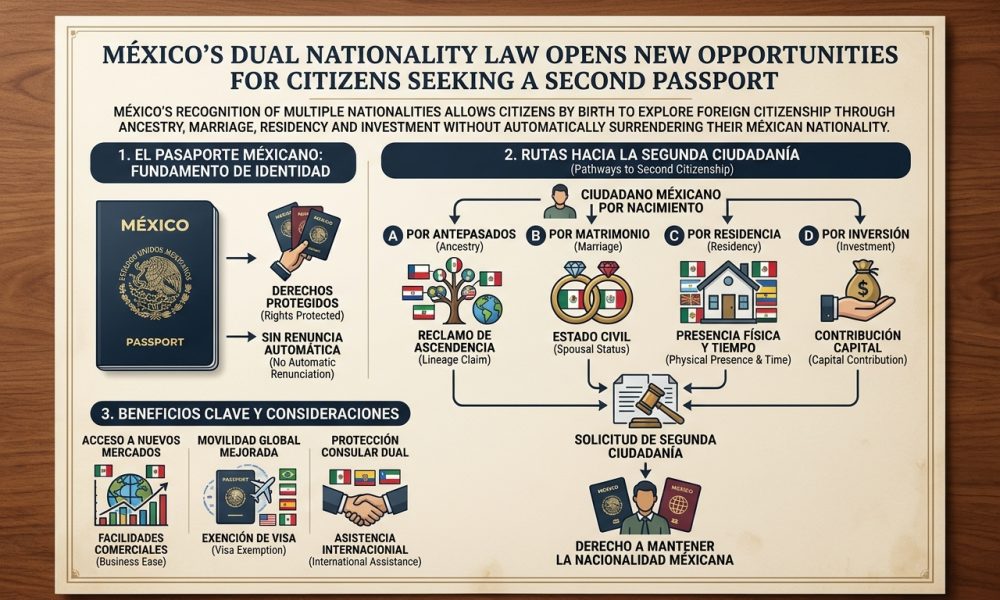
Mexico’s recognition of multiple nationalities allows citizens by birth to explore foreign citizenship through ancestry, marriage, residency, and investment without automatically surrendering their Mexican nationality, although naturalized Mexicans and applicants pursuing additional citizenship must understand important constitutional distinctions.
WASHINGTON, DC, November 19, 2026 — Mexican citizens considering a second passport have substantial opportunities to expand their international mobility because Mexico’s constitutional framework protects nationality acquired by birth, allowing eligible individuals to obtain additional foreign citizenship without automatically losing their original Mexican nationality.
The legal distinction has become increasingly relevant as Mexican families, internationally mobile professionals, retirees, and business owners explore citizenship through European ancestry, foreign marriage, long-term residence, and investment programs that provide opportunities beyond those associated with a Mexican passport.
However, nationality protections differ between Mexicans by birth and individuals who became Mexican citizens through naturalization, making the distinction essential when evaluating another country’s citizenship requirements, international travel documentation, and the potential consequences of acquiring additional nationality.
Mexico’s Constitution Protects Nationality Acquired by Birth
Article 37(A) of Mexico’s Constitution establishes that Mexicans by birth cannot be deprived of their Mexican nationality, providing an important constitutional foundation for individuals who subsequently acquire foreign citizenship through recognized legal pathways.
This Protection allows qualifying citizens to pursue another nationality without automatically sacrificing their Mexican citizenship. However, the country granting the additional nationality may impose separate requirements concerning citizenship retention, residence, naturalization, or declarations of allegiance.
For individuals exploring international relocation, this distinction offers significant planning flexibility because retaining Mexican nationality preserves a continuing legal connection to Mexico while allowing another country to recognize additional rights under its own nationality legislation.
The 1998 Nationality Reform Established the Modern Framework
Mexico’s contemporary recognition of multiple nationalities developed through constitutional reforms that took effect in March 1998, fundamentally changing how Mexican nationals who voluntarily obtained citizenship in another country are treated.
Before those reforms, earlier provisions could result in the loss of Mexican nationality upon foreign naturalization, creating difficult choices for emigrants seeking political participation, employment opportunities, and more secure immigration status in their adopted countries.
The revised framework recognized the importance of maintaining national connections with Mexican communities living abroad, particularly families established in the United States whose members increasingly qualified for American naturalization or possessed children entitled to citizenship in both countries.
Mexicans by Birth and Naturalized Mexicans Face Different Rules
The constitutional Protection against deprivation of nationality applies specifically to Mexicans by birth, while Article 37(B) establishes separate circumstances under which Mexican nationality acquired through naturalization may be lost.
Those circumstances include voluntarily acquiring another nationality and certain other actions specified in constitutional legislation, meaning a naturalized Mexican should obtain qualified legal advice before beginning a foreign citizenship application that could affect existing status.
This distinction matters especially for foreign-born individuals who obtained Mexican citizenship through residence or another naturalization pathway, because acquiring additional nationality later may carry consequences not applicable to citizens recognized as Mexican from birth.
Mexican Citizenship by Descent Can Extend Beyond Mexico’s Borders
Mexico’s nationality legislation recognizes qualifying individuals born outside Mexican territory who acquire Mexican nationality through their parents, creating important opportunities for families whose children or later generations were born and raised internationally.
Constitutional changes in 2021 expanded nationality transmission through Mexican parents, removing an earlier generational limitation that complicated recognition for certain descendants born outside the country.
Although qualifying descendants may be Mexican by birth under applicable law, obtaining civil registration and official documentation remains essential to establish nationality in practice and secure the passports needed for international travel.
Demand for Mexican Dual Citizenship Reflects International Mobility Trends
Interest in Mexican citizenship documentation has increased among eligible families in the United States, particularly as applicants seek the ability to reside in Mexico while preserving their existing American citizenship and employment opportunities.
A September 2026 Los Angeles Times report on rising Mexican dual-citizenship applications described growing demand at Mexico’s Los Angeles consulate, highlighting how ancestry-based recognition and simplified documentation procedures are attracting younger generations.
The reporting also explained how Mexico’s constitutional changes expanded nationality opportunities for descendants living abroad, illustrating that second citizenship can develop through family relationships rather than requiring substantial investment or years of foreign residence.
American Citizenship Is a Major Opportunity for Mexican Nationals
Mexicans who qualify for United States permanent residence may eventually become eligible for American citizenship through naturalization, provided they meet federal requirements for residence, physical presence, good moral character, and other applicable conditions.
For Mexican citizens by birth, acquiring American nationality does not automatically terminate Mexican citizenship, allowing qualifying individuals to maintain lawful citizenship relationships with both governments while enjoying the rights and responsibilities associated with each nationality.
American citizenship can provide permanent residence rights, federal voting eligibility, and employment opportunities unavailable to ordinary foreign visitors. However, naturalization does not eliminate continuing responsibilities under Mexican law or automatically resolve international taxation considerations.
United States Law Generally Permits Dual Nationality
American nationality law generally allows individuals to acquire or retain foreign citizenship without automatically losing U.S. nationality. However, relinquishment can arise under specific legal circumstances involving voluntary expatriating acts and the required intention.
The U.S. Department of State’s official guidance on dual nationality explains that Americans may hold citizenship in more than one country and must understand the potentially different legal obligations each government imposes.
For Mexican-American dual citizens, the practical consequence is that lawful nationality in both countries can provide extensive residence and family opportunities. At the same time, travel, taxation, and consular assistance remain governed by separate legal frameworks.
European Citizenship Through Ancestry Creates Additional Possibilities
Mexican citizens with qualifying European ancestors may explore citizenship through descent in countries such as Ireland, Italy, Poland, or other jurisdictions where nationality legislation recognizes specific family relationships and historical citizenship transmission.
Eligibility depends on the relevant country’s requirements for ancestral records, birth registration, parental nationality, and potential interruptions in citizenship transmission, so having a European surname or distant family connection does not automatically establish entitlement.
For successful applicants, European Union citizenship may provide substantial rights to reside and work within participating member states, creating mobility opportunities that complement Mexican nationality without automatically requiring Mexicans by birth to relinquish their original citizenship.
Italian Ancestry Applications Require Updated Legal Assessment
Mexicans with Italian family ancestry have traditionally explored recognition through citizenship by descent, but changes to Italian nationality legislation in 2025 introduced significant limitations affecting certain applicants born outside Italy.
As a result, individuals who previously assumed that a distant Italian ancestor established eligibility must review the current rules, applicable transitional provisions, and their family circumstances before concluding that citizenship recognition remains available.
Mexico’s Protection of nationality acquired by birth remains important for successful applicants. Still, it cannot override Italian eligibility restrictions or guarantee that a foreign government will recognize an ancestral claim unsupported by applicable law.
Irish Citizenship Offers a Separate Ancestry Route
Mexican citizens with qualifying Irish parents or grandparents may be eligible to investigate Irish citizenship through descent, depending upon the nationality status of earlier generations and the registration requirements established by Irish law.
Some applicants may need to register through Ireland’s Foreign Births Register before becoming citizens. In contrast, others may already have citizenship through qualifying parental circumstances and need documentation establishing that status.
An approved Irish citizenship claim can provide European Union citizenship rights in addition to Irish nationality, offering eligible Mexican citizens greater flexibility for long-term residence, employment and family settlement in Europe.
Marriage Can Create a Pathway but Not Automatic Citizenship
Mexican citizens married to foreign nationals may qualify for residence permits or accelerated naturalization opportunities in the spouse’s country, although marriage itself does not automatically grant citizenship in many jurisdictions.
Governments commonly require evidence of a genuine marital relationship, lawful residence, integration, language proficiency, or other statutory conditions before approving naturalization, so application requirements depend on the country’s immigration legislation.
For Mexicans by birth, successful foreign naturalization through a qualifying marriage generally does not eliminate Mexican nationality. Still, the applicant should separately verify whether the other government permits retention of existing citizenship.
Residence-Based Naturalization Can Expand Long-Term Options
Mexican citizens who establish lawful residence in another country may eventually qualify for naturalization after satisfying applicable residency periods, physical presence requirements, language obligations, and other conditions imposed by the destination government.
These pathways can appeal to professionals, entrepreneurs and retirees who initially relocate for employment, education or lifestyle reasons and later decide that acquiring citizenship would provide more secure long-term rights.
However, a residence permit and citizenship are separate legal statuses, meaning obtaining permission to live abroad does not automatically guarantee naturalization or establish eligibility for a foreign passport after a particular number of years.
Spain Provides a Notable Advantage for Mexican Citizens by Origin
Spain’s nationality legislation creates an important opportunity for qualifying nationals by origin of Ibero-American countries, including Mexico, because eligible applicants may apply for Spanish nationality following a reduced legal residence period.
Under Article 22 of Spain’s Civil Code, qualifying Mexican nationals by origin generally benefit from a two-year legal residence requirement rather than the ordinary ten-year period, provided they meet the necessary conditions for a naturalization application.
This distinction matters because the two-year period establishes eligibility to apply, not automatic approval, and applicants must still meet applicable residence continuity, good conduct, integration, and documentary requirements.
Spanish Naturalization Can Provide European Mobility Rights
A Mexican citizen by origin who completes Spain’s naturalization process may acquire Spanish nationality and the associated rights of European Union citizenship, creating additional residence and employment opportunities across participating European countries.
Spain also provides favorable nationality-retention treatment for qualifying citizens of Ibero-American countries. However, applicants should distinguish Spanish renunciation rules from the independent nationality laws governing their original citizenship and personal circumstances.
For Mexican-born citizens evaluating long-term European relocation, Spain can therefore offer a meaningful citizenship pathway, provided they first establish lawful residence and meet every statutory requirement rather than relying on passport-eligibility claims alone.
Citizenship by Investment Requires Careful Evaluation
Some foreign jurisdictions offer citizenship programs involving qualifying financial contributions, approved investments, or other government-established requirements, potentially creating additional nationality opportunities for Mexican applicants who satisfy the relevant eligibility conditions.
These programs differ substantially in financial commitments, family inclusion, processing procedures, background screening, and nationality rights, so applicants should verify details directly with the responsible government or authorized representative before applying.
Mexicans by birth may generally retain Mexican nationality when acquiring citizenship through a lawful investment program. Still, they must also establish that the destination country’s laws permit the intended nationality combination and that the program remains operational.
Foreign Residence and Citizenship Should Not Be Confused
International investors frequently encounter programs marketed as golden visas or golden passports, although these descriptions refer to different legal arrangements involving residence authorization and citizenship acquisition.
A qualifying residence-by-investment program may allow an applicant to live in another country without granting immediate nationality. At the same time,citizenship-by-investment legislation may offer a separate route to citizenship under specified government requirements.
Mexican applicants should therefore determine whether a proposed arrangement grants residence, permanent residence, or citizenship, because each status carries different legal rights and may involve different renewal, physical presence, and documentation obligations.
Additional Citizenship Does Not Automatically Change Tax Residency
Mexican citizens acquiring foreign nationality should distinguish their citizenship status from tax residence, because obtaining another passport does not independently determine which governments may impose income taxes or require financial disclosures.
Mexico generally evaluates individual tax residence through statutory connections such as home, center of vital interests, and other applicable conditions. At the same time, hile countries including the United States impose additional rules that can affect citizens living abroad.
For Mexican-American dual citizens, international tax planning can become particularly important because the United States generally taxes its citizens on worldwide income, subject to applicable exclusions, credits, treaties and reporting requirements.
Foreign Banking Can Create Additional Reporting Responsibilities
Second citizenship may facilitate legitimate opportunities to establish banking relationships abroad, particularly when the additional nationality provides lawful residence rights or simplifies local Identification and administrative requirements.
However, financial institutions commonly apply independent customer verification, tax Identification, and beneficial ownership procedures, meaning a foreign passport does not automatically establish account eligibility or exempt the applicant from applicable international reporting requirements.
Mexican citizens with financial interests across several jurisdictions should seek appropriate tax and financial advice before transferring substantial assets, especially when foreign residence, American citizenship, or international business activities create overlapping compliance obligations.
Mexican Dual Citizens Must Follow Mexican Entry and Exit Rules
Mexican nationality law requires individuals who possess Mexican citizenship alongside another nationality to identify themselves as Mexican nationals when entering or departing Mexico, making appropriate documentation essential for international travel.
A Mexican-American dual citizen should therefore carry the documentation required by both governments, including a valid American passport for applicable United States travel requirements and Mexican nationality documents for Mexican entry and departure procedures.
Presenting one passport during immigration inspection does not automatically eliminate the other nationality, because citizenship arises from legally recognized status rather than the traveler’s choice of document at a particular border.
Consular Assistance Can Be Limited in a Country of Citizenship
Mexicans holding foreign nationality should understand that another government may treat them exclusively as its own citizens when they enter that country, potentially limiting assistance available from Mexican diplomatic or consular representatives.
Similar complications can affect Mexican-American citizens visiting Mexico, where local authorities may regard the individual as Mexican and where applicable nationality rules and international arrangements may restrict American consular assistance.
These limitations do not diminish the legitimate advantages of additional citizenship. Still, they demonstrate why travelers should understand the obligations of both countries before assuming that one passport provides unrestricted diplomatic Protection.
Mexico’s 2026 Political Reform Highlights Limits on Dual Citizenship
Mexico’s recognition of multiple nationalities does not mean every government position remains equally accessible to citizens holding foreign nationality, particularly when constitutional and political eligibility requirements apply to senior public offices.
In October 2026, Mexico enacted a reform affecting eligibility for the presidency, state governorships and the Mexico City mayoralty, with the new restrictions scheduled to apply beginning in 2028 and requiring affected candidates to address foreign citizenship ties.
The reform generated debate between supporters who emphasized national allegiance in senior government positions and critics who questioned its consequences for Mexican communities abroad, illustrating how dual citizenship recognition can coexist with specific political restrictions.
Accurate Documentation Is Essential for Second-Citizenship Applications
Mexican citizens pursuing another nationality should maintain authentic birth certificates, civil registry records, passports, marriage certificates, and other supporting documents needed to establish identity and eligibility under the destination country’s nationality legislation.
Where an application involves ancestors born abroad, applicants may also need historical citizenship records, official translations, apostilles, or other authenticated documents, depending on the requirements of the foreign government reviewing the claim.
Individuals who have completed lawful name changes should ensure that supporting records explain differences between historical and current documentation, because inconsistent identity information can complicate applications without necessarily affecting otherwise valid citizenship rights.
Amicus International Consulting and Second-Citizenship Planning
Second citizenship can create meaningful opportunities for Mexican citizens seeking expanded international residence options, educational opportunities, family mobility, and additional legal connections abroad, provided the chosen pathway meets the relevant government’s nationality requirements.
Amicus International Consulting discusses international citizenship considerations through its second-passport and international advisory services, offering a starting point for evaluating lawful mobility strategies while leaving nationality approval and official document issuance to the competent government authorities.
For Mexican citizens by birth, a responsible planning process should review the additional country’s eligibility rules, residency obligations, and travel-document requirements while maintaining accurate Mexican nationality records and complying with applicable international laws.
Mexican Nationality Can Support a Broader International Plan
For Mexican citizens by birth, constitutional Protection against the loss of nationality provides a strong foundation for exploring additional citizenship opportunities without automatically surrendering residence rights and other legal connections associated with Mexico.
A second citizenship may offer greater flexibility when establishing a home overseas, supporting family members, pursuing employment, or responding to changing personal circumstances. However, the actual advantages depend upon the nationality acquired.
The most effective approach is to evaluate the proposed citizenship based on its genuine legal benefits rather than assumptions about visa-free travel, tax exemptions, or special protections that may not apply to every applicant.
Conclusion: Mexico’s Dual Nationality Framework Expands Lawful Opportunities
Mexico’s constitutional Protection for citizens by birth creates valuable opportunities for individuals seeking another nationality, enabling qualifying Mexicans to explore ancestry, marriage, residence, and investment pathways while generally retaining their original Mexican citizenship.
However, the distinction between birthright and naturalized citizenship remains essential, particularly because Article 37 establishes different rules that can affect individuals who acquired Mexican nationality through naturalization and subsequently pursue another country’s citizenship.
For Mexican citizens evaluating second passports in 2026, European ancestry opportunities, Spanish residence-based naturalization, and other lawful citizenship programs can provide meaningful international benefits when supported by accurate documentation and realistic eligibility assessments.
Ultimately, Mexico’s recognition of multiple nationalities allows eligible citizens to maintain enduring ties to their homeland while expanding opportunities abroad, making informed legal planning essential to realizing the legitimate advantages of additional citizenship.




