
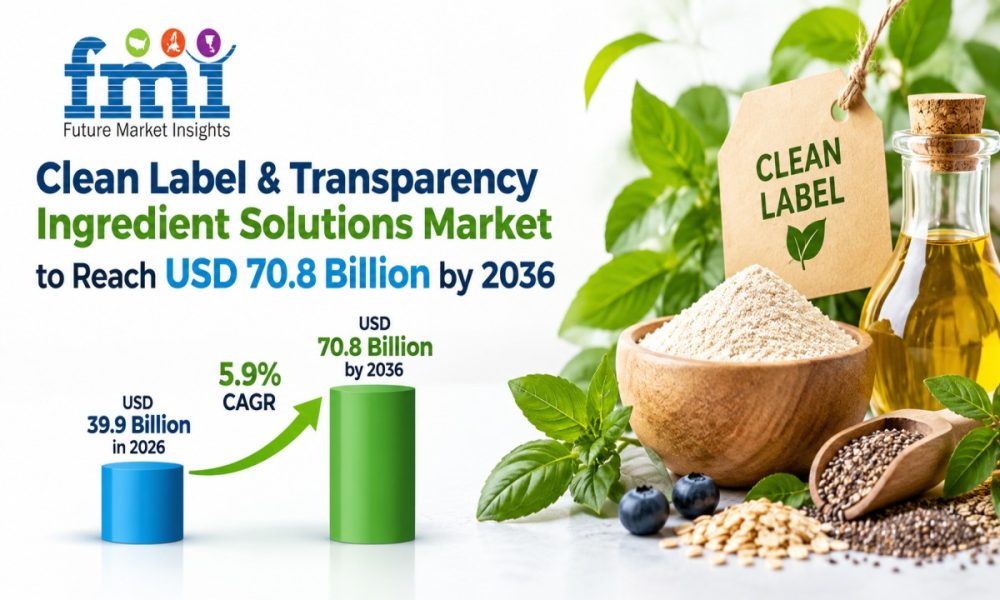
The global Clean Label & Transparency Ingredient Solutions Market is projected to reach USD 70.8 billion by 2036, up from approximately USD 39.9 billion in 2026, expanding at a 5.9% CAGR during the forecast period, according to the latest analysis by Future Market Insights (FMI).
Market growth is being supported by food manufacturers seeking simpler ingredient declarations while maintaining the texture, stability and shelf life delivered by conventional formulations. Reformulation decisions increasingly require manufacturers to balance consumer-facing label expectations with processing performance under existing plant conditions.
Get Detailed Market Forecasts, Competitive Benchmarking, and Pricing Trends:
https://www.futuremarketinsights.com/reports/sample/rep-gb-34579
Label-Friendly Starches Continue to Anchor Solution Demand
Label-friendly starches are estimated to account for 49.3% of solution demand in 2026, making them the leading solution category.
These starches are used to maintain viscosity, texture and process stability while supporting simpler ingredient declarations. Food developers evaluate replacements against conventional starch performance under commercial heat, shear and storage conditions.
The qualification process therefore extends beyond ingredient-list simplification. Manufacturers need to confirm that the selected starch maintains mouthfeel and processing tolerance at commercial scale before routine purchasing begins.
Bakery Leads Application Demand
Bakery is projected to account for 41.8% of application demand in 2026, making it the leading application segment.
Bakery formulations must balance crumb softness, freshness, mold control and production-line tolerance across the intended distribution window. Replacing conventional functional ingredients can disturb one or more of these properties, creating the need for additional plant trials and shelf-life validation.
Corbion launched Verdad Essence WH100 in April 2025 for natural mold inhibition in bread and bakery formats. Such developments broaden label-friendly preservation options, although manufacturers still need to validate shelf-life performance within individual formulations.
Package Transparency Sustains Reformulation Activity
Package-level nutrition requirements are encouraging manufacturers to revisit ingredient systems alongside nutritional targets and sensory performance.
In March 2026, the UK Department of Health and Social Care stated that restrictions on less-healthy food advertising incentivize reformulation. Such portfolio reviews can create opportunities for clean-label emulsifiers and other replacement ingredients when they preserve the sensory and processing characteristics expected from the original formulation.
Qualification Requirements Can Slow Ingredient Switching
Simpler declarations do not automatically guarantee equivalent product performance. Natural preservation and clean-label texture substitutions can require plant trials, microbiological testing and shelf-life validation.
European Commission guidance issued in December 2025 on Listeria monocytogenes shelf-life studies for ready-to-eat foods highlights the importance of formula-specific evidence when manufacturers evaluate preservation systems. Ingredient suppliers therefore need to demonstrate performance across the intended distribution period before substitutions become recurring commercial orders.
Application Support Creates Commercial Opportunities
Regional application laboratories can shorten qualification cycles by reproducing customer processing conditions before a reformulated product reaches commercial production.
Cargill announced in November 2024 that it was transforming its Singapore Innovation Center to support foodservice and indulgent-product customers across Asia. Application-focused testing can help ingredient developers identify processing problems earlier and reduce the number of trials required before commercial release.
Canada Shows the Fastest Growth Among Highlighted Markets
Among the profiled countries, Canada is projected to record an 8.0% CAGR through 2036, followed by the USA at 7.6%, the United Kingdom at 7.2%, France at 6.8% and Germany at 6.4%.
Canada leads the comparison as front-of-package nutrition labeling requirements encourage manufacturers to coordinate formulation changes with scheduled packaging updates. The USA follows as proposed front-of-package labeling gives manufacturers greater flexibility to align ingredient changes with packaging and renovation cycles.
Competitive Landscape
The Clean Label & Transparency Ingredient Solutions Market includes texture specialists, natural-preservation companies and broad formulation providers.
Key companies profiled by FMI include Ingredion, Kerry, Cargill, ADM, Tate & Lyle, Corbion, Novonesis and IFF.
Competition is shaped by the ability to reproduce texture, preservation performance and processing stability while meeting cleaner-label requirements. Ingredient suppliers also differentiate through application expertise, formulation support and geographic reach.
Ingredion and Tate & Lyle compete strongly in label-friendly starch and texture platforms. Kerry and Corbion focus on natural preservation and fermentation-based solutions, while Cargill and ADM provide broader reformulation capabilities. Novonesis and IFF contribute enzyme technologies that can reduce reliance on conventional functional additives in bakery applications.
Key Industry Developments
In August 2025, Corbion announced a collaboration with BRAIN Biotech AG to develop novel biobased antimicrobial compounds, supporting its natural-preservation capabilities.
In September 2025, Kerry inaugurated its Biotechnology Centre in Leipzig to expand enzyme and fermentation development across food and beverage applications.
In May 2025, Cargill reported that its natural-antioxidant flavor system had preserved more than 1.5 million pounds of ground beef, with planned expansion into patties and whole-muscle cuts.
Analyst Perspective
“Clean-label ingredients earn a place in a formula after they reproduce the texture or shelf life the existing system already delivers. The strongest offer reduces plant trials and keeps cost-in-use within the brand’s margin target, making formulation support more valuable than a shorter ingredient list alone.” — Nandini Roy Choudhury, Principal Consultant, Future Market Insights
Exclusive Discounts on Full Report :
Report Scope
The FMI study covers the Clean Label & Transparency Ingredient Solutions Market by solution, application and region. Solution categories include label-friendly starches, natural preservation and clean emulsifiers. Applications include bakery, dairy, beverages and meat.
The research covers North America, Latin America, Europe, East Asia, South Asia and Pacific, and the Middle East and Africa, with Canada, USA, UK, France, Germany and more than 20 countries included in the full report.
Key Executive Benefits
- Decision-Ready Insights
- Reduced Strategic Risk
- Market Entry Confidence
- Competitive Advantage
- Faster Growth Decisions
- Primary Market Validation
To explore how FMI Custom Research can support your strategic priorities, connect with our team at [email protected].
About Future Market Insights (FMI)
Future Market Insights, Inc. is an ESOMAR-certified, ISO 9001:2015 market research and consulting organization trusted by Fortune 500 companies. With a global presence across the U.S., UK, India and Dubai, FMI delivers data-driven insights across 30+ industries and 1,200 markets worldwide.



