
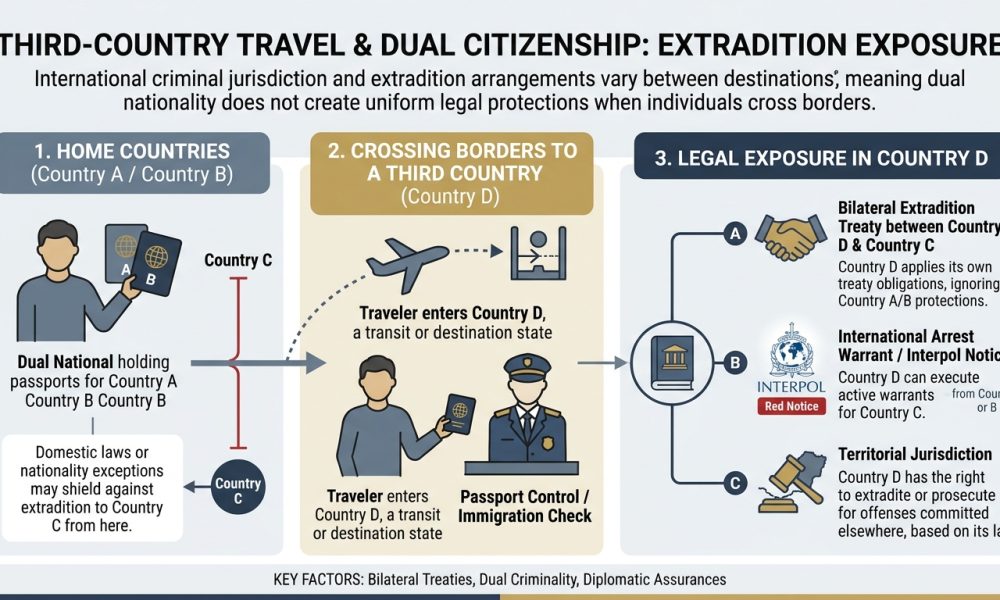
International criminal jurisdiction and Extradition arrangements vary by destination, so dual nationality does not create uniform legal protections when individuals cross borders, especially when third-country authorities apply different treaties, nationality restrictions, and international arrest procedures.
WASHINGTON, DC, November 19, 2026 — Americans holding second citizenship face different legal considerations when traveling through countries where they possess neither nationality, because Extradition laws, international treaties, and judicial cooperation arrangements can differ substantially from the protections available within their own countries of citizenship.
Although some governments restrict the Extradition of their nationals, those constitutional or statutory protections do not automatically extend to foreign jurisdictions, where local authorities may consider Extradition requests under entirely different legal standards and international agreements.
The distinction has become increasingly important as internationally mobile individuals acquire additional citizenship through ancestry, naturalization, marriage or investment programs, often expecting their new passports to provide consistent legal advantages across international borders.
For dual nationals, understanding third-country Extradition exposure requires examining nationality recognition, applicable treaties, international police notices, and the independent authority of foreign courts to determine whether a person may lawfully be detained or surrendered.
Nationality Protections May End at Another Country’s Border
A country that prohibits the Extradition of its own citizens generally applies that restriction through its domestic legal system, meaning the Protection does not necessarily bind another sovereign government where the individual happens to travel.
For example, a German-American dual citizen may have constitutional protections against Extradition to the United States while physically present in Germany. Still, those protections do not automatically control proceedings initiated by authorities in an unrelated third country.
The third country’s courts may instead examine their own Extradition legislation, applicable agreements with the requesting government, and the circumstances surrounding the individual’s arrest before determining whether international surrender is legally permissible.
This distinction shows why citizenship should not be confused with worldwide immunity, since the same individual can face different Extradition outcomes depending on the country exercising jurisdiction and the legal authority governing the request.
Third-Country Extradition Depends on the Requested State’s Laws
International Extradition generally requires a requesting government to seek the surrender of a person located within another country’s jurisdiction, with the requested state responsible for determining whether its legal requirements permit the proposed transfer.
The U.S. Department of Justice explains in its official international Extradition guidance that Extradition ordinarily involves a judicial review of the relevant legal requirements, followed by an executive decision on whether to authorize surrender.
When an individual possesses two nationalities but is arrested in a third country, the requested state’s own rules may carry greater immediate significance than the constitutional protections available in either country of citizenship.
Consequently, a favorable nationality restriction in one jurisdiction does not require an unrelated government to refuse Extradition, particularly when that government maintains a separate treaty relationship with the country requesting surrender.
Dual Citizenship Does Not Establish a Universal Legal Shield
A second passport may provide residence rights, employment opportunities, and other nationality-based benefits. Still, it does not independently determine how every foreign government must respond to allegations involving international criminal jurisdiction.
A dual national with citizenship in two countries may still be treated as a foreign national in a third jurisdiction, subject to that jurisdiction’s immigration laws, criminal procedures, and Extradition arrangements.
Although diplomatic representations and applicable international legal protections may influence particular proceedings, citizenship alone does not require third-country authorities to disregard valid arrest warrants or refuse cooperation with another government’s lawful request.
The relevant legal analysis must therefore consider where the individual is located, which government seeks surrender, what offenses are alleged, and whether the requested country recognizes any applicable nationality-related or humanitarian Protection.
A Reuters-Documented Case Illustrates Third-Country Exposure
In April 2025, Reuters reported on an international prisoner exchange involving Russian-German national Arthur Petrov, whose earlier arrest in Cyprus and subsequent Extradition to the United States demonstrated how third-country proceedings can affect individuals possessing multiple nationalities.
Petrov was arrested in Cyprus in August 2023 at the request of American authorities investigating allegations involving the unlawful procurement and export of sensitive microelectronics intended for entities associated with Russia’s military supply networks.
Despite holding Russian and German citizenship, Petrov was extradited from Cyprus to the United States, where prosecutors brought charges involving export control violations, smuggling-related conduct and money laundering allegations associated with the international transactions.
His case illustrates the importance of the country conducting the Extradition proceedings, since Cyprus applied its own legal framework rather than treating Petrov’s Russian or German citizenship as an automatic prohibition against surrender.
The Petrov Case Demonstrates the Importance of Travel Jurisdiction
Petrov’s international movements placed him within a jurisdiction where American authorities could pursue a formal Extradition request, showing that an individual’s location can materially influence which national courts exercise authority over surrender.
The criminal allegations involved an alleged international procurement network using business entities and transactions across several jurisdictions, showing how cross-border investigations can establish legal connections beyond the individual’s countries of citizenship.
The subsequent prisoner exchange in April 2025 was a separate diplomatic development. It should not be confused with the earlier judicial procedures that led to Petrov’s Extradition to face American federal charges.
For individuals evaluating dual nationality, the documented sequence reinforces that citizenship status, international travel arrangements, and the requesting government’s legal authority are distinct elements of the Extradition process.
The Danhong Chen Case Provides Another International Example
Danhong “Jean” Chen, also known as Maria Sofia Taylor, was extradited from the Kyrgyz Republic to the United States in March 2025 after being detained on outstanding American federal criminal charges.
Federal prosecutors accused the California immigration attorney of participating in alleged visa fraud involving the EB-5 investor immigration program, including claims concerning applications submitted on behalf of more than 100 foreign investors.
Court records established that Chen had spent considerable time outside the United States before traveling to Kyrgyzstan, where authorities detained her in April 2024 and subsequently considered the American government’s Extradition request.
The transfer demonstrated that international law enforcement cooperation can operate through jurisdictions outside a defendant’s principal country of residence. At the same time, the underlying allegations remained subject to the applicable American criminal proceedings.
International Police Notices Can Affect Travelers in Transit
Interpol Red Notices provide an international mechanism for requesting assistance in locating individuals sought for prosecution or the enforcement of criminal sentences. However, the notices themselves do not constitute universally enforceable arrest warrants.
Each participating country determines what legal effect an international notice has under its domestic legislation, meaning a traveler may face detention procedures in one jurisdiction that would not automatically apply in another.
A dual national passing through an international airport may therefore face scrutiny when local authorities identify an outstanding notice and possess sufficient legal authority to initiate provisional arrest or related judicial procedures.
However, a Red Notice does not establish guilt, and any subsequent Extradition must meet applicable legal requirements rather than proceed automatically because information appears in an international police system.
Provisional Arrest Can Precede a Formal Extradition Request
Many Extradition arrangements permit provisional arrest in urgent circumstances, allowing authorities to detain an individual temporarily while the requesting government prepares and submits the documentation required for formal Extradition proceedings.
These procedures may become relevant when authorities locate an individual during international travel and determine that immediate action is legally justified under the governing treaty and domestic legislation.
A provisional arrest does not establish that Extradition will ultimately be approved, because the requesting government must still satisfy applicable submission deadlines and the requested country must examine the legal conditions governing surrender.
For dual nationals, this distinction matters because the initial detention may occur before a court has completed its assessment of nationality protections, evidentiary requirements, or other objections recognized under local law.
Extradition Treaties Differ Between Countries
Bilateral Extradition agreements establish obligations and exceptions that can vary substantially, including differences concerning extraditable offenses, evidentiary requirements, nationality restrictions, sentencing conditions, and the authority responsible for approving surrender.
An individual traveling between several countries may consequently encounter different treaty provisions governing the same foreign criminal allegation, even though the underlying accusation and the person’s citizenship remain unchanged.
Some agreements expressly permit requested governments to refuse to surrender their own citizens, while others impose broader Extradition obligations or set conditions under which nationality may influence the final decision.
These differences make generalized descriptions of countries as Extradition destinations or nonextradition jurisdictions unreliable, because the actual legal outcome depends upon the specific agreement, applicable legislation and judicial findings.
The Absence of a Treaty Does Not Establish Complete Protection
Although Extradition generally depends upon an applicable treaty or another recognized legal basis, the absence of a bilateral agreement with the United States does not necessarily eliminate every mechanism for international criminal cooperation.
Certain jurisdictions permit surrender under domestic legislation, reciprocal arrangements or qualifying multilateral conventions, while other forms of lawful cooperation may address immigration status, evidence gathering or domestic criminal proceedings.
These mechanisms vary considerably across legal systems, and immigration removal should not be treated as interchangeable with Extradition because each process operates under separate statutory requirements and procedural protections.
For internationally mobile individuals, the relevant question is whether a government has lawful authority to act, rather than whether a simplified treaty list identifies that country as outside an Extradition arrangement.
Dual Criminality Can Influence Third-Country Proceedings
Many Extradition treaties apply the principle of dual criminality, requiring that the underlying conduct qualify as a criminal offense under both the requesting and requested countries’ legal systems.
This requirement does not always demand identical criminal statutes or matching offense titles, because courts may examine whether the alleged conduct would constitute a qualifying crime under each jurisdiction’s substantive legislation.
An allegation involving financial fraud, for example, may satisfy dual criminality despite differences in statutory terminology, provided the relevant conduct meets the applicable treaty’s criminality and seriousness requirements.
Conversely, substantial differences between national criminal laws may create legitimate legal objections, making the alleged conduct and the requesting government’s evidence central to the court’s analysis.
Nationality Acquired Through Naturalization May Require Additional Review
Some countries distinguish citizens by birth from naturalized citizens when applying Extradition restrictions, while others extend equivalent nationality protections to both categories under their domestic constitutional and statutory frameworks.
The date of naturalization can also become relevant when a treaty or constitutional provision distinguishes offenses committed before citizenship acquisition from conduct allegedly occurring after the individual became a national.
These considerations are particularly important for dual nationals because a second passport does not necessarily establish that the holder qualifies for every Protection available to citizens under the issuing country’s Extradition legislation.
However, third-country authorities must apply their own governing law and treaty commitments, meaning the issuing country’s classification of citizenship may not resolve the legal questions presented in another jurisdiction.
European Union Citizenship Creates Additional Legal Considerations
European Union citizenship provides important rights involving movement and residence within participating member states. Still, those rights do not establish immunity from Extradition or prevent lawful cooperation with non-European criminal justice authorities.
European judicial decisions have addressed circumstances in which a member state receives a request from a non-EU government concerning someone who holds citizenship in another EU member state.
Depending upon the circumstances and applicable European law, the requested government may need to consider whether the individual’s member state of nationality should receive an opportunity to pursue relevant proceedings through available European mechanisms.
These arrangements introduce additional procedural considerations, but they should not be understood as an absolute prohibition against extraditing European dual nationals to countries outside the European Union.
Domestic Constitutional Protections Do Not Automatically Travel Abroad
Germany’s constitutional restrictions on extraditing German citizens provide an example of how nationality-based Protection can operate within the legal system of the country recognizing that citizenship.
However, those constitutional provisions do not automatically govern authorities in Canada, Australia, Cyprus or another unrelated jurisdiction where a German citizen may be located and subject to a foreign Extradition request.
Third-country courts must instead determine the significance of nationality through their own legislation, applicable international agreements and any additional obligations arising under regional legal frameworks.
This distinction explains why possession of a passport from a country restricting Extradition should not be interpreted as a portable guarantee that every foreign government must refuse surrender.
Human Rights Protections Can Apply Independently of Citizenship
International Extradition proceedings may raise concerns involving torture, inhuman treatment, political persecution, discriminatory prosecution, or other matters protected under applicable domestic legislation and international human rights obligations.
These safeguards can apply independently of the individual’s nationality, meaning a person may possess legally relevant objections to surrender even when the requested country does not recognize any special citizenship-based exemption.
Nevertheless, the availability of particular protections depends on the relevant jurisdiction and legal standards, and courts and executive authorities often must examine the supporting evidence and circumstances individually.
Human rights arguments should therefore be evaluated through qualified legal representation, rather than being treated as automatic protections established merely by alleging that another country’s justice system is unfair.
Political Offense Exceptions Require Specific Legal Grounds
Certain Extradition treaties contain political offense exceptions intended to prevent surrender for particular conduct associated with political conflict, although the scope of those provisions differs among international agreements.
A criminal allegation does not automatically become a political offense because the accused disputes the government’s motives, participates in political activities, or holds citizenship in another country.
Modern treaties may exclude particular serious offenses from political offense protections, making the legal classification of the alleged conduct essential to determining whether a relevant exception is available.
Applying these provisions depends on treaty language, domestic judicial interpretation, and the facts, requiring a legal assessment separate from the individual’s passports or ordinary citizenship rights.
International Transit Does Not Automatically Eliminate Legal Exposure
International airport transit areas are sometimes misunderstood as spaces beyond ordinary national jurisdiction, but immigration arrangements do not necessarily remove local authorities’ power to enforce applicable criminal and Extradition legislation.
Passengers changing flights without formally entering a country’s ordinary immigration system may still be subject to lawful detention procedures when local authorities possess jurisdiction and the necessary legal grounds.
The specific treatment of transit passengers depends upon domestic law, airport arrangements and applicable international agreements, meaning the absence of an ordinary entry stamp does not automatically establish immunity from local enforcement.
For dual nationals, the broader issue is that crossing international borders can introduce additional legal systems, each with its own procedures for evaluating requests originating from foreign authorities.
Consular Assistance Does Not Determine Extradition Outcomes
American dual citizens may request appropriate consular assistance when detained overseas, but diplomatic representatives cannot simply override foreign Extradition proceedings or require local courts to release an individual.
Consular officers may provide information about legal resources, seek permitted access, and communicate with relatives under applicable procedures. At the same time, the competent foreign authorities remain responsible for applying their own Extradition laws.
Where the traveler also possesses citizenship in the country conducting the proceedings, local nationality rules may further affect consular access, although the relevant restrictions require examination of the specific jurisdiction.
The availability of consular assistance should therefore be distinguished from a legal defense against Extradition, because diplomatic communication and the judicial determination of surrender involve separate authorities and legal standards.
International Financial Investigations Can Cross Several Jurisdictions
Cases involving alleged fraud, money laundering, corruption, and unlawful international financial transactions often require evidence and cooperation across multiple countries, creating circumstances in which several jurisdictions may have relevant investigative interests.
Foreign bank records, corporate documents and electronic communications may become relevant through lawful mutual legal assistance procedures, although investigators must satisfy applicable authorization requirements before obtaining or using protected information. International accounts or foreign companies do not automatically establish criminal wrongdoing; however, authorities may still examine legitimate financial structures when investigating alleged cross-border offenses.
For dual nationals operating international businesses, accurate documentation and compliance with applicable laws remain important regardless of citizenship, because foreign nationality does not automatically prevent authorized investigations involving overseas transactions.
A Third Country May Face Competing Extradition Requests
Extradition proceedings can become more complicated when two or more governments request surrender of the same individual, requiring the requested country to examine competing legal obligations and relevant treaty provisions.
Depending upon the applicable agreements, authorities may consider the seriousness of the alleged offenses, the locations of the conduct, the dates of the requests, and other legally relevant circumstances.
Citizenship may be one factor in the evaluation, but it does not necessarily determine which request receives priority or whether a government must surrender the individual to a particular country.
These competing requests demonstrate how international criminal jurisdiction can involve several governments simultaneously, creating legal questions that cannot be resolved through the nationality shown on a single passport.
The Rule of Specialty Can Limit Proceedings After Extradition
Many Extradition agreements recognize a rule of specialty, which generally restricts prosecution or punishment following surrender to offenses covered by the Extradition authorization, subject to applicable exceptions and consent procedures.
The rule can provide meaningful Protection because the requesting government ordinarily must respect the conditions upon which the requested state agreed to surrender the individual.
However, the precise scope of specialty protections depends on treaty language and relevant legal interpretations, and additional proceedings are sometimes permissible when the requested state subsequently consents.
For individuals facing Extradition, the Protection should be evaluated under the governing international agreement rather than assumed to apply identically across every jurisdiction or criminal case.
Second-Citizenship Planning Requires Accurate Legal Expectations
International citizenship planning can legitimately provide additional residence rights, employment opportunities, educational access and family mobility, but those benefits should not be confused with Protection against outstanding criminal proceedings.
Amicus International Consulting discusses related considerations in its explanation of Interpol Red Notices and international law enforcement procedures, including distinctions relevant to international police information and lawful cross-border processes.
Individuals evaluating additional nationality should assess the real rights associated with citizenship and seek separate advice from qualified attorneys when unresolved legal matters or international criminal proceedings are involved.
A second passport should therefore be understood as documentation of a legally recognized nationality, not as a guarantee that foreign governments must disregard applicable Extradition treaties or valid judicial decisions.
Legal Advice Must Account for Every Relevant Jurisdiction
Individuals facing international criminal proceedings should seek advice from lawyers qualified in the countries involved, particularly when the requesting government, country of citizenship, and place of detention are different jurisdictions.
A complete assessment may require examining nationality classifications, Extradition treaties, procedural deadlines, evidentiary requirements, and any relevant human rights protections, along with the status of existing judicial proceedings.
Legal professionals must distinguish between an Extradition request and a conviction, because the surrender process generally aims to determine whether transfer is legally authorized rather than to establish guilt.
The outcome of such proceedings ultimately depends upon the applicable laws and facts, making generalized claims about passport Protection unreliable substitutes for individualized legal analysis and independent professional representation.
International Mobility Carries Responsibilities Beyond Passport Ownership
The expansion of citizenship by descent, naturalization, and international investment programs has given individuals more opportunities to establish lawful connections abroad. Still, nationality recognition does not remove the authority of other sovereign governments.
For Americans with another citizenship, international travel can involve overlapping obligations concerning entry documentation, domestic criminal law, consular access, and Extradition arrangements that must be evaluated by destination.
The value of second citizenship therefore lies primarily in the legitimate rights granted by the issuing government, including residence, work and family opportunities, rather than assumptions about immunity from international criminal justice cooperation.
Understanding these distinctions allows internationally mobile individuals to make better-informed decisions while recognizing that courts and governments may reach different conclusions under different treaties concerning the same underlying allegations.
Conclusion: Third-Country Travel Changes the Applicable Legal Framework
Third-country travel can expose dual citizens to Extradition arrangements that differ substantially from the rules operating within either country of nationality, particularly when the destination maintains its own international agreements and arrest procedures.
The Petrov Extradition from Cyprus and the Chen Extradition from Kyrgyzstan illustrate how international criminal proceedings can advance through jurisdictions separate from the countries where individuals possess nationality or maintain longstanding personal connections.
Constitutional restrictions against extraditing nationals can provide meaningful legal protections within particular jurisdictions, but they do not automatically bind foreign courts, prevent international police cooperation, or eliminate valid criminal proceedings.
For American dual citizens and individuals considering second citizenship in 2026, the essential principle remains that additional nationality can expand lawful international mobility without creating uniform Protection against Extradition, making jurisdiction-specific legal analysis indispensable.




