
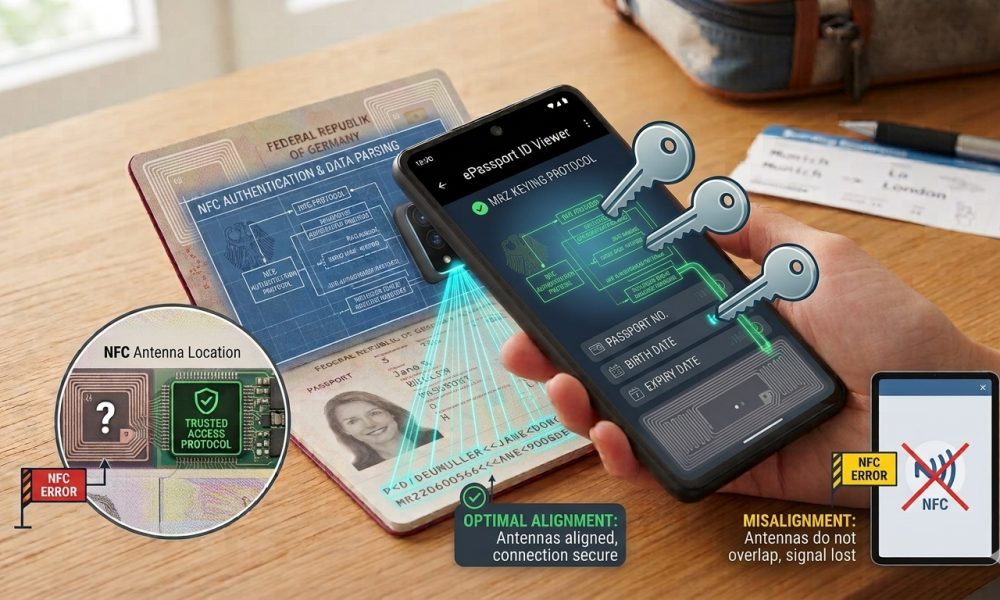
The passport number, birth date, and expiration date help compatible apps initiate protected communication with the document.
WASHINGTON, DC, October 2, 2026 — When a smartphone application reads an electronic passport, the process commonly begins with the machine-readable zone, whose standardized printed information gives compatible software the document-related values needed to begin protected communication with the passport’s contactless chip.
Although the two lines of characters were originally standardized to make passports easier for automated inspection systems to process, selected MRZ information now serves an additional security function by helping electronic readers verify information obtained from the physical travel document.
The MRZ Connects the Physical Passport With Its Chip
The machine-readable zone creates an important bridge between the visible identity page and the electronic component because a compatible smartphone application can capture printed document information before attempting to communicate with the contactless chip embedded inside the booklet.
The ICAO electronic passport security specifications require chip-access mechanisms to use information from the physical document, with the MRZ serving as the standardized, interoperable source for linking document presentation to electronic access.
Three Document Values Have a Particular Access Role
For interoperable electronic passport access, information derived from the passport number, holder’s date of birth, and document expiration date contributes to the password-related material compatible readers use during supported chip-access procedures.
These values are already represented within the physical passport and machine-readable zone, allowing specialized applications to obtain the required information automatically without asking travelers to remember or manage a separate password for their electronic travel document.
The Passport Number Identifies the Particular Document
The passport number identifies the specific travel document being presented and forms part of the structured machine-readable information that passport applications capture before attempting protected NFC communication with the embedded chip.
Because the number belongs to the document rather than functioning as a personal password chosen by the traveler, its security value comes from its role within a broader standardized access procedure rather than from secrecy alone.
The Birth Date Adds Another Document-Associated Value
The holder’s date of birth provides another standardized element that a compatible passport application can obtain from the MRZ and combine with the other required document information used during electronic access establishment.
A birth date alone would obviously provide weak security because it may be widely known. Still, the passport architecture does not rely upon that value independently as the complete secret protecting electronic identity information.
The Expiration Date Completes the Core Combination
The passport’s expiration date provides another document-specific element, helping distinguish the current credential from earlier or later passports issued to the same individual even when other biographical information remains unchanged.
Together with the document number, birth date, and associated standardized check information, the expiration value becomes part of the structured physical-document knowledge used by compatible electronic access mechanisms.
The Smartphone Camera Usually Captures These Values Automatically
Passport-reading applications commonly use the smartphone Camera to identify the MRZ and convert its characters into structured data before activating the NFC stage of the workflow, avoiding unnecessary manual transcription of document information.
The software can recognize the standardized character layout, separate relevant fields, and check whether the captured information meets expected formatting requirements before attempting electronic communication with the passport.
Check Digits Help Confirm Accurate Capture
The MRZ includes standardized check digits that let specialized software detect common recognition mistakes in passport numbers, dates, and other fields before inaccurate information reaches the electronic access stage.
This verification matters because a single misread character can prevent the smartphone and passport from deriving compatible access information, even when the electronic chip remains fully functional.
A Camera Error Can Look Like an NFC Problem
When an application repeatedly fails to communicate with a passport, users may assume the NFC antenna or chip is defective, even though the problem can stem from incorrectly captured machine-readable information.
Repeating the optical scan under better lighting or correcting an inaccurately recognized field can sometimes resolve the issue because the smartphone must begin the electronic interaction with information that matches the physical passport precisely.
The MRZ Does Not Function Like an Ordinary Password
The passport number, birth date, and expiration date remain visible on the physical document, so they should not be treated as confidential credentials comparable to a private encryption key or a carefully chosen banking password.
Their security role comes from requiring the reader to obtain information associated with the presented passport before ordinary protected chip data become available through the contactless communication interface.
Chip Access Control Prevents Completely Open Reading
ICAO requires modern electronic passport implementations to use access-control mechanisms intended to prevent the contactless chip from functioning like unrestricted wireless storage that reveals identity information simply because compatible radio equipment approaches the document.
The inspection system must instead demonstrate knowledge derived from the physical passport through a cryptographic procedure before the chip grants access to ordinary protected information stored within the electronic travel-document application.
The Physical Passport Must Usually Be Seen First
ICAO’s model assumes that the required access information should be obtained optically or visually from the physical travel document, creating a practical relationship between knowingly presenting the passport and allowing electronic information to be read.
This architecture does not make the printed MRZ secret. Still, it prevents the contactless chip from becoming completely independent from possession or presentation of the physical booklet during normal interoperable passport inspection.
Basic Access Control Uses MRZ-Derived Information
Earlier electronic passports commonly used Basic Access Control, usually abbreviated BAC, which derives cryptographic material from selected MRZ information before establishing protected communication between the passport and compatible inspection equipment.
BAC represented an important improvement over unrestricted electronic access because a nearby reader lacking the relevant document information could not simply request and display ordinary passport data immediately.
PACE Strengthens the Same Physical-to-Electronic Relationship
Password Authenticated Connection Establishment, commonly known as PACE, can also derive its initial password-related information from the MRZ while using a stronger cryptographic exchange to establish protected communication.
ICAO specifies that when PACE is supported, the inspection system can derive the necessary password key from the MRZ and then establish strong session keys used for secure messaging with the electronic document.
PACE Does Not Use the Printed Values as Final Session Keys
The passport number, birth date, and expiration date help initiate the process. Still, PACE does not simply combine those visible values and use the result directly as the permanent encryption key protecting the complete interaction.
Instead, the protocol uses the document-derived information within a stronger cryptographic procedure that produces temporary session keys whose security is not limited directly by the relatively modest secrecy of the printed MRZ.
Session Keys Protect Subsequent Communication
After successful access establishment, the smartphone and passport can communicate through secure messaging in which protected commands and responses receive confidentiality and integrity safeguards during the active electronic session.
The MRZ therefore helps initiate the protected relationship, while stronger cryptographic keys derived during the protocol protect the identity information that subsequently travels between the contactless chip and compatible reader.
The MRZ Helps Reduce Unauthorized Skimming
Skimming refers to attempts to obtain electronic information from a contactless document without the holder intentionally presenting the passport to the reader, creating an obvious privacy concern for government identity credentials.
Requiring physical-document information before chip access adds a barrier because detecting the passport’s radio interface does not automatically provide everything needed to establish the protected electronic session.
The Same Architecture Also Helps Against Eavesdropping
Unauthorized reading and interception represent different threats because an outsider can either attempt to communicate directly with the passport or observe legitimate communication already occurring between the chip and an authorized reader.
Access-control protocols address both concerns by regulating how communication begins and establishing cryptographically protected messaging that makes intercepted radio traffic far less useful to unauthorized observers.
The MRZ Makes Smartphone Passport Reading Practical
The Regula mobile document-reading platform illustrates how modern smartphone verification systems combine MRZ recognition with RFID or NFC chip reading, treating optical capture and electronic communication as connected parts of one identity-document workflow.
This combination avoids requiring users to type several fields manually and lets the application move directly from recognizing the physical document to the protected electronic procedures supported by the passport.
Optical Recognition Does More Than Copy Characters
Passport-specific software understands the standardized MRZ layout and can divide the captured characters into meaningful document fields rather than treating the two printed lines as an arbitrary block of text.
That structured interpretation lets the same Camera capture support electronic access, data consistency checks, expiration assessment, document Identification, and comparison with information later retrieved from the passport chip.
The Electronic Information Can Be Compared With the Printed MRZ
Once the smartphone gains access to permitted chip records, specialized software can compare electronically stored document information against the values previously obtained from the physical passport.
Agreement between those representations provides useful consistency evidence, while an unexplained difference involving a passport number, date, nationality field, or other standardized value can justify closer professional examination.
An MRZ Match Does Not Authenticate the Complete Passport
Matching printed and electronic information does not independently establish that every physical feature is genuine because a complete authenticity assessment can also require examination of materials, personalization, optical devices, binding, and other document characteristics.
The comparison is therefore an important security check, but it does not become a universal conclusion about every physical and electronic component in the travel document.
Successful Access Also Does Not Authenticate the Issuer
A smartphone can use correct MRZ information to establish chip communication without necessarily verifying the government digital signature protecting the electronic passport records retrieved afterward.
Passive Authentication performs that separate task by evaluating signed security information and trusted issuing certificates, distinguishing successful electronic access from meaningful cryptographic verification of thedata’ss origin and integrity.
A Smartphone Application Needs Trusted Certificates for Stronger Results
When software performs passport-signature validation, it needs trusted public certificate information from the issuing authority before it can determine whether the document’s electronic signature connects to an expected governmental trust chain.
The MRZ supplies information needed for access, but it does not provide the external trust anchors required for authenticating the sovereign authority responsible for digitally signing the electronic records.
Different Apps Can Stop at Different Stages
One smartphone application might scan the MRZ and display chip data. At the same time, another may continue through Passive Authentication, issuer-certificate validation, anti-cloning procedures, facial comparison, or additional consistency checks.
Users should therefore interpret the application’s specific results rather than assume that every program that uses MRZ information to open an electronic passport performs the same level of verification.
Chip Authentication Addresses Another Separate Question
Even properly signed data can theoretically be copied without modification, meaning a valid digital signature does not necessarily establish that those records remain stored on the original electronic component.
Supported Active Authentication or Chip Authentication procedures can provide additional evidence concerning possession of protected cryptographic credentials, adding another security layer after MRZ-assisted access has already been established.
The MRZ Cannot Grant Access to Every Biometric.
Some electronic passports contain fingerprint records or other additional biometrics protected behind stronger authorization requirements, meaning successful MRZ-based access does not automatically unlock every file stored inside the chip.
Terminal Authentication can require government inspection equipment to demonstrate additional cryptographic authorization before sensitive information becomes available, preserving a distinction between ordinary passport access and privileged biometric retrieval.
Consumer Applications Normally Operate at the Lower Access Level
A consumer passport reader can therefore retrieve ordinary biographical information and the electronic facial Image while remaining unable to access fingerprints protected by governmental authorization controls.
This limitation reflects proper electronic passport security rather than inadequate NFC hardware, because the document itself determines what information is available at each established authorization level.
The Facial Image Usually Becomes Available After Standard Access
Once standard electronic communication succeeds, compatible applications can typically retrieve the digital portrait associated with the passport holder, along with other permitted identity information stored in the chip.
That electronic Image can provide a cleaner reference than photographing the printed portrait because it avoids many reflections, surface patterns, perspective distortions, and other artifacts associated with Camera capture of the physical page.
Retrieving the Portrait Does Not Verify the Person Holding the Passport
The smartphone can display an authentic electronic facial Image without determining whether the individual operating the application is the lawful holder represented by that portrait.
Holder verification requires a separate biometric comparison or trained human assessment, keeping the traveler’s identity distinct from the electronic access procedure enabled by machine-readable information.
The MRZ Cannot Reveal Whether the Passport Was Later Canceled.
Information printed when the passport was issued remains unchanged when a government subsequently records the document as lost, stolen, revoked, canceled, or otherwise invalid for continued travel.
Current status therefore requires access to appropriate government records, which is why a successful MRZ scan and electronic passport reading cannot independently establish present administrative validity.
The MRZ Cannot Determine Immigration Eligibility.
The passport number, birth date, expiration date, and other identity information can support document processing without establishing whether the traveler possesses a required visa or satisfies the destination country’s current admission rules.
Immigration eligibility remains a separate legal and administrative question handled by government systems, not by the chip-access information printed in the passport.
A Stolen Passport Can Produce Perfect MRZ Results
Someone with another person’s genuine passport can capture the same machine-readable information as the legitimate holder, establish electronic access, and potentially obtain successful document-authentication results because the underlying credential remains genuine.
This scenario shows why possessing MRZ information supports access without proving legitimate ownership or entitlement to travel under the identity represented by the passport.
Manual Entry Provides an Alternative When Camera Capture Fails
ICAO requires inspection systems to allow manual entry of relevant access information when machine reading is unavailable, ensuring that optical recognition failure does not make an otherwise valid electronic passport impossible to inspect.
This fallback becomes useful when glare, physical wear, unusual Camera conditions, or other practical problems interfere with automated recognition. At the same time, the printed document information remains readable to the user or inspector.
Camera Capture Remains Faster and Less Error-Prone
Automatic MRZ recognition reduces manual typing and lets check digits flag many incorrect captures before the software moves to the NFC stage, improving both convenience and reliability during smartphone passport reading.
The workflow can therefore move from Camera capture to electronic communication within seconds while preserving standardized checks intended to reduce avoidable transcription mistakes.
The MRZ Remains Important Despite More Advanced Passport Technology
Modern passports can include polycarbonate data pages, laser engraving, digital signatures, cryptographic chips, sophisticated optical devices, biometric portraits, and complex government certificate infrastructures. Yet standardized machine-readable text still performs essential operational functions.
Its longevity reflects the value of a format that supports rapid data capture, physical-to-electronic access, automated consistency checking, and international interoperability across generations of passport technology.
Smartphones Make the MRZ’s Security Role Easier to See
A user watching a passport-reading application first scan the printed lines and then request NFC positioning can see how the physical passport provides the information needed before the electronic component becomes accessible.
This sequence makes an otherwise invisible security architecture understandable, showing that smartphone passport reading is not simply a matter of touching an NFC antenna to a chip and downloading unrestricted personal information.
The MRZ Starts the Process Rather Than Completing Verification
Through Amicus International Consulting’s passport security resource, readers can examine how machine-readable information works alongside PACE, secure messaging, digital signatures, chip Authentication, physical examination, biometric comparison, and government status verification.
The MRZ plays a foundational role because it supplies standardized physical-document information that compatible applications can use to begin protected communication. At the same time, stronger procedures determine whether the retrieved electronic records deserve trust.
Three Familiar Values Help Open a Sophisticated Electronic Channel
The passport number, date of birth, and expiration date may seem like ordinary administrative information. Yet, in electronic passport systems, they also link physical document presentation to protected access to the contactless chip.
Compatible smartphone applications capture and structure those values, use them within the appropriate access-control mechanism, and then establish the secure electronic session required before retrieving permitted identity information.
The result demonstrates how seemingly simple printed passport information supports sophisticated cryptographic communication while remaining only the first stage in a much broader verification process involving Authentication, holder comparison, physical inspection, and current government records.




