
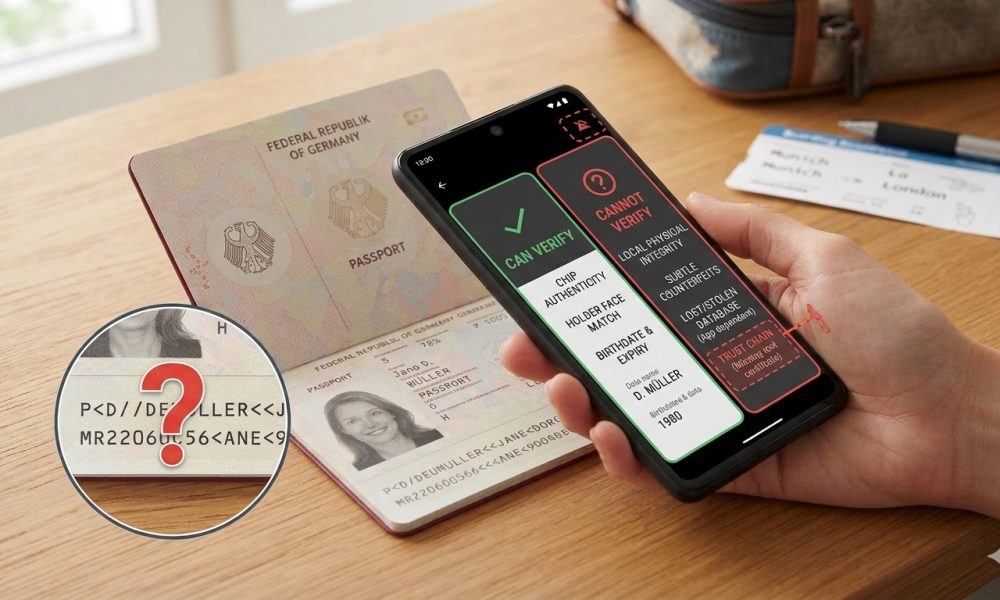
Mobile checks can examine chip data and certain security features, but their results depend on the app’s capabilities and trusted certificate coverage.
WASHINGTON, DC, October 2, 2026 — A modern smartphone can communicate with the contactless chip inside many electronic passports, retrieve protected identity information, and perform selected cryptographic checks, but the meaning of those results depends heavily upon the application, available certificates, supported protocols, and verification environment.
Mobile passport scanning can therefore provide valuable evidence about electronically stored information while remaining fundamentally different from complete border inspection, where authorities may combine official cryptographic infrastructure, physical document readers, biometric systems, government databases, and trained personnel.
Reading the Chip Is the Starting Point
A smartphone with suitable Near Field Communication hardware can communicate with an electronic passport once compatible software gathers the information needed to access the contactless chip and start the protected electronic session.
The phone can then retrieve permitted data groups containing identity information, document details, a digital facial Image, and security information associated with the electronic travel document, depending upon the passport generation and software capabilities.
Successful Reading Proves Less Than Many Users Assume
When an application successfully displays a passport holder’s name, portrait, document number, nationality, birth date, and expiration information, the result establishes that the phone retrieved those records from an electronic component communicating through the expected passport interface.
That result alone does not establish that every record was authentically issued, that the chip is original, that the booklet remains physically genuine, that the passport remains valid, or that the person holding the document is its lawful owner.
Authentication Requires Additional Cryptographic Checks
A more capable application can perform Passive Authentication, which verifies the digital signature protecting electronic passport information and compares cryptographic reference values against the records retrieved from the chip.
The ICAO ePassport validation framework explains that electronic passport validation depends upon checking digitally signed information through trusted certificates associated with issuing authorities, providing considerably stronger evidence than merely confirming successful NFC communication.
Passive Authentication Checks Data Integrity
Passive Authentication allows software to determine whether protected passport information remains consistent with the cryptographic hashes and digital signature established during legitimate document personalization by the issuing authority.
When that process succeeds against a trusted certificate chain, the application gains evidence that the electronically signed records have not been modified after issuance and that they cryptographically connect to the expected issuing infrastructure.
The Trust Store Determines What the Application Can Recognize
A digital signature cannot be validated meaningfully unless the software possesses the public certificates needed to establish trust in the issuer, making certificate coverage one of the most important limitations affecting consumer passport applications.
An application with incomplete or outdated Country Signing Certification Authority information can read a genuine passport successfully. Still, it cannot establish the full certificate chain required for a positive country-signature validation result.
An Inconclusive Certificate Result Does Not Automatically Mean Fraud
When an application cannot establish a trusted signing chain, the issue may be missing trust material rather than a counterfeit passport, especially when the app does not maintain comprehensive or continuously updated certificate coverage.
Users should therefore distinguish between a failed cryptographic verification and a situation where verification could not be completed because the application lacked the issuer certificate needed to reach a trusted conclusion.
ReadID Me Illustrates This Limitation Clearly
The ReadID Me application can read ICAO-compliant electronic passports and perform checks including document-signature, country-signature, and supported anti-cloning verification, while its provider explicitly cautions that the consumer version uses a static list of country certificates.
Inverid states that this embedded certificate list may not always be complete or fully current, demonstrating why even technically sophisticated smartphone results need interpretation within the limits of the application’s available trust infrastructure.
Certificate Coverage Can Change the Final Result
Two passport applications examining the same genuine document could theoretically produce different trust conclusions when one possesses the appropriate issuing certificate. At the same time, another lacks the certificate necessary to complete the validation chain.
This does not mean cryptographic verification is unreliable, because the underlying mathematics remains strong. Still, it demonstrates that successful verification depends upon both the passport data and the trusted reference material available to the reader.
Official Systems Can Maintain Broader Trust Infrastructure
Border agencies can connect document readers with national repositories, international certificate exchanges, and other controlled sources that provide considerably broader and more systematically maintained cryptographic trust information than a standalone consumer application.
That infrastructure lets official systems validate a wider range of electronic passports while managing certificate updates and issuer relationships in an operational environment designed specifically for travel-document inspection.
Hash Validation Provides Another Important Check
Electronic passport security objects contain cryptographic reference values associated with protected data groups, allowing applications performing Passive Authentication to recalculate those values and determine whether the stored information remains unchanged.
If retrieved information no longer produces the expected cryptographic result, the application can identify an integrity inconsistency rather than simply displaying altered electronic information as though nothing unusual had occurred.
Passive Authentication Does Not Detect Every Cloned Chip
An exact copy of legitimately signed passport data can retain a valid digital signature because cloning does not necessarily modify the information itself, meaning Passive Authentication alone cannot always distinguish original storage from an exact duplicate.
More advanced security procedures can address that limitation by requiring the electronic component to demonstrate possession of protected cryptographic secrets that should remain associated with the legitimate chip.
Active Authentication Can Add Anti-Cloning Evidence
Some electronic passports support Active Authentication, which allows the reader to send a fresh cryptographic challenge and evaluate whether the chip can generate the expected response using a protected private key.
A mobile application supporting that mechanism can therefore obtain evidence beyond static data validation, although availability depends upon whether both the passport and the application implement the particular security procedure.
Chip Authentication Can Provide Similar Additional Assurance
Other passport generations can support Chip Authentication, which uses a cryptographic key-agreement procedure to demonstrate possession of protected chip credentials while establishing strong session keys for subsequent secure communication.
A smartphone application that implements Chip Authentication can provide additional evidence of chip authenticity. Still, a simpler application that merely reads passport files may never perform this check, even if it presents the information convincingly.
Applications Can Differ Dramatically in Their Capabilities
One mobile application may perform only NFC data retrieval. At the same time, another can combine Passive Authentication, Active Authentication, Chip Authentication, facial comparison, optical document capture, and additional consistency checks within a single workflow.
The phrase “passport scan” therefore describes a broad category rather than one standardized level of verification, making the provider’s technical documentation important whenever users need to understand what a particular result actually establishes.
Access Protocol Support Also Matters
Electronic passports issued during different periods can use Basic Access Control, Password Authenticated Connection Establishment, Extended Access Control, or combinations of several mechanisms depending upon national implementation and document generation.
An application needs suitable protocol support to communicate correctly with every legitimate passport, meaning failure with one document can reflect software limitations rather than an authenticity problem within the passport itself.
A Smartphone May Read Standard Data but Not Fingerprints
Where an electronic passport stores fingerprint information behind Extended Access Control, ordinary consumer applications generally cannot retrieve those sensitive records merely because they have established NFC communication with the document.
Terminal Authentication can require government-authorized credentials before the chip releases protected fingerprints, creating a clear distinction between routine passport reading and privileged access to highly sensitive biometric information.
The Stored Portrait Is Usually Accessible
Compatible applications can commonly retrieve the electronic facial Image associated with the passport holder, providing a digital reference that differs from a smartphone photograph taken from the visible identity page.
Because the portrait comes directly from the chip, it can avoid glare, perspective distortion, printing patterns, and other visual artifacts affecting photographs of the physical passport page.
Displaying the Portrait Does Not Verify the Holder
Retrieving a genuine facial Image establishes what portrait the passport contains. Still, it does not determine whether the person holding the smartphone is actually the individual represented by that biometric record.
Holder verification requires an additional comparison between the stored reference portrait and a live or otherwise appropriately captured facial Image of the person presenting the document.
Some Mobile Systems Can Add Facial Comparison
Commercial mobile identity-verification systems can combine NFC passport reading with live facial capture, comparing the authenticated electronic portrait against the user while applying additional image-quality or liveness procedures where supported.
That functionality extends the smartphone beyond document reading, but biometric comparison remains separate from cryptographic passport Authentication and should be interpreted independently of the electronic chip result.
Facial Matching Still Does Not Authenticate the Booklet
A person can match the portrait associated with a passport while the physical booklet contains an alteration or manufacturing inconsistency unrelated to the holder’s appearance.
A successful mobile facial comparison should therefore not be interpreted as proof that holograms, laser engraving, substrates, ultraviolet features, binding, and other physical passport elements remain genuine.
Physical Security Features Remain a Major Blind Spot
Smartphone NFC reading cannot fully examine tactile printing, dynamic optical devices, specialized substrates, binding construction, page replacement, ultraviolet artwork, microprinting, or many other physical safeguards incorporated into modern passports.
A phone camera can photograph some visible features. Still, ordinary imaging does not reproduce the controlled lighting, magnification, ultraviolet examination, infrared analysis, and tactile assessment available within professional document-inspection environments.
A Genuine Chip Can Exist With a Suspicious Physical Document
Electronic Authentication can succeed even when authorities have concerns about physical alteration surrounding the chip, particularly when manipulated elements exist outside the signed electronic information or the original electronic component remains intact.
Professional verification therefore compares the authenticated chip records with the visible identity page and physical document structure, rather than assuming a successful electronic result automatically authenticates the entire booklet.
A Failed NFC Scan Is Also Not Proof of Fraud
Smartphones can fail to communicate with genuine passports because of antenna positioning, document wear, phone hardware, cases containing interfering materials, software compatibility, operating-system restrictions, or damage to the passport’s electronic component.
A failed mobile scan should therefore be treated as a technical outcome requiring interpretation, not as a definitive declaration that the passport lacks an authentic chip or was unlawfully manufactured.
Phone Model Differences Can Affect Results
NFC performance varies among smartphones because antenna placement, supported communication modes, operating-system behavior, and hardware sensitivity differ across manufacturers and device generations.
The same passport may therefore scan easily with one phone but require repeated positioning with another, making hardware performance another variable separate from the document’s authenticity or integrity.
Application Updates Can Affect Verification Coverage
Passport technologies and cryptographic certificates change over time, meaning an application that has not received current protocol, document, or trust-store updates can produce weaker or less comprehensive verification than a properly maintained implementation.
Users evaluating important results should therefore consider software version, provider support, certificate-update practices, and technical documentation rather than assuming every installed passport application remains equally capable indefinitely.
Country Certificate Validation Is Especially Important
Document-signer certificates establish the signatures that protect individual passport data. Still, those certificates must ultimately connect to trusted country-level signing authorities before the reader can establish the expected chain of trust.
An application lacking the relevant country certificate may verify internal relationships but lack enough trusted information to draw the strongest conclusion about which sovereign issuing authority stands behind the electronic signature.
The Difference Between “Invalid” and “Unverified” Matters
A cryptographic signature that demonstrably fails validation is materially different from a signature whose validation cannot be completed because an expected trust certificate is unavailable.
Well-designed verification systems should distinguish those outcomes because labeling missing trust material simply as a fraudulent passport would turn an infrastructure limitation into an unsupported accusation about the document.
Mobile Verification Cannot Usually Check Current Passport Status.
A smartphone application can authenticate information established when the passport was issued while lacking access to authoritative government systems showing whether the document was subsequently canceled, revoked, reported lost, or reported stolen.
A passport can therefore remain cryptographically genuine and readable by a consumer application even though authorities have administratively invalidated it for future travel.
Current Status Requires External Government Information
Document status changes occur outside the passport chip after issuance, meaning a standalone application cannot discover them unless it has authorized access to appropriate live databases or receives current information from another trusted service.
This limitation matters when users interpret a successful cryptographic result, because authenticity at issuance and current legal validity remain separate properties of a travel document.
A Mobile Scan Cannot Determine Immigration Admissibility.
Whether a passport is authentic says nothing by itself about visas, residence rights, entry restrictions, immigration history, or other legal requirements governing admission to a destination country.
Official border systems combine identity and document verification with governmental records and legal decision-making that consumer passport applications are neither designed nor authorized to reproduce.
A Smartphone Cannot Establish Lawful Possession Automatically.
Someone who finds or steals a genuine passport can place it against an NFC-enabled smartphone and potentially obtain the same successful electronic Authentication results that the lawful holder would receive.
The mobile device can evaluate the document but cannot infer from chip authenticity alone whether the person scanning it obtained the passport legitimately or has legal authority to use the identity it represents.
Privacy Practices Differ Among Passport Applications
Passport chips contain sensitive personal information, making it important to understand whether an application processes data entirely on the phone, transmits information to a verification service, retains images, or shares results with another organization.
Consumers should review the provider’s stated privacy model carefully because two applications offering apparently similar NFC functionality can handle the resulting identity information in substantially different ways after completing the passport scan.
Local Processing Can Reduce Some Privacy Exposure
Applications that perform verification entirely on the mobile device can reduce the need to transmit passport information to remote servers. However, users still need confidence in the application’s software behavior, storage practices, and security architecture.
Other legitimate commercial systems intentionally use server-side verification because centralized services can maintain broader certificate repositories, perform additional fraud checks, or support regulated organizational identity-verification workflows.
Server-Based Verification Can Offer Broader Infrastructure
Professional identity-verification platforms can combine mobile NFC capture with centralized certificate management, cryptographic validation, analytics, and other controls unavailable within a completely standalone consumer application.
The presence of a server does not automatically make a system better or worse, because the appropriate architecture depends upon security requirements, privacy obligations, regulatory responsibilities, and the specific verification purpose involved.
The Meaning of a Green Checkmark Depends on the Test
A successful result displayed by an application might mean NFC communication succeeded, signed data matched cryptographic hashes, an issuer certificate was trusted, anti-cloning Authentication passed, or several of those checks succeeded together.
Users therefore need to understand what the interface defines as verified rather than assuming that one green indicator represents physical authenticity, chip genuineness, biometric identity, legal validity, and current government status simultaneously.
Detailed Results Are More Useful Than a Single Verdict
Applications that show individual results for document signatures, country signatures, Active Authentication, Chip Authentication, and other supported mechanisms give knowledgeable users far more context than interfaces that show only one overall authenticity label.
Separating those results lets users understand a failed or unavailable check within its specific technical category, rather than treating every aspect of an otherwise readable passport the same way.
Official Border Verification Is Broader by Design
Border authorities can integrate electronic passport validation with specialized physical readers, biometric cameras, document references, immigration systems, stolen-document records, watchlists, and officer review within one operational process.
A consumer smartphone usually addresses only a subset of those functions, making it valuable for examining the electronic credential without becoming equivalent to an official border inspection environment.
Smartphone Verification Can Still Be Powerful
The limitations of mobile passport scanning should not obscure its usefulness because a properly designed application can retrieve trusted electronic identity information and perform meaningful cryptographic tests that ordinary visual inspection cannot replicate.
For passport holders, developers, compliance professionals, and identity-verification organizations, smartphone NFC technology has made sophisticated electronic document examination possible with widely available consumer hardware.
The Best Result Comes From Understanding the Scope
A mobile application becomes most useful when users know precisely whether it performed only data retrieval, Passive Authentication, country-certificate validation, anti-cloning verification, facial comparison, or a broader combination of checks.
That transparency lets users interpret the result proportionately, building confidence where the technology offers strong evidence without extending that confidence into areas the application never examined.
Mobile Results Should Be Compared With the Physical Document
Electronic information retrieved from the chip can be compared with names, dates, document numbers, portraits, and machine-readable information visible on the passport, helping users identify unexplained inconsistencies between physical and digital representations.
Such comparison still does not replace professional physical inspection, but it demonstrates how smartphone reading can add an independent electronic reference to traditional examination of the document.
A Consumer App Is an Inspection Tool, Not an Issuing Authority
No smartphone application can independently transform questionable data into an officially valid passport, determine legal nationality, or override the status assigned to a document by its issuing government.
The application examines evidence available through the document and its supporting trust infrastructure, while the appropriate public institutions retain final authority over issuance, validity, cancellation, and border acceptance.
Certificate Coverage Defines an Important Verification Boundary
A sophisticated mobile application can implement excellent cryptography but still reach an inconclusive country-signature result if its trusted certificate collection does not include the credential required for the passport being examined.
This limitation explains why users should evaluate both the security procedures an application supports and the quality of the trust infrastructure supplying the certificates those procedures rely on.
Smartphone Scanning Works Best as One Layer
Through Amicus International Consulting’s passport security resource, readers can examine how NFC reading, digital signatures, chip Authentication, physical inspection, biometric verification, and government records contribute different forms of evidence during contemporary passport examination.
The smartphone adds a valuable electronic layer because it can reveal information and cryptographic relationships invisible to ordinary visual inspection. Still, its results are strongest when interpreted alongside checks that remain outside the mobile device.
A Smartphone Can Verify Important Things Without Verifying Everything
A capable mobile passport application can read electronically stored identity information, verify protected data against digital signatures, validate trusted issuing certificates when available, and perform selected anti-cloning procedures when both the passport and software support them.
It cannot automatically establish the authenticity of every physical security feature, the passport’s current administrative status, lawful possession by the person holding it, immigration eligibility, or protected biometric information requiring governmental authorization.
Smartphone passport scanning therefore provides meaningful and increasingly sophisticated verification. Still, the reliability and scope of every result depend upon exactly what the application checked, which trusted certificates it possessed, and which important questions remained outside its technical reach.




