
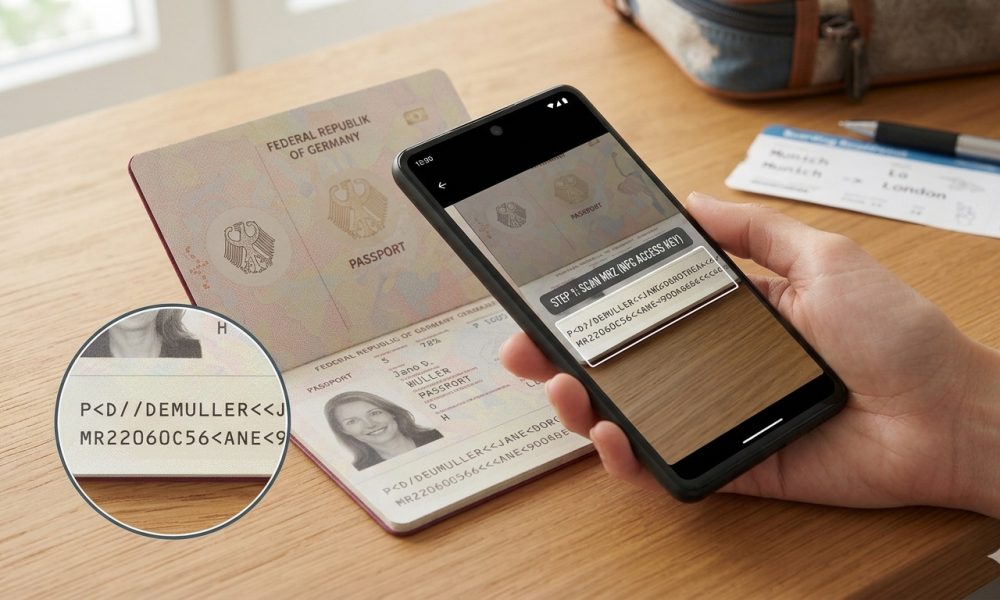
Compatible phones and specialized apps allow passport holders to inspect electronic identity information stored in their travel documents.
WASHINGTON, DC, October 2, 2026 — Many modern smartphones contain the Near Field Communication hardware needed to communicate with electronic passports, allowing compatible applications to retrieve identity information from the contactless chip and perform selected security checks without requiring a dedicated desktop passport reader.
The process usually combines the phone’s camera, software that can interpret machine-readable travel documents, NFC communication, and cryptographic protocols that control access to protected passport information before the app can display electronically stored biographical and biometric records.
An Electronic Passport Contains a Contactless Chip
Electronic passports, often called ePassports, contain an integrated circuit that communicates over a short-range radio-frequency connection while storing standardized identity information, biometric references, security objects, and cryptographic material used during electronic document verification.
The familiar international ePassport symbol on many passport covers indicates that the booklet contains a contactless electronic component designed to meet internationally recognized machine-readable travel-document standards, rather than functioning solely as a traditional paper credential.
The Smartphone Provides the Reader Hardware
Many contemporary smartphones already include NFC hardware because the same technology supports contactless payments, digital credentials, access cards, and other short-range communication functions used throughout modern mobile computing environments.
With appropriate software, that built-in NFC capability can communicate with compatible electronic travel documents, allowing the phone to act as a portable passport reader rather than requiring users to purchase a separate specialized radio-frequency device.
Regula’s current mobile documentation confirms that electronic passport RFID processing can use the integrated NFC module of compatible mobile devices, including supported iOS and Android implementations designed to communicate with ICAO-standard electronic documents.
A Specialized Passport Application Is Still Required
Ordinary NFC utilities are generally insufficient because electronic passports use structured applications, access-control protocols, secure messaging, data groups, and cryptographic authentication procedures designed specifically for machine-readable travel documents.
A specialized passport application understands those structures and guides the smartphone through the sequence required to obtain access, communicate with the chip, retrieve permitted information, and interpret the electronic records returned by the document.
The Camera Usually Comes Before the NFC Reader
A typical smartphone passport-reading process begins with the camera capturing the passport identity page, particularly the standardized machine-readable zone printed near the bottom of that page.
The application uses optical character recognition to extract selected document information that helps establish electronic access, connecting the visible passport with the contactless chip before protected records become available to the phone.
The Machine Readable Zone Supplies Access Information
Electronic passport access protocols can use information derived from the machine-readable zone, including document-related values, to establish communication between the passport and reader without leaving the contactless chip openly readable by every nearby NFC device.
This means the smartphone normally needs information from the physical passport before it can begin retrieving protected electronic records, creating an intentional relationship between possession of the booklet and access to its chip.
ReadID Me Demonstrates the Process for Passport Holders
The publicly available ReadID Me application uses the smartphone camera to scan the passport data page and machine-readable zone, then uses NFC to read the electronic chip and display available biographical, biometric, and document information.
Inverid states that its consumer application can perform selected electronic security checks, including document-signature and country-signature validation, while keeping passport information on the user’s device rather than transmitting those records to Inverid during the client-only demonstration process.
The Phone Must Be Positioned Near the Passport Antenna
After obtaining the required document information, the application instructs the user to place the smartphone against or very near the passport so the phone’s NFC antenna can communicate with the antenna embedded inside the booklet.
The ideal physical position varies by smartphone and passport design because antenna locations differ, so a user may need to move the phone slowly across the document until communication begins and then keep both devices relatively still.
Inverid specifically notes that unsuccessful readings frequently result from poor alignment between the smartphone and document antennas rather than from a defective passport chip, making careful positioning an important part of consumer NFC reading.
The Passport Does Not Simply Broadcast Everything
Detecting the electronic chip does not normally cause the passport to transmit unrestricted personal information immediately, because access-control protocols regulate communication before ordinary protected data become available to the reader.
Depending upon the document generation, the electronic interaction can use mechanisms such as Basic Access Control or Password Authenticated Connection Establishment to establish the protected relationship needed for further communication.
PACE Can Create a Stronger Protected Connection
Password Authenticated Connection Establishment uses document-associated information in a cryptographic procedure that lets the smartphone and passport establish strong session keys to protect subsequent communication.
This differs significantly from treating the machine-readable information itself as the complete encryption key, because the protocol derives stronger temporary cryptographic material for the electronic session.
Older Passports May Use Basic Access Control
Earlier electronic passport generations can rely upon Basic Access Control, which also uses information derived from the physical passport to regulate electronic access and establish protected communication.
Consumer applications therefore need sufficient protocol support to communicate with passports issued across different generations, rather than assuming that every electronic document worldwide uses the same access mechanism.
Secure Messaging Protects the Wireless Exchange
Once appropriate access has been established, the passport and smartphone can communicate through secure messaging that protects commands and responses using cryptographic session keys created for the electronic interaction.
These protections help prevent someone merely observing the radio-frequency exchange from straightforwardly reading the identity information moving between the legitimate passport and smartphone.
The Application Can Retrieve Biographical Information
Electronic passport chips typically contain standardized information that closely matches the identity shown on the physical document, allowing compatible applications to display electronically stored names, dates, nationality information, document details, and other permitted records.
Comparing those electronic values with the visible passport gives the user another way to understand whether the physical and digital representations correspond. However, a consumer application should not be treated as a complete forensic document examination system.
The Stored Facial Image Can Also Be Retrieved
Electronic passports contain a biometric facial Image that inspection systems can use as a trusted reference for comparing the document with the person presenting it, and compatible smartphone applications can commonly display that Image after obtaining electronic access.
The chip photograph can look different from a photo taken directly from the printed passport page because the electronic record contains a digital biometric Image rather than a camera reproduction of the visible personalization.
The Electronic Portrait Can Be Higher Quality
A camera photograph of a physical passport page can suffer from glare, perspective distortion, reflections, printing patterns, or protective overlays. At the same time, the chip provides access to the digital portrait stored during document personalization.
This distinction makes NFC reading valuable in legitimate identity-verification environments because the application can work with electronically stored source information rather than relying exclusively upon a photograph of a photograph printed within the document.
Reading the Chip Is Not the Same as Authenticating It
An application can successfully retrieve electronic passport information without necessarily performing every cryptographic check needed to establish strong confidence in that information’s authenticity.
Professional interpretation therefore distinguishes between communicating with the chip, reading its files, validating digital signatures, testing anti-cloning mechanisms, examining the physical booklet, comparing the holder, and checking the document’s current status.
Digital Signature Validation Provides Stronger Evidence
Electronic passports contain digitally signed security information allowing compatible software to assess whether protected records remain associated with the issuing authority and unchanged from legitimate passport personalization.
The ICAO ePassport validation framework explains how electronic signature verification helps establish authenticity and integrity, providing a stronger conclusion than simply confirming that an NFC chip responded to a smartphone reader.
Trust Certificates Are Required for Full Signature Checking
Digital signature verification depends upon trusted public certificates associated with passport-issuing authorities, meaning an application needs an appropriate trust store before it can evaluate the government signature protecting electronic passport information.
A limited or outdated collection of trusted certificates can reduce the scope of validation even when the application reads the passport correctly, which is why consumers should interpret results according to the capabilities and trust information available to that particular application.
Inverid explicitly cautions that the consumer ReadID Me application uses a static list of country-signing certificates that may not be complete, illustrating why its own documentation does not present the application as a replacement for official border infrastructure.
Some Applications Can Perform Anti-Cloning Checks
More advanced passport-reading software can support Active Authentication or Chip Authentication when those mechanisms exist in the document, providing additional evidence that the electronic component has the protected credentials expected from the original passport chip.
Regula currently states that its mobile document-reading technology can support Passive Authentication, Active Authentication, Chip Authentication, and Terminal Authentication depending upon the electronic document and configured implementation.
Not Every Passport Supports the Same Security Procedures
Electronic passport technology has evolved for decades, leaving valid documents in circulation with different combinations of access protocols, cryptographic algorithms, anti-cloning mechanisms, biometric records, and chip capabilities.
An application can therefore pass one set of checks on one passport while showing different security results on another legitimate document issued under an earlier or different national specification.
Fingerprint Information May Remain Inaccessible
Some electronic passports can contain fingerprint records protected by additional authorization requirements, meaning an ordinary consumer smartphone application may read standard passport information without accessing those sensitive biometric records.
Terminal Authentication can require an inspection system to demonstrate recognized governmental credentials before the chip releases protected fingerprint information, separating routine electronic passport reading from biometric access.
A Consumer App Cannot Simply Bypass Those Restrictions.
Possessing an NFC-capable smartphone does not give a user unrestricted access to everything stored inside a passport because the document itself can enforce access-control conditions before releasing specially protected data.
This security architecture lets ordinary information remain usable for interoperable passport verification while keeping stronger restrictions on biometric records,s whose disclosure requires higher levels of authorization.
The Smartphone Can Confirm That NFC Communication Works
For passport holders, one practical benefit of an appropriate application is confirming that the phone can communicate with the electronic document and retrieve the expected permitted information from its contactless chip.
A successful reading shows that the chip and antenna are responding. Still, it should not automatically be taken as proof that every electronic and physical security mechanism in the passport has passed official Authentication.
Failure to Read the Chip Has Several Possible Causes
An unsuccessful smartphone scan can result from antenna alignment, movement during reading, a thick phone case, passport construction, unsupported NFC, damaged electronics, or incompatibility between the device and document.
Users should therefore avoid concluding immediately that a failed consumer NFC scan means the passport contains no chip or that the document is fraudulent, particularly when ordinary technical factors can interrupt contactless communication.
Phone Cases Can Interfere With NFC Communication
Protective cases with thick materials, magnets, metallic components, or card holders can sometimes weaken or block the short-range communication needed between the smartphone and electronic passport.
Removing the phone or passport from an interfering cover can improve reading reliability without changing the passport’s electronic contents or underlying authenticity.
Holding the Phone Still Becomes Important After Connection
Once communication starts, moving the smartphone away from the passport can interrupt the exchange before the application finishes retrieving data groups and performing supported electronic security checks.
Consumer applications often provide visual or vibration feedback while the NFC session remains active, helping users keep the correct position until the required electronic operations finish.
NFC Reading Differs From Photographing the Passport
A camera scan captures what appears physically on the passport page, while NFC reading retrieves information directly from the electronic component embedded within the document.
Combining both sources lets software compare physical and electronic information, providing much stronger evidence than applications that examine only an uploaded photograph or Image of the passport.
A Browser Alone Usually Cannot Perform the Same NFC Process.
Passport chip reading requires access to compatible NFC functionality and specialized software that can communicate with the electronic document application, making native mobile implementations more suitable than ordinary browser-only document capture.
Regula’s current architecture documentation states that its RFID processing requires NFC and is available through mobile-device implementations. At the same time, its standard web components concentrate upon camera-based document capture rather than passport-chip processing.
Smartphone Hardware Does Not Equal Border Hardware
A modern smartphone can perform impressive electronic passport operations. Still, border inspection infrastructure can combine specialized full-page document readers, controlled illumination, official certificate repositories, biometric cameras, government databases, and operational rules unavailable to ordinary consumers.
The phone therefore provides a useful personal inspection tool without becoming functionally equivalent to the complete technological and institutional environment operating at an international border checkpoint.
Physical Passport Inspection Still Matters
A smartphone chip scan cannot determine whether all ultraviolet features, holograms, laser engraving, microprinting, watermarks, page construction, and tactile security elements in the physical booklet match an authentic document.
Electronic verification becomes strongest when it complements physical inspection rather than encouraging users to assume that a successfully authenticated chip proves every surrounding passport component remains genuine and unaltered.
Facial Comparison Is Another Separate Check
Some commercial mobile identity systems can compare the electronic passport portrait with a live facial Image, extending smartphone verification beyond document reading into holder verification when appropriately implemented.
That biometric comparison asks whether the person resembles the passport holder, while chip Authentication addresses a different question: whether the electronically stored document information deserves trust.
Consumer Applications Should Be Judged by Their Actual Functions
Applications marketed as passport readers can differ significantly in whether they merely display chip information, perform Passive Authentication, validate issuing certificates, attempt anti-cloning checks, compare faces, or transmit information to external services.
Users should therefore examine the application provider’s documentation and privacy policy rather than assuming that every NFC passport app performs identical security procedures simply because each can communicate with a contactless travel document.
Privacy Practices Also Matter
Reading an electronic passport can expose highly sensitive identity information to the application, including biographical records and a facial Image, making local processing, storage policies, transmission practices, and provider security relevant considerations.
ReadID Me states that its consumer demonstration operates as a client-only application in which document information remains on the phone and is deleted after the application closes, distinguishing that use from commercial workflows designed to share verified identity information with another organization.
Official Border Systems Have Access Consumers Do Not
Government inspection environments can possess official certificate infrastructure, document-status connections, authorized biometric credentials, immigration records, and additional security capabilities that consumer applications ordinarily cannot reproduce.
A smartphone scan therefore offers useful insight into the electronic document. Still, it cannot establish automatically whether authorities have canceled the passport, recorded it as lost or stolen, or determined that the traveler satisfies current entry requirements.
A Genuine Chip Can Belong to an Invalid Passport
Electronic cryptographic information established during issuance can continue functioning even after a government later revokes or cancels the passport, because administrative status changes do not necessarily reprogram the document remotely.
Consumer applications without authoritative, live status information can therefore authenticate aspects of a document that is no longer valid for travel, showing why electronic authenticity and current administrative validity remain separate questions.
A Successful Scan Does Not Prove the User Is the Holder
The phone can read a genuine passport perfectly even when the person using the app is not the individual represented in the document, because NFC authenticates electronic relationships rather than lawful possession.
Connecting the passport with its holder requires separate biometric or human comparison, reinforcing the distinction between verifying a travel document and identifying the person currently presenting it.
Smartphone Reading Can Still Be Highly Informative
Despite those limitations, personal NFC inspection can help passport holders understand what an electronic passport contains, confirm that compatible devices can communicate with the chip, view stored identity information, and examine selected electronic security results.
The technology makes sophisticated travel-document capabilities accessible through hardware already carried by millions of people, providing an unusually direct demonstration of how physical passports and cryptographic identity systems operate together.
The Process Shows Why the MRZ Still Matters
A smartphone reader shows the continuing importance of the machine-readable zone because the application commonly uses information captured from those printed lines before establishing protected electronic communication with the passport chip.
The sequence connects traditional optical document reading with modern cryptography, showing how established physical passport standards still support technologies developed long after machine-readable zones became part of international travel documents.
The Process Also Shows Why NFC Alone Is Not Authentication
Simply detecting a chip or displaying stored information is only the beginning of electronic passport verification, because stronger conclusions require assessing digital signatures, trusted certificates, supported anti-cloning mechanisms, and consistency with the surrounding physical document.
This distinction prevents ordinary consumer readings from overstating the evidence and helps users understand why official border systems run several checks after establishing contactless communication.
Smartphones Have Made Electronic Passport Technology Visible
Through Amicus International Consulting’s passport security resource, readers can examine how NFC reading works alongside machine-readable information, cryptographic access control, digital signatures, chip Authentication, physical security, biometrics, and government verification systems.
The smartphone has transformed technology once visible mainly inside border inspection equipment into something passport holders can observe personally, making the electronic architecture of modern travel documents much more understandable to ordinary users.
A Phone Can Read a Passport Without Replacing Professional Verification
Compatible smartphones and specialized applications can retrieve electronic passport information because their cameras capture document data for verification. At the same time, built-in NFC hardware communicates with the contactless chip through standardized security protocols.
More capable applications can also perform selected signature and chip-authentication procedures, giving passport holders meaningful evidence concerning electronic information while remaining subject to the software’s trust data, technical capabilities, and authorization level.
The result is a powerful personal inspection capability. However, official passport verification still extends beyond smartphone reading by combining authoritative cryptographic trust, physical document examination, holder verification, current government status information, and border-specific legal checks.




