
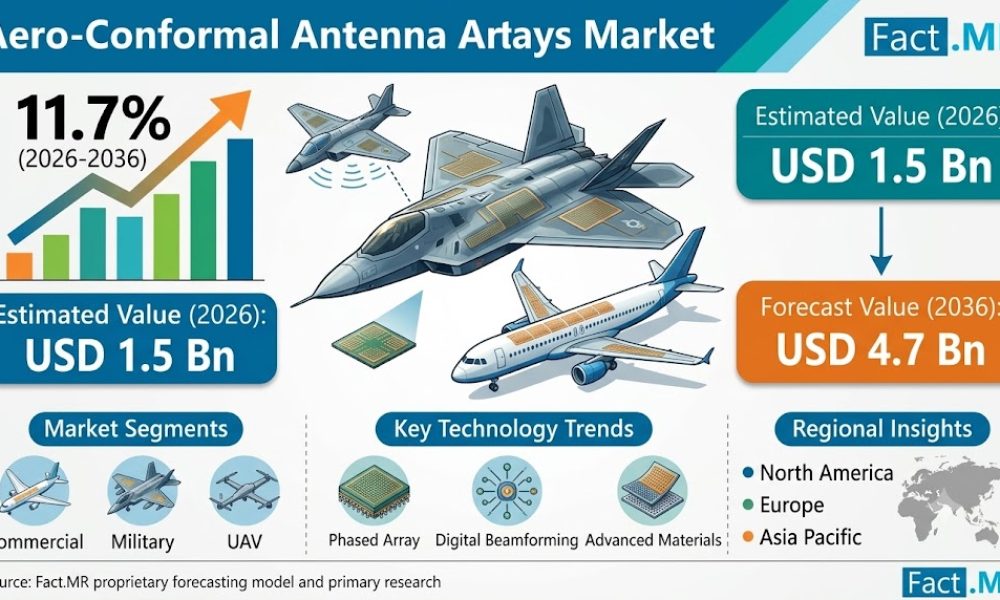
The global aero-conformal antenna arrays market is projected to grow from USD 1.5 billion in 2026 to USD 4.7 billion by 2036, expanding at a 11.7% CAGR during the forecast period. The market was valued at USD 1.4 billion in 2025, creating an absolute opportunity of USD 3.2 billion between 2026 and 2036. Demand is being supported by aircraft programs that are placing more radar, electronic warfare, SATCOM, and data-link functions into low-profile antenna arrays.
Aero-conformal arrays are designed around aircraft surfaces or embedded within the airframe. This allows radar and other RF functions to be distributed across fuselage, wing, nose, tail, or skin locations while limiting exposed hardware. Fact.MR identifies low-profile aircraft fit, AESA radar upgrades, airborne electronic warfare growth, and SATCOM and data-link integration as key demand drivers.
Get Detailed Market Forecasts, Competitive Benchmarking, and Pricing Trends: https://www.factmr.com/connectus/sample?flag=S&rep_id=16558
Global Segment Leaders
- Fuselage conformal — 39.0% share in 2026: Fuselage conformal arrays lead the geometry segment because the fuselage provides broad surface area and multiple possible locations for RF coverage.
- AESA — 33.0% share in 2026: AESA leads the array technology segment. Electronic beam steering allows the beam to be controlled without mechanical movement and supports multifunction radar and electronic warfare architectures.
- X band — 29.0% share in 2026: X band accounts for the leading RF-band share, supported by its established role in airborne radar where compact array dimensions and target resolution are relevant.
- Radar — 36.0% share in 2026: Radar leads the aircraft-function segment because surveillance and fire-control missions require precise beam control for detection and tracking.
Country-Level Performance
- Japan — 12.5% CAGR: Japan records the highest projected CAGR among the five profiled countries. Fighter upgrades are increasing the need for compact radar and electronic warfare integration. Japan’s Ministry of Defense budgeted for eight F-35A aircraft in FY2025 and stated that domestic companies would continue final assembly and checkout for F-35As acquired from FY2023 through FY2027.
- United States — 12.2% CAGR: The U.S. market is supported by fighter-fleet scale and airborne radar and EW upgrades. In June 2026, the U.S. Government Accountability Office reported that the Department of Defense operated and sustained more than 800 U.S. F-35 aircraft, creating ongoing aircraft-fit requirements across new-build and sustainment programs.
- Germany — 11.9% CAGR: Germany’s market is forecast to benefit from Eurofighter renewal and electronic warfare integration. The Bundeswehr stated that Germany will receive 20 Eurofighter Tranche 5 aircraft, with the aircraft planned to receive the Arexis self-protection system with future AI capabilities.
- France — 11.6% CAGR: France is projected to expand at 11.6%, supported by Rafale upgrades and airborne sensing programs. In June 2025, France’s Ministry of the Armed Forces reported that the Rafale F5 would feature a new radar, enhanced connectivity, and greater emphasis on electronic warfare.
- United Kingdom — 11.3% CAGR: The UK records the lowest CAGR among the five profiled markets. The Ministry of Defence reported 507 fixed-wing platforms as of April 1, 2026, including 124 Typhoon aircraft. These fleets support continued work on radar, electronic warfare, and other aircraft mission systems.
Regional Context
Fact.MR covers North America, Latin America, Western Europe, Eastern Europe, East Asia, South Asia & Pacific, and the Middle East & Africa, with country-level analysis for the United States, United Kingdom, Germany, Japan, and France.
The displayed country CAGR range spans 1.2 percentage points, from 12.5% in Japan to 11.3% in the UK. Japan’s growth is linked to fighter upgrades and dense mission-system integration, while the U.S. outlook reflects its large combat-aircraft fleet. Germany’s demand is connected with Eurofighter renewal, France’s with Rafale modernization, and the UK’s with Typhoon radar upgrades.
Competitive Landscape
Key companies profiled in the aero-conformal antenna arrays market include RTX, Northrop Grumman, L3Harris, BAE Systems, and ThinKom Solutions. Competition is expected to center on RF performance, aircraft integration, size and weight, power and cooling requirements, and the depth of ground and flight qualification.
L3Harris reported in February 2025 that its Viper Shield electronic warfare system completed its first flight on a single-seat Block 70 F-16. The flight included compatibility testing with the mission computer and other avionics subsystems, along with interoperability testing involving the APG-83 AESA fire-control radar.
Northrop Grumman provides the APG-83 SABR AESA radar and IVEWS electronic warfare suite for the F-16, with the systems designed for digital interoperability. RTX and BAE Systems also participate in airborne radar and electronic warfare systems, while ThinKom Solutions is included among the profiled providers.
Analyst Opinion
Shambhu Nath Jha, Principal Consultant at Fact.MR, stated:
“Commercial results depend on how well an array works after it is fitted to the airframe surface. The market is forecast to reward firms that prove RF results together with cooling and aircraft fit. Firms that link array design with flight clearance and mission electronics are forecast to have a clearer route to aircraft programs.”
Market Considerations
For antenna manufacturers, RF subsystem suppliers, and aircraft integrators, several technical factors remain important:
- Airframe integration: Curved surfaces and installation depth need to be considered during array design rather than after the RF architecture is finalized.
- Thermal management: Cooling routes and power requirements need to be evaluated alongside RF performance.
- AESA performance: Developers need to document beam results across different installed shapes so aircraft teams can compare flush and conventional array configurations.
- RF coexistence: Radar and electronic warfare functions need early coordination because aircraft space and spectrum are limited.
- Flight qualification: Ground testing must eventually support aircraft-level flight clearance and mission-system integration.
- Distributed apertures: Distributed skin arrays and multi-band flush arrays are identified as opportunities for expanding RF coverage across constrained aircraft surfaces.
Flight and mission clearance, heat and power limits, curved-array calibration, and long aircraft program cycles remain constraints on deployment. Fact.MR also identifies flexible and printed arrays, special-mission aircraft retrofits, and distributed skin arrays as areas of opportunity.
Research Methodology
Fact.MR’s analysis draws on 120+ sources, 35+ company portfolios, 25+ countries, and more than 20 industry interviews. Primary research includes manufacturers, service providers, technology developers, distributors, end users, and subject-matter experts. Desk research covers government statistics, regulatory publications, company filings, trade data, technical studies, industry associations, standards, public policy, and other authoritative sources.
Market estimates combine historical performance, demand indicators, pricing and volume trends, segment shares, company participation, country-level growth, adoption patterns, investment activity, and barriers to market expansion. Findings are validated against primary interviews, public data, company activity, regulatory changes, trade patterns, and industry developments.
Explore More Related Studies Published by Fact.MR Research:
Clean-Opening Lidding Films Market
Die-Lip Buildup Reducers Market
About Fact.MR
Fact.MR is a leading provider of market research and consulting services, offering syndicated and customized research across industries including Consumer Goods, Healthcare, and Chemicals & Materials.



